

How does AtroPIM increase efficiency and productivity?
It allows you to fully exploit the potential of AI through direct integration with Gemini, ChatGPT or Claude. AtroPIM offers a REST API that covers 100% of the functionality including your custom configurations to allow full integration with any software. We provide native, fully customizable integration with many e-commerce platforms, ERP systems, and marketplaces. AtroPIM is extensible with modules – you only pay for what you need. The software can be deployed in the cloud or on-premises – you decide!
For which companies is AtroPIM intended?
- Any industry, any size: from a small team managing one catalog to a corporation with several plants, markets, and sales channels.
- Product data at the center: built around how manufacturers, wholesalers, distributors, and retailers actually work with product information.
- Companies with their own processes: configure the data model, interfaces, permissions, and workflows to match how you work, rather than adopting a vendor template.
- Teams that want to start simple: if your case is standard, the delivered configuration is ready to use, and the freedom to change it stays available.
- Organizations that are growing: the platform scales with catalog size, users, languages, and channels, so growth does not mean replacing the system.
- Buyers who watch the budget: the core is open source, so your budget goes into the modules and services you actually need.
- The 1% of exceptions: when configuration and existing modules are not enough, we build a custom module for your case.
- Anyone tired of separate tools: PIM and integration platform in one system, instead of a catalog tool plus middleware to connect it.
- Your volumes are large: tested with 50 million records and 1 billion attribute values.

What can our software be used for?
We handle every aspect of product data, from content creation to distribution.
Product Data Management
Consolidate all product-related information in one solution – import, create (also with the help of AI), unify, classify, enrich and translate your data. Ensure high data quality, consistency, and compliance.
Data Import & Export
Regardless of your configured data model, you can import from multiple sources and export any data in any structure (XML, JSON, Tabbed Excel, CSV). Create import feeds from your export feeds. Export channel-specific product data.
Product Data Exchange
Create, manage, and (automatically) distribute standardized product catalogs using industry-specific data formats and classification standards such as ETIM, BMEcat, ECLASS, GS1, and others.
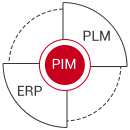
Integration Platform
Synchronize your data uni- or bi-directionally with ERPs, e-commerce platforms, marketplaces, and other relevant systems to save time, reduce errors, and improve productivity and efficiency.

Digital Asset Management
Create, integrate (e.g. via Sharepoint, Amazon S3, etc.) and manage your digital assets directly in the PIM, associate them with products, categories, catalogs, etc. Share your digital assets with customers and partners.

Product Data Publishing
Create any kind of multi-page PDF publications like flyers, brochures, catalogs directly in AtroPIM or in Adobe InDesign, easily improve and quickly update your publications.

Product Data Syndication
Distribute and synchronize consistent, accurate channel-specific product data across multiple sales, marketing, and distribution channels, enhancing visibility and ensuring a cohesive customer experience.

Workflow Management
Streamline and automate business processes, enabling teams to efficiently collaborate, ensuring data accuracy and consistency across all channels. Save time and increase productivity of your teams.
PIM and Integration Platform in one solution
- One platform, two jobs: AtroPIM handles product data, AtroCore handles every other record type and the exchange between systems.
- Modular by design: Start with the open-source core and add modules for classifications, workflows, or synchronization when you need them.
- Any data, not only products: Suppliers, customers, assets, contracts, and your own entities live in the same system as your catalog.
- Built-in integration layer: Import, export, and synchronization are part of the platform, so no separate middleware sits between your systems.
- Collaboration where the data is: Assignments, mentions, and comments stay on the record, instead of scattering across email and chat.
- Automation instead of reminders: Workflows move records through statuses, approvals, and follow-up steps without anyone chasing them.
- Complete on day one: Even without paid modules, the platform manages the product data of a small company on its own.
- Grow without switching: Buy or rent modules as requirements grow, rather than migrating to a bigger product later.

Feature Highlights
Configurable data model: add entities, fields, and relations directly in the interface, with no coding.
Hierarchies and data inheritance: child records inherit values from their parents, including in your own custom entities.
20+ data types incl. nested attributes: pick the type that fits the value, so quality is enforced by the model itself.
Flexible attribute management: group, scope, and reuse attributes across entities and records.
Classifications for all entities: assign classification schemes to any entity, with attribute sets following the classification.
Custom relation properties: store data on the link itself, such as a category-specific description of a product.
Fully customizable user interfaces: arrange panels, fields, and lists per entity, per role, and per user.
Validation and auto-fill rules: UI Handlers check entries and prefill or hide fields depending on the values a record holds.
Personalized dashboards and widgets: every user arranges the views, completeness figures, and open tasks they need.
Mobile-friendly user interfaces: the interface adapts to tablets and phones without a separate app.
Customizable record previews using HTML/CSS: design how a record is presented to users and partners.
Product-centric data management: entities, screens, and logic built around products and their data.
Hierarchical product variants: model configurable products and their variants in a parent and child structure.
Product category trees: several independent category structures per catalog, channel, or market.
Channels and channel-specific attributes: different values per sales channel, maintained on one product record.
Bidirectional associations: link records both ways, from upsell and cross-sell to spare parts and accessories.
Product listings: curated product selections for catalogs, campaigns, or channel exports.
Custom text blocks: reusable marketing and legal text placed into product content where needed.
Content localization: maintain values per language and keep all translations side by side.
Unit management with auto-conversion: store a measurement once and let the system convert between units.
Multi-currency support: prices and amounts maintained per currency and converted where needed.
DAM and file management: store, categorize, and reuse assets, including language and channel-specific versions.
Advanced filtering and saved searches: build a complex filter once, save it, and reuse it across your team.
Bulk data and relation editing: update hundreds of records or their links in a single step.
Collaboration in context: assignments, mentions, and comments keep the discussion on the record it belongs to.
System and email notifications: users are informed about the changes that actually concern their work.
Configurable action buttons: trigger custom operations straight from a record, a list, or a mass selection.
Automated workflows: statuses, approvals, and follow-up steps run on their own instead of by reminder.
AI-assisted content: connect Gemini, ChatGPT, or Claude to draft and improve product content in place.
Fine-grained access control: rights defined per team, role, entity, record, and individual field.
Change and action history: every change recorded with user, timestamp, and the old and new value.
Advanced background job management: heavy operations run in queues and can be monitored and retried per job.
Advanced import and export: handle any data structure, in any common format, with a detailed log of every run.
Synchronization with any system: exchange data through database queries, file transfer, or API requests, on your schedule.
Complete REST API coverage: every entity, record, and operation is available programmatically.
Extensible with (custom) modules: add functionality on top of the open-source core whenever configuration ends.
Why many businesses choose AtroPIM?
- “Incredible flexibility” – AtroPIM can cover all business processes directly or indirectly related to your product data, the way you want it. Change your processes anytime – AtroPIM will adapts.
- “Better collaboration” – manage all your data in one single place and enable your employees to easily collaborate on it.
- “Better control” – gain many opportunities to control and influence the data quality and the processes associated with it.
- “High-quality results” – implement custom quality assurance processes, add more details to your product data and unify it, quickly distribute and update your data across all relevant channels.
- “Faster time-to market” – prepare and distribute, improve and update your product data faster and with fewer errors.
- “Sales increase” – create high-quality marketing-relevant product information to support your omnichannel strategy, better engage with potential customers and increase your sales.
- “Cost savings” – save significant time and money on product data preparing, enriching, publishing, and distributing thanks to rich functionality, workflow automation and seamless integrations with other systems, websites and marketplaces.
- “Excellent price-performance ratio” – you get a lot for what you spend!

Some of our customers
Our software is used in more than 30 countries worldwide.

Latest Publications

B2B Product Marketing Is Data Work: A Guide For Manufacturers With Complex Catalogs

B2B Product Catalogue Management: Why It Differs From B2C And Which Tools Fit