


Key Takeaways
Data quality matters, yet 80% of retailers are not confident in the quality of their product data.
Product Information Management (PIM) centralizes product data, ensures accuracy, completeness, and consistency across all sales and marketing channels, and enhances the customer experience through rich content—detailed descriptions, images, videos, and specifications, reducing returns and increasing conversions.
Key PIM benefits include:
- Data Quality & Consistency to ensure accurate, complete, and reliable product information across all channels.
- Operational Efficiency through automation, faster time-to-market, and streamlined team collaboration.
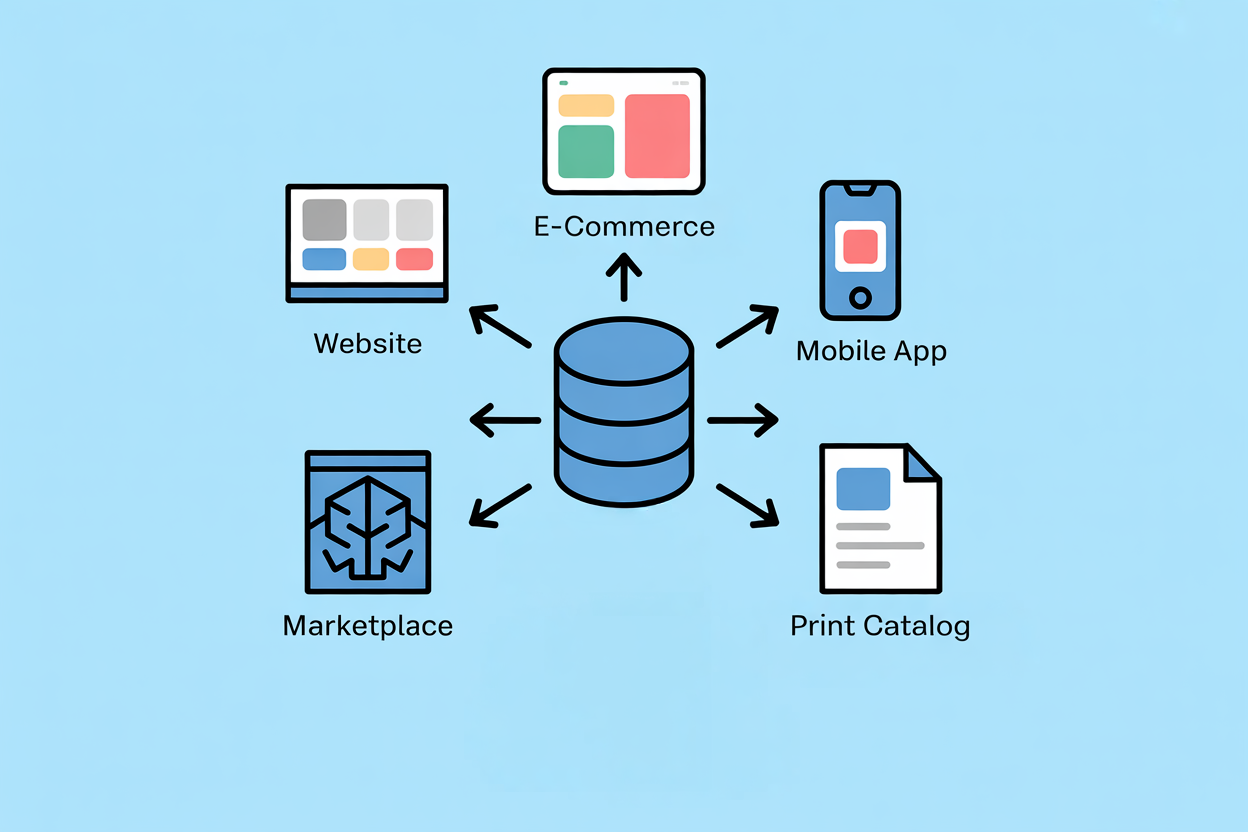
- Omnichannel Enablement by maintaining a single source of truth for product data across online, mobile, social, marketplaces, and print.
- Customer Experience & Conversion with rich, high-quality product content that reduces returns and increases sales.
- Scalability to manage thousands or millions of SKUs and support business growth.
- Consistent Brand Messaging via integration with Digital Asset Management (DAM) for uniform brand presentation.
- Compliance & Governance through role-based access, validation rules, audit trails, and review workflows.
- Global Readiness with localized content, language, units, and regulatory compliance for international markets.
Common Product Data Challenges
Managing product information in 2025 is not for the weak. The number of sales channels businesses operate continues to grow, from eCommerce platforms and mobile apps to marketplaces, social commerce, and printed catalogs. Each channel requires precise, up-to-date product information, and even small inconsistencies can lead to poor reviews, customer dissatisfaction, and rapid reputational damage. At the same time, product assortments have become more complex, variations are increasing, and competition is more intense than ever.
This environment makes Product Information Management (PIM) a must for most businesses. In this article, you’ll discover the key reasons to invest in PIM software in 2025, supported by industry research and real-world business insights.
But before we explore the benefits, let’s clarify what PIM software actually is and what it does for businesses.
Product Information Management (PIM) is a centralized system designed to collect, manage, enrich, and distribute all product-related data across every sales and marketing channel. It ensures that businesses maintain a single, accurate source of truth for product details, such as descriptions, specifications, pricing, images, and technical attributes, so that information remains consistent, complete, and up-to-date everywhere customers encounter it.
Companies that implement a PIM system gain not only operational efficiencies but also strategic advantages. Independent research from Ventana Research reveals that dedicated PIM software helps over 40% of organizations eliminate data errors and supports a consistent customer experience, with 61% of surveyed companies citing improved data quality.
Roles and Responsibilities in PIM
PIM supports multiple teams: suppliers contribute product details, procurement manages pricing and quality, marketing creates enriched content, and customers or partners can access accurate information. This highlights PIM’s collaborative role across the product lifecycle.
-
Assortment Expansion and Long-Tail Strategy
PIM helps wholesalers extend product assortments efficiently, enabling long-tail strategies and better coverage of niche products without overloading internal teams. -
Brand Awareness and Marketing
When integrated with Digital Asset Management (DAM), PIM ensures consistent brand messaging across all channels, strengthening customer loyalty and trust. -
Classification and Standards Compliance
Some PIM systems support industry classification standards out of the box, simplifying product standardization and reporting. -
Catalog Preparation
PIM accelerates digital and print catalog creation, including integration with tools like Adobe InDesign for automated, error-free catalog generation. -
SEO and Digital Visibility
Structured and consistent product content in PIM supports SEO, improving online discoverability without manual intervention. -
Global and Regional Readiness
PIM allows regional adaptations such as local units, images, or regulatory-specific details, supporting international expansion efficiently. -
Data Governance and Compliance
Validation rules, approval workflows, and audit trails ensure data quality, regulatory compliance, and secure content management.
Key Benefits of Implementing a PIM System
1. Data Quality & Consistency
According to GS1 US, 80% of retailers are not confident in the quality of their product data. Data challenges are just as common in wholesale, where large catalogs and inconsistent supplier data often lead teams to manage thousands of SKUs in fragmented spreadsheets. A PIM system fixes this by providing a single, centralized repository for all product data, from SKUs and specifications to pricing, images, and videos.
With PIM, validation rules and structured workflows catch errors early (e.g., missing or inconsistent attributes), which lowers the risk of publishing incorrect information. Standardized naming conventions, taxonomies, and attribute models ensure data is consistent and enriched. Rich media attachments (like images and videos) further enhance the quality.
2. Operational Efficiency
Coordinating product data across marketing, sales, and product teams often slows down new product launches. Independent studies show that PIM systems can accelerate time-to-market, with some organizations reporting up to 2× faster launches.
PIM also reduces manual work since managing product data becomes up to six times faster compared to using spreadsheets. By automating repetitive tasks, such as bulk editing, channel formatting, and data enrichment, teams can shift their focus from routine data work to strategic initiatives. Meanwhile, in practical deployments, some companies have seen a 20–30% reduction in data-maintenance costs.
These efficiency gains also support better collaboration: product, marketing, sales, and IT teams all work from the same up-to-date data. This reduces miscommunication and disjointed review cycles. PIM’s integration with ERP, CRM, and content platforms ensures seamless data flow across the organization.
3. Omnichannel Enablement
Many consumers now interact with brands across a wide variety of platforms, from marketplaces like Amazon to social media and even printed catalogs. According to a 2023 B2B e‑commerce survey, 40% of companies adopted PIM to gain better control over product data across sales channels.
By centralizing product data in a PIM system, businesses can maintain a single source of truth: updates made in one place are pushed consistently across all channels. This means that product descriptions, images, prices, and specifications remain synchronized, regardless of whether the customer is browsing online, shopping in-store, or viewing a social feed.
Beyond consistency, PIM systems also enable companies to adapt content, such as language, currency, and regional measurements, for different markets.
On the business-impact side, omnichannel campaigns tend to outperform single-channel ones: data from Productsup suggests omnichannel campaigns see up to a 287% higher purchase rate than those limited to a single platform.
4 Customer Experience & Conversion
High-quality product information significantly influences customer confidence and purchase decisions. Rich content, detailed descriptions, high-resolution images, videos, and precise technical specifications help shoppers understand exactly what they are buying, reducing uncertainty and lowering return rates.
Research shows that inaccurate or incomplete product information is a major driver of returns and abandoned purchases. For example, 42% of consumers reported returning an online purchase in the past year due to poor product content, and 25% have abandoned a cart for the same reason (Shotfarm / Refrigerated & Frozen Food). Additionally, 22% of product returns are caused by items not matching their online description (Linnworks).
Better-structured and accurate product data also improves search and navigation, helps customers find products faster, and enables personalized recommendations. Consistent content across all channels, like online, mobile, and print, strengthens omnichannel strategies, builds trust, and enhances brand credibility.
5. Scalability & Integration
As businesses grow, the complexity of managing product information increases. Research from GS1 emphasizes that good-quality product data reduces cost and increases operational efficiency by ensuring accurate and complete data across systems (GS1). PIM systems provide structured data management that can handle thousands or even millions of SKUs, helping companies maintain accurate and organized product information at scale.
Flexible data models in PIM allow organizations to adapt to different industries, product types, or business processes without adding operational complexity.
Case studies show that manufacturers and distributors using PIM can scale their product catalogs efficiently; for example, PIM helped a leading healthcare retailer overcome catalog scalability challenges by centralizing and streamlining thousands of products, improving accuracy and operational efficiency (Nahdi case study).
6. Compliance & Governance
In regulated industries, precise product information is critical. Product data must comply with labeling rules, safety regulations, ingredient disclosures, and more. A PIM system centralizes this data, enables strong governance through role‑based access, validation rules, and audit trails so that only authorized users can make changes, and every change is tracked.
Modern PIM platforms also support version control and review workflows, allowing cross-functional teams (e.g., legal, product, quality assurance) to approve regulated content before it’s published. This helps organizations maintain traceability and accountability over labeling and compliance-critical fields.
The benefits are measurable: according to a recent analysis, 78% of businesses report compliance challenges due to poor product data, reflecting how fragmented or inaccurate information can expose companies to regulatory risk. (Crystallize)
PIM systems also help with international compliance. By managing translated product labels, market-specific legal text, and region-based product variants in a structured way, PIM supports expansion into new markets without increasing risk.