


Key Takeaways
- Bad product data has a direct, calculable cost: returns driven by mismatched specs, launches delayed by weeks of file reconciliation, and compliance incidents traced back to attributes that were never synchronized across systems.
- A PIM system addresses this by making product data owned once, governed centrally, and distributed automatically. Manufacturers and distributors using PIM consistently report faster launches and lower data maintenance costs than those running parallel spreadsheet workflows.
- The core PIM benefits are data quality, operational efficiency, omnichannel consistency, fewer returns, catalog scalability, and compliance governance. For B2B companies, the compliance and scalability dimensions often matter most.
- Product data quality directly affects return rates. Consumer research shows that over 40% of online returns are linked to poor product content, and the consequences in B2B purchasing are more severe still: a single wrong attribute on a high-value order can damage a supplier relationship.
- Open-source PIM like AtroPIM gives manufacturers and distributors full control over their data model without vendor lock-in, and can be deployed on-premise or as SaaS depending on infrastructure requirements.
The Cost of Bad Product Data
The benefits of PIM software become clear the moment you calculate what bad product data actually costs. Returns driven by mismatched specs. Product launches delayed by weeks while teams reconcile conflicting files. Compliance incidents traced back to a labeling attribute updated in one system but not the others.
Our customers often come to us with the same pattern: product data spread across spreadsheets, ERP exports, and shared drives, with no single owner and no reliable version of the record. A launch that should take two weeks takes six because marketing, product management, and logistics are each working from different files. The webshop contradicts the print catalog. Marketplace listings carry outdated specs.
According to GS1 US, 80% of retailers are not confident in the quality of their own product data. In manufacturing and wholesale, the numbers are no better. The problem is structural: product data that lives in multiple systems, owned by no single team, governed by no consistent rules, will drift. More channels and more SKUs make it worse.
Who Needs a PIM System
Product Information Management (PIM) is a centralized system for collecting, managing, enriching, and distributing all product-related data: descriptions, technical specifications, images, pricing logic, regulatory content, and market-specific variants. Updates made once push downstream to every connected channel automatically.
The clearest signal is time. Specifically, how long it takes your team to find, confirm, and publish a current product record. If that process involves chasing colleagues or reconciling files, a PIM is probably overdue.
A PIM system becomes a practical necessity when:
- Product data is maintained in spreadsheets across multiple teams, with no authoritative central version
- The same product has different descriptions, specs, or images on different sales channels
- New product launches consistently take longer than they should because data is assembled manually each time
- The catalog has grown beyond a few hundred SKUs and supplier data arrives in inconsistent formats
- Expansion into new markets or channels is blocked by the effort required to adapt and localize content
Manufacturers, distributors, and wholesalers reach this point faster than pure retailers because their product data is technically more complex. An industrial distributor managing 50,000 SKUs sourced from 80 suppliers cannot maintain product data quality at that scale without a structured system. A manufacturer whose products require distinct compliance attributes for every country they sell into faces the same wall.
The Core Benefits of PIM Software
1. Data Quality and Consistency
Product data degrades in siloed environments. Suppliers send data in varying formats. Internal teams enrich it inconsistently. Different channels end up with different versions of the same product.
A PIM system consolidates all of this into one place and applies validation rules before data reaches any channel. Missing or malformed attributes get flagged in the system rather than discovered by a customer. Standardized taxonomies and naming conventions apply across the entire catalog, so a "nominal pipe diameter" attribute means the same thing everywhere, is captured the same way, and appears consistently in every output.
PIM also tracks product completeness. Each product gets a completeness score based on which required attributes, images, and documents are present. Teams can see at a glance what needs attention before a product is ready to publish, rather than discovering gaps after a listing goes live.
Consistently populated, normalized attributes also improve faceted search and filtered navigation on e-commerce platforms. When buyers can filter by exact specification values and trust the results, they reach the right product on the first attempt rather than the third.
In projects we implemented for industrial equipment distributors, centralizing product data in a PIM resolved a recurring returns problem: customer service teams were processing returns because the product dimensions on the webshop differed from what was in the ERP export used to print the packing slip. Once the PIM became the single authoritative source that both systems read from, that category of error disappeared.
Rich media attachments, including technical drawings, safety data sheets, installation videos, and high-resolution images, are stored and linked to the correct product variant. This replaces ad hoc file folders and shared drives that no one can reliably maintain at scale.
AtroPIM supports a fully configurable data model, meaning attribute structures and validation rules can be shaped to fit any product taxonomy without custom development.
2. Operational Efficiency
Coordinating product data across marketing, sales, product management, and IT is slow when each team works from separate files. A new product launch stalls waiting for someone to confirm which version of the spec sheet is current. Updates to a product range require manual edits across every channel separately.
PIM changes this by turning bulk editing, channel formatting, and data enrichment into tasks teams do once and apply everywhere. In projects we delivered for manufacturers with fragmented legacy workflows, consolidating product data in a PIM cut the time spent on data preparation and maintenance by 60 to 70 percent. Product launches that required three to four weeks of internal coordination moved to under two.
Cross-functional collaboration improves as a result. Product, marketing, sales, and logistics teams all work from the same up-to-date record. Review cycles get shorter. Errors caused by competing spreadsheet versions stop.
Task management, review workflows, and bulk enrichment tools built into AtroPIM reduce the coordination overhead that typically fragments product launch processes across departments.
3. Omnichannel Enablement
Selling across multiple channels creates a data coordination problem. Each channel has its own format requirements, attribute sets, and content standards. Without a PIM, teams maintain separate versions of product content for each channel, and a change in one place does not propagate to the others.
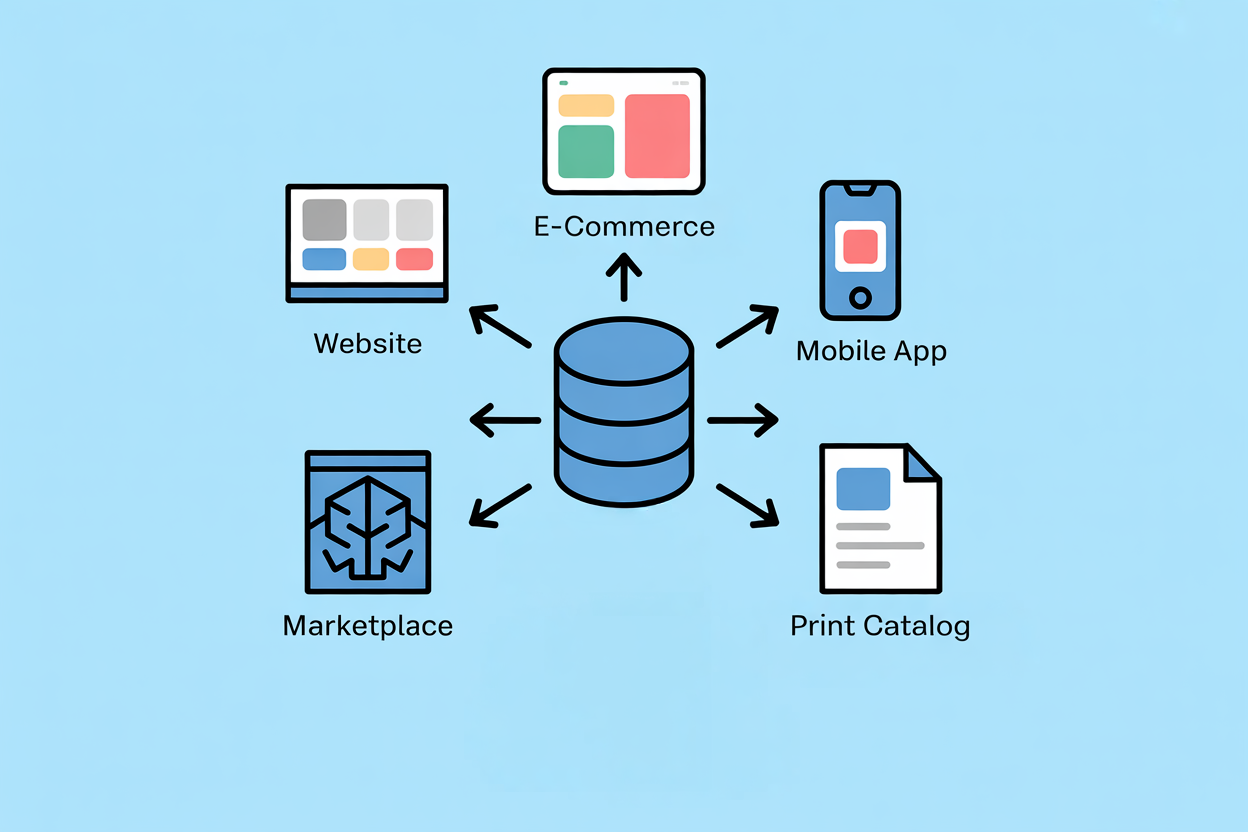
A PIM system addresses this through a single master product record. When a specification changes, the update flows automatically to every connected channel. The webshop, Amazon listing, B2B portal, and printed catalog all reflect the same content without any manual reconciliation.
The business case for getting this right is significant. Aberdeen Group research found that companies with strong omnichannel engagement strategies retain 89% of their customers, compared to 33% for companies with weak omnichannel strategies. Consistent product content across channels is a precondition for that kind of engagement, and PIM is the infrastructure that makes it sustainable at scale.
Channel-specific output configurations allow the same master record to feed different channels with the correct structure and content for each. A product attribute that appears as "nominal diameter (mm)" on the webshop and as "ND" in an EDI feed can be transformed at the output layer without touching the master data.
Localization works the same way. Regional variants, translated descriptions, local units of measure, and market-specific regulatory content are managed as structured variants within the same product record. For a manufacturer selling in 15 countries, this is the difference between a manageable localization workflow and a permanent backlog.
In projects we delivered for electrical components manufacturers, a single product record in AtroPIM feeds the webshop, three distributor portals, and the print catalog from one source. A spec change that previously required four separate updates now requires one.
4. Customer Experience and Fewer Returns
In B2B and industrial purchasing, wrong product data causes compounding damage. A buyer who orders the wrong pipe fitting or the wrong cable gauge because the technical attributes on the product page were outdated returns the item, and the buyer's project is delayed. Their procurement team files a complaint. The relationship is damaged. A single incorrect attribute on a high-value B2B order can cost more than a month of data quality investment.
The Shotfarm Product Information Report found that 42% of consumers returned an online purchase due to poor product content, and more than 25% had abandoned a cart for the same reason. Linnworks separately reports that 22% of product returns are caused by items not matching their online description.
Better-structured product data reduces this risk directly. Detailed technical specifications, high-resolution images from multiple angles, accurate dimensional data, and properly linked related products give buyers the information they need to make confident decisions. In technically complex categories, buyers rely primarily on attribute data and spec sheets rather than on marketing copy. Rich, structured content is an expectation, not a differentiator.
5. Scalability, Integration, and Supplier Onboarding
As product catalogs grow across lines, variants, markets, and channels, the absence of a structured system turns growth itself into a liability. More SKUs mean more manual steps, slower launches, and more compounding errors.
PIM systems handle catalogs of any size, from a few thousand to millions of SKUs, with the same data quality and governance mechanisms at every scale. Flexible data models allow organizations to add new product categories with entirely different attribute structures without rebuilding the system from scratch.
Supplier data onboarding is one of the more underappreciated PIM benefits for distributors. When product data arrives from dozens of suppliers in inconsistent formats, it has to be normalized and validated before it can be published. A PIM with configurable import mappings and validation rules automates most of this, dramatically reducing the time it takes to add new supplier content to the catalog. Industry-reported outcomes for large HVAC distributors managing over 500,000 SKUs from 75-plus suppliers show new product launch times dropping from three weeks to three days after implementing structured PIM workflows.
Product data does not live in isolation. It connects to ERP data (pricing, stock availability), DAM assets (images, videos, documents), e-commerce platforms, and partner portals. A PIM that integrates cleanly with existing systems eliminates the fragile manual bridges that accumulate between spreadsheet-based processes and the channels they feed.
AtroPIM is built on the AtroCore platform and supports integration through a REST API, webhooks, and pre-built connectors. It also generates PDF product sheets and catalogs directly, covering a common need for manufacturers without requiring a separate publishing tool.
6. Compliance, Governance, and Traceability
In regulated industries, a wrong product record is not a data quality problem in isolation. It is a legal exposure. Labeling errors, missing safety classifications, or outdated regulatory text can trigger product recalls, market access bans, or fines that dwarf the cost of getting the data right in the first place.
PIM systems centralize compliance-relevant data and apply governance controls that spreadsheet workflows cannot match. Role-based access ensures only authorized users can edit specific fields. Validation rules prevent non-compliant records from being published. Audit trails capture every change: who made it, when, and what the previous value was.
Review workflows allow legal, quality assurance, and product teams to approve regulated content before it goes live. Version control maintains a full change history for every product record.
For companies selling across markets, PIM manages region-specific compliance complexity. Translated regulatory text, market-specific legal declarations, and jurisdiction-specific product variants are structured content within the same product record, not scattered across email threads and shared document folders.
Our customers in building materials and safety equipment find this critical. A single product may require different labeling in Germany, France, and the UK, with distinct regulatory attribute sets for each. Managing that across a large catalog without a structured system is not feasible. A PIM with configurable validation rules and regional content management makes it tractable at scale.
The cost of getting it wrong is not abstract. A product held at customs due to a missing or incorrect compliance attribute delays delivery to the buyer, triggers penalty clauses in supply contracts, and sometimes requires a product recall that extends across every market where the same data error was published. Unstructured compliance data management creates internal inefficiency and liability that scales with catalog size.
PIM Benefits vs. the Alternative
The comparison is not really between PIM and spreadsheets. Most organizations that come to us have already outgrown spreadsheets. The real comparison is between a structured, governed, integrated product data system and the patchwork of tools, manual processes, and informal conventions most companies rely on before they implement one.
That patchwork works at small scale. It breaks down when catalogs reach a few thousand SKUs, when sales channels grow beyond two or three, or when a compliance requirement demands that every attribute change is logged and auditable.
The fundamental PIM benefit is not efficiency. It is control. Efficiency follows from control, but without it, adding more channels, more products, or more markets just compounds the existing disorder.
A PIM system gives organizations the structure to grow their catalog without growing their data management headcount proportionally. For manufacturers and distributors, that is what makes the investment worthwhile.
AtroPIM's open-source architecture means the data model is genuinely yours, not constrained by a vendor's schema decisions. That is what makes control durable rather than contingent on a subscription. The system is fully configurable, deployable on-premise or as SaaS, and built to integrate with the ERP, e-commerce, and DAM systems already in place. Teams can start with core PIM functionality and extend as needs grow, without re-platforming.