


Three weeks before a product launch, someone finds a wrong weight spec on the retailer portal. Nobody knows which system it came from. The product manager checks the ERP. The copywriter checks the spreadsheet she exported last Tuesday. The e-commerce team checks the CMS. They all show something different.
That scenario plays out in most mid-sized product companies at least once a quarter. Not because people are careless, but because product data was never given a "home". It lives wherever whoever needed it last decided to put it.
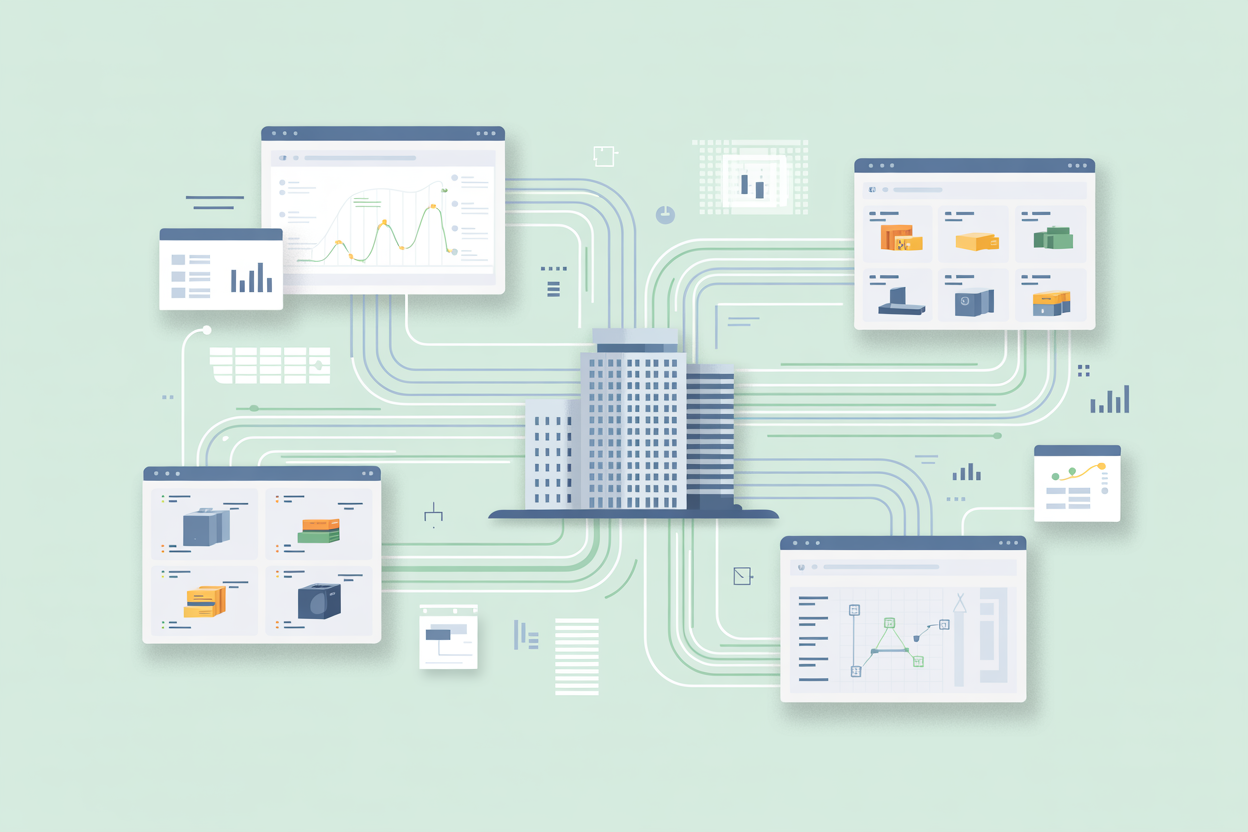
A PIM system is that home. One place where a product's dimensions, descriptions, certifications, images, and channel-specific variants are stored, approved, and pushed out, so when the German retailer needs a localized datasheet, and the D2C site needs a hero image resized for mobile, both requests draw from the same verified source instead of two different people's desktops.
PIM is a centralized hub for all product content, with the governance, workflow tools, and integrations needed to make that content reliable and usable across a complex organization.
What Is Enterprise Product Information Management?
An enterprise PIM system holds everything that describes a product commercially. At minimum, that means technical attributes, marketing content, and compliance documentation. In practice, it also includes localized content for different regions and languages, digital assets linked from a connected DAM, and channel-specific variants of all the above.
Not every PIM is built for enterprise use
Lighter tools work for a catalog of a few hundred SKUs and one or two sales channels. They stop working the moment a business is running thousands of SKUs across regions, retailers, and marketplaces, with separate teams touching the same data and a compliance requirement that someone can prove who changed what and when. Enterprise PIM is a different category, a system built around governance from the ground up rather than bolted on later. Access controls, audit trails, configurable approval workflows, and integrations that connect to the ERPs and commerce platforms already in the stack.
Scale that to tens of thousands of SKUs across multiple markets and languages, and a spreadsheet becomes a liability. A regulatory change requiring updates across 40,000 records falls on people, one record at a time. Regional markets need localized units, legal disclaimers, and market-specific certifications. A manufacturer that takes three weeks to publish a new product hands a window to competitors who can move in days.
A compliance error on a medical device, chemical, or food product can trigger regulatory consequences or a product recall. Without controlled workflows and audit trails, these errors reach customers before anyone inside the organization knows they exist.
Enterprise PIM vs. ERP, MDM, DAM, and CMS
One of the most common obstacles to a well-functioning enterprise PIM project is confusion about what it does versus what other systems in the stack do. Enterprises already running SAP, Salesforce, or Adobe Experience Manager sometimes wonder whether they need PIM on top.
These systems are complementary, not competing.
Your ERP manages operational product data: SKU codes, pricing, inventory, and procurement. It is the source of record for what exists and what it costs. But ERPs are not built to manage rich marketing content, localized descriptions, or multi-channel publishing.
MDM platforms govern master data across the whole enterprise, and an enterprise PIM draws from that but specializes in the commercial product content that MDM is not designed to handle in depth.
CMS platforms present product content to customers; enterprise PIM governs the structured data behind that presentation.
If your organization is trying to make one of these systems do the job of all of them, that is usually why product data problems persist despite significant system investments.
Key Features of Enterprise PIM Software That Matter at Scale
Enterprise PIM platforms vary considerably in what they actually deliver. Two capabilities separate genuine enterprise platforms from tools that call themselves enterprise.
Workflow and approval controls are where most implementations succeed or fail. In a large organization, product data does not flow freely. Legal reviews compliance claims. Marketing approves copy. Regional teams validate localized content before it goes live. A capable enterprise PIM system has configurable approval chains, role-based access control, task assignments, and audit logs. Without this, you have a repository, not a governed system. The depth of workflow configurability is the sharpest dividing line between real enterprise PIM software and catalog tools with a polished interface.
Flexible data modeling matters at the same level. Enterprise catalogs are rarely flat. Product families, variants, components, bundles, and accessories all carry different attribute sets. A platform that forces products into a generic schema creates workarounds from day one. The ability to define hierarchical data models that reflect actual product structure, rather than vendor assumptions, is fundamental.
Beyond those two, enterprises should also expect multi-channel publishing with channel-specific output templates and transformation rules; structured supplier onboarding portals that replace email-and-spreadsheet data collection; an API-first integration layer that keeps connections to ERPs, DAMs, and commerce platforms maintainable; and AI-assisted enrichment for content generation and attribute suggestions, which has become genuinely useful for teams processing high volumes of incoming supplier data.
Beyond Classic PIM: Integration and Process Automation
A manufacturer we recently worked with produces around 8,000 automotive parts distributed through a B2B portal and several regional retail partners. Before implementing AtroPIM, their product data team was manually reconciling updates between their ERP, a translation agency, and a shared folder. Every product change required coordinating across three systems with no validation step before content reached the channel. Errors surfaced only after customers flagged them.
After implementation, incoming supplier data triggers automated validation rules. Approved updates flow directly to localized channel outputs without manual steps. The team now manages exceptions rather than every record. Time from product update to live across all channels dropped from weeks to days.
This outcome comes from using enterprise PIM as an orchestration layer. AtroPIM is built on the AtroCore platform, which extends the scope beyond classic product information management into broader data management and business process automation. Configurable entities, event-based workflows, and flexible business rules mean it can manage not just product data but related operational data, with automated processes triggered by data changes rather than manual intervention. For enterprises looking to reduce the number of separate systems to maintain and integration points to manage, this scope matters.
The REST API is generated per instance according to OpenAPI standards, which makes custom integrations with existing enterprise systems straightforward for internal development teams.
How to Implement Enterprise Product Information Management
Implementing enterprise product information management is not primarily a technology project. The platform is usually the easy part. The hard part is data.
A research team at Harvard Business Review found that only 3% of company data meets basic quality standards across completeness, accuracy, and consistency dimensions.
In our experience, this holds in enterprise PIM projects. Teams routinely discover mid-implementation that the data they assumed was clean and centralized is actually fragmented, inconsistent, or missing outright. The data audit phase makes this visible, and it is often uncomfortable.
Taxonomy and data model design are where the most consequential decisions happen. Getting this phase right requires answering some fundamental questions:
- What product categories exist, and how are they structured?
- What attributes belong to each category?
- How are variants related to their base products?
Rushing through these decisions is the most reliable way to create technical debt that limits the system for years. Most implementations that stall do so at this stage, not because the software is difficult, but because agreeing on data structure means surfacing ownership questions that teams have been avoiding since before the project started.
Once data modeling is done, the remaining phases tend to move relatively quickly when the upstream decisions are solid. These include:
- Integration architecture
- Data migration
- Workflow configuration
- Channel publishing setup
One thing teams consistently underestimate is training. A system that nobody uses correctly is just a very expensive shared drive.
Realistic timelines range from four to six months for focused rollouts to twelve to eighteen months for complex multi-region projects. Executive sponsorship and cross-functional ownership are requirements, not optional.
Why Enterprise PIM Implementations Fail
The failure modes are predictable enough to name directly.
Underestimating data quality work is the most common. Teams expect to migrate existing data and discover mid-project that they effectively need to create it from scratch. Poor source data is the leading cause of timeline overruns. Lack of cross-functional ownership is the second.
Enterprise product information management touches IT, marketing, product management, compliance, and operations. When nobody owns it across these groups, decisions stall, and adoption suffers. A single named owner with actual authority is not optional.
Treating it as an IT project is the third. When IT leads implementation without strong involvement from the business teams who will live in the system daily, you often end up with a technically correct system that product managers do not actually use.
Over-engineering the data model upfront rounds out the list. Getting the core structure right, going live, and iterating based on real usage consistently delivers better outcomes than trying to model every edge case before launch.
Choosing an Enterprise PIM Solution
The enterprise PIM market has several mature options. Akeneo, Salsify, Contentserv, Syndigo, Stibo Systems, and inriver are among the solutions most commonly evaluated at this scale. SAP and Oracle have PIM capabilities embedded in their broader suites.
Most of these platforms are prescriptive by design. They offer defined data models, set workflow structures, and fixed integration patterns. For organizations whose requirements fit that mold, that predictability is an advantage. For organizations with complex or non-standard data structures, heavily customized processes, or a need to adapt the system as requirements evolve, that rigidity becomes a recurring cost. Every configuration change goes through the vendor.
AtroPIM takes a different approach. The open-source model means the platform can be adapted without vendor dependency, which directly addresses the governance and flexibility challenges that cause most enterprise PIM implementations to stall or underdeliver. The open-source edition is fully functional with no licensing cost.
What Sets It Apart
Two capabilities stand out as differentiators:
- Fully configurable data model.
Entities, attributes, hierarchies, and relationships are defined by the organization, not inherited from a vendor schema. - Built-in DAM.
Digital asset management is part of the AtroCore platform rather than a separate module, removing a common integration point and cost.
Beyond those, the platform includes:
- Flexible attribute management
- Content localization
- Fine-grained access control
- Bidirectional product associations
- Channel-specific attributes
- Complete REST API coverage
Premium Modules
Premium modules extend the platform with:
- AI integration
- PDF generation for catalogs and datasheets
- Multi-step workflows
- Translation management
- Revision history
- Pricing management
Pricing and Integrations
For SaaS deployment, hosted tiers start at around €1,240 per quarter, covering cloud hosting and support.
Integrations are available as one-time configuration fees starting at €2,900, covering ERP systems such as SAP, Business Central, and Odoo, as well as e-commerce platforms including Magento, Shopware, and Shopify.
For organizations that have been burned by rigid platforms and growing vendor bills, the open-source model is worth evaluating seriously before signing a multi-year SaaS contract.
Measuring ROI from Enterprise Product Information Management
Once the system is live, these are the metrics worth tracking.
Time-to-market for new products is the most direct measure. How many days from product creation to live across all channels? For manufacturers with mature PIM implementations, this typically falls from weeks to a few days. The gap is wide enough that it shows up clearly in competitive situations where launch timing matters.
Data completeness rates show whether product records are actually being enriched. An enterprise PIM with validation rules makes this measurable and improvable. Without validation enforcement, completeness tends to drift as teams take shortcuts under pressure.
Content syndication speed and manual effort on data preparation are both worth tracking directly. How quickly do approved updates reach all channels? How many hours per week are product data teams spending on tasks the system should be handling? These numbers before and after implementation are the clearest internal argument for continued investment.
Error and return rates linked to incorrect product information provide a direct quality signal and are worth separating from other return reasons in your reporting.
The Commercial Case for Enterprise PIM
Enterprise product information management belongs in the commercial strategy conversation, not the IT budget review.
A manufacturer who can take a new product from ERP to all active channels in three days has a structural advantage over one whose process takes three weeks. Marketing spend does not close that kind of operational gap.
Companies with mature enterprise PIM capabilities launch products faster, expand to new channels with less friction, and push consistent content across every touchpoint. The ones without it spend more headcount on lower-value work, move more slowly, and make more errors that reach customers.
The organizations that sustain that advantage treat product data governance as an ongoing discipline with named ownership, clear standards, and regular audits. The ones that treat enterprise PIM as a one-time implementation project get the same system at roughly the same cost and significantly less commercial output to show for it.
Frequently Asked Questions
What is the difference between PIM and enterprise PIM?
Standard PIM tools manage product content for smaller catalogs and simpler channel requirements. Enterprise product information management adds governance depth: configurable approval workflows, multi-region localization, supplier onboarding portals, API-first integration, and the scalability to handle hundreds of thousands of SKUs across many markets simultaneously. The gap is primarily in workflow controls, integration capability, and how well the system fits the organizational complexity of large teams.
What is the difference between enterprise PIM and MDM?
MDM governs all master data across an enterprise, including customers, suppliers, locations, and products. Enterprise PIM specializes in commercial product content: descriptions, attributes, digital assets, compliance data, and channel-specific variants. The two systems are complementary. MDM provides the master record; enterprise PIM enriches and distributes it commercially.
How long does an enterprise PIM implementation take?
Focused implementations with a single region and clear data governance typically take four to six months. Multi-region rollouts with complex integrations and large data migration requirements commonly run twelve to eighteen months. Data quality issues are the most frequent cause of delays. Organizations that invest time in the data audit and data model design phases before touching the software consistently hit shorter timelines.
What does enterprise PIM software cost?
Open-source platforms like AtroPIM carry no licensing cost for the base edition, with SaaS tiers starting around €1,240 per quarter. Proprietary enterprise PIM platforms generally charge annual licensing fees in the range of tens of thousands to hundreds of thousands of euros, depending on the vendor, the number of users, and catalog size. In most cases, implementation, integration, and training costs in the first year exceed the licensing fee, regardless of which platform you choose.