


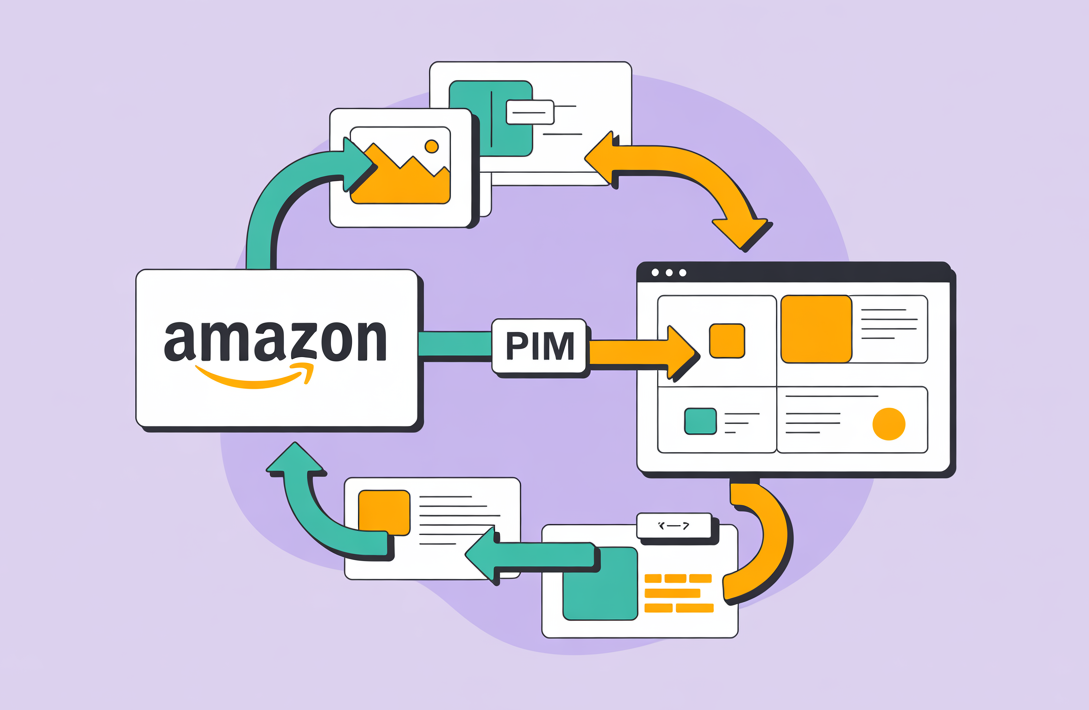
Selling on Amazon is more complex than it looks. Between A+ Content, variation relationships, compliance rules, and the split between Vendor Central (1P) and Seller Central (3P), you need a Product Information Management (PIM) system that goes well beyond a basic connection. This guide cuts through the noise and evaluates each platform on the depth of its Amazon integration, not just whether one exists.
Understanding Amazon's Ecosystem
Your PIM needs to match your selling model. Here's a quick overview of how Amazon's models differ:
| Model | Who Sells? | Who Ships? | Prime Badge? | Price Control | Best For |
|---|---|---|---|---|---|
| FBA (Fulfilled by Amazon) | You (3P) | Amazon | Yes | You | Standard size items, high volume |
| FBM (Fulfilled by Merchant) | You (3P) | You | No | You | Low margin, heavy items, or beginners |
| SFP (Seller Fulfilled Prime) | You (3P) | You | Yes | You | Heavy items needing Prime badge |
| Vendor Central (Standard 1P) | Amazon (1P) | Amazon | Yes | Amazon | Large brands wanting bulk POs |
| Direct Fulfillment (Vendor Dropship) | Amazon (1P) | You | Yes | Amazon | "Endless aisle" items |
Amazon maintains entirely separate documentation for Seller Central (3P) and Vendor Central (1P). Vendor Central integration is notably more complex, so make sure your PIM explicitly supports your model.
What to Look For in a PIM for Amazon
Five dimensions separate a good Amazon integration from a frustrating one:
1. Connectivity & Synchronization — Does it use the modern SP-API for real-time bidirectional sync, or slower legacy flat-file feeds? Can it receive data back from Amazon (prices, Buy Box status, listing errors)? Does it handle multiple regions from a single product record?
2. A+ Content & Rich Media — Does the PIM have a native drag-and-drop A+ builder, or does it just store assets and push them blindly? Can it auto-resize images to Amazon's specs? Is the DAM tightly coupled with product data so updates cascade automatically?
3. Compliance & Readiness — Does it run a pre-flight check before publishing (catching things like a bullet point that's 10 characters too long)? Does it show human-readable error messages when Amazon rejects a listing? Does it auto-update validation rules when Amazon changes category requirements?
4. Catalog Management — Can it handle Amazon's Variation Themes (Size/Color) with proper parent-child relationships? Can you map multiple ASINs to one internal SKU? Can you send a capped "display stock" to Amazon while keeping real inventory separate?
5. Workflow & Usability — Can you preview the Product Detail Page before publishing? Is there a full change history showing who edited what and when?
Top PIM Systems for Amazon Integration
1. Salsify — Market Leader for Amazon
Best For: Brands managing multiple Amazon catalogs where A+ Content is central to the strategy.
Connectivity: Direct SP-API supporting both Vendor Central (1P) and Seller Central (3P) with high-volume throughput.
A+ Content: Native Visual Builder. You drag and drop Amazon modules (Standard Comparison Chart, Standard 4 Image Text) onto a live canvas inside Salsify and see exactly how the page looks before it goes live.
Validation: Amazon Readiness Reports pull live schema requirements directly from Amazon and flag errors with plain-language explanations before anything leaves the system.
Catalog Management: Handles complex GDSN data pools often required for new item setup in Vendor Central.
Key Differentiator: Native Simulation. Salsify mimics Amazon's backend experience inside the PIM itself. Amazon featured Salsify as a success story on its Developer Hub.
Weaknesses: Implementation is heavy and expensive. Bulk publishing queues can stall with large catalogs, and support teams have a reputation for blaming Amazon rather than solving mapping issues.
2. Contentserv — Enterprise PXM Approach
Best For: Global enterprises with strict data governance needs and complex multi-region requirements.
Connectivity: Enterprise-grade connectors (sometimes labeled "SAWS" or "Shopping Graph") with robust bidirectional syncing of price, stock, and content.
A+ Content: Asset Association. Assets and text blocks are managed as structured data and pushed to Amazon's API. There is no visual layout designer inside the PIM.
Validation: Data Quality Gates enforce "Golden Record" rules so that products that don't meet Amazon completeness criteria are blocked from syndication.
Catalog Management: Exceptional Context Management that automatically adapts product data (images, descriptions) per Amazon region (US vs. DE vs. FR).
Key Differentiator: Context Management. Automatic per-region data adaptation makes it ideal for brands spanning multiple Amazon marketplaces.
Weaknesses: No visual A+ builder means users map assets without any preview. The Context architecture also makes it dangerously easy for non-technical users to accidentally overwrite global data when updating a single region.
3. Sales Layer — Ease of Use Focus
Best For: Mid-market teams that need fast deployment without dedicated technical resources.
Connectivity: Direct API Connector with separate configuration flows for Seller Central and Vendor Central.
A+ Content: Field Mapping. You select A+ modules and map your PIM fields to those slots. It's a form-filling exercise, not a visual design experience.
Validation: A 0–100% Quality Score based on completeness. Helpful for SEO, but less strict than schema validation, so you may still hit API errors if Amazon updates a technical rule.
Catalog Management: Clean handling of Variants for grouping products into parent-child Amazon variation themes.
Key Differentiator: Ease of Use. Straightforward setup that marketing teams can manage without engineering support.
Weaknesses: The Quality Score can create false confidence by missing category-specific API compliance rules. The 1P Vendor connector is noticeably weaker, lacking advanced Direct Fulfillment and EDI acknowledgment handling.
4. Pimworks — Workflow & Collaboration
Best For: Teams migrating from manual Amazon management who need to import existing listings.
Connectivity: API-based syndication that centralizes data from multiple sources before pushing to marketplaces.
A+ Content: Template Selection. Pick a compliant template, fill in the data slots, and sync to Amazon. Good for staging content, but there is no live visual designer.
Validation: Pre-flight Compliance Checks against standard Amazon requirements for fields like Title and Bullet Points.
Catalog Management: A "crawl" feature can pull your existing Amazon listings directly into the PIM, which is particularly useful during initial setup.
Key Differentiator: Import/Crawl. Fetching live Amazon data into the PIM makes migrations significantly easier.
Weaknesses: Noticeable sync latency during bulk updates means price and stock changes aren't always instant. A+ support is limited to rigid templates that can conflict with internal approval workflows.
5. Catsy — Specialized for Automotive & Technical Products
Best For: Automotive, industrial, and B2B sellers with complex technical specifications.
Connectivity: Direct API integration focused on high-volume technical data.
A+ Content: Template Mapping. Link technical specs and assets to Amazon's A+ templates.
Validation: Grade Reporting gives products a readiness score before publication.
Catalog Management: Strong SKU relationship handling and technical specification management.
Key Differentiator: Fitment (ACES/PIES). Built natively to manage Year/Make/Model fitment data, which most PIMs can't push to Amazon's Auto Part Finder without a separate feed.
Weaknesses: Struggles with "emotional" content, so lifestyle imagery and brand storytelling for high-converting A+ pages aren't its strength. Integration can also be fragile when syncing disparate data from complex ERP environments.
6. Gepard PIM — Data Transformation Powerhouse
Best For: Brands with complex internal data structures that require heavy transformation before reaching Amazon.
Connectivity: Strong API & Feed capabilities with automatic structure-to-structure data mapping.
A+ Content: Data Transformation. Scripts automatically convert internal rich descriptions into the HTML/JSON format Amazon's A+ API requires. There is no visual builder.
Validation: Rule-Based Validation with complex If/Then logic (e.g., "If Category is Electronics, require Attribute X").
Catalog Management: Strong variation handling and complex data relationships.
Key Differentiator: Taxonomy Mapping. Internal category maps update automatically when Amazon changes its category tree, so products don't get stranded in the wrong category.
Weaknesses: The script-driven approach creates a "black box" where content tweaks require developer intervention. Live market data pull (Buy Box status) is also weaker than competitors.
7. AtroPIM — Open-Source Flexibility
Best For: Growing brands and technical teams that want enterprise capabilities without the enterprise price tag. AtroPIM is built for teams that need complete ownership of their integration logic and data security (on-premise), rather than relying on "black box" connectors.
Connectivity: The modular Amazon connector is a one-time €4,900 setup built on Synchronization and Import/Export modules. It supports both Seller Central and Vendor Central with bidirectional sync via SP-API. Amazon's taxonomy data is automatically downloaded, and attribute mapping is handled through Amazon classification assignments.
A+ Content: Managed through the Components module with 12 configurable out-of-the-box components representing A+ modules. You create records, control data structure, and export with precision. More technical than a visual builder, but significantly more flexible.
Validation: Configurable Rules. You define your own validation logic through the workflow engine, including complex conditional checks tailored to specific categories, regions, or business rules.
Catalog Management: Fully flexible data modeling with custom entity types, variation themes, parent-child hierarchies, and attribute inheritance. Amazon listings live in a dedicated "Listing" entity linked to (but separate from) the core product record.
Key Differentiator: Open-Source + AI Integration. Licensed under GNU GPLv3 with full source code access. Core software is free with no user or record limits. Includes native integration with ChatGPT, Gemini, and Claude AI for content generation, translation, and SEO. Available as cloud (SaaS from €300/month) or on-premise, with support packages from €190/month.
Weaknesses: This is a "do-it-yourself" or "do-it-with-AtroCore" system. Attribute mapping rules must be created manually, and the configuration depth required means a content manager may not be able to operate it independently without technical support.
8. Ergonode — Modern UX & Multi-Language
Best For: European brands managing multi-language listings across Amazon EU marketplaces.
Connectivity: Amazon Data Feed App that generates the necessary feeds for Amazon.
A+ Content: Attribute Mapping. Rich text attributes are mapped to Amazon description fields. There is no dedicated visual A+ builder; the approach relies on clean data preparation upstream.
Validation: Completeness Grid. A Kanban-style visual showing which products meet your Amazon channel completeness rules at a glance.
Catalog Management: Strong multi-language support ("Variables") for efficiently managing translations of bullet points across Amazon DE, FR, IT, and ES.
Key Differentiator: UX & Multi-Language. Modern interface with the strongest translation management for EU sellers.
Weaknesses: Feed-based updates mean delayed error feedback, so a failed listing might not surface for hours. There is also no on-the-fly image transformation, meaning assets must be pre-formatted to Amazon's exact pixel specs before upload.
Comprehensive Comparison Table
| System | Connectivity Type | Amazon Models | A+ Content Handling | Validation & Readiness | Key Differentiator | Starting Price |
|---|---|---|---|---|---|---|
| Salsify | Direct SP-API | 1P & 3P | Native Visual Builder | Readiness Reports (live schema) | Native Simulation | ~$35,000/year |
| Contentserv | Enterprise Connector | 1P & 3P | Asset Association | Data Quality Gates | Context Management | Custom quote |
| Sales Layer | API Connector | 1P & 3P | Field Mapping | Quality Score (0–100%) | Ease of Use | $1,000/month |
| Pimworks | Syndication Module | Primarily 3P | Template Selection | Pre-flight Checks | Import/Crawl | $699/month |
| Catsy | Direct API | 1P & 3P | Template Mapping | Readiness Grade | Fitment (ACES/PIES) | $599/month |
| Gepard PIM | Transformation Engine | 1P & 3P | Data Transformation | Rule-Based Validation | Taxonomy Mapping | Custom quote |
| AtroPIM | Custom Connector (Modular) | 1P & 3P | Components Export | Configurable Rules | Open-Source + AI | €190/mo + €4,900 setup |
| Ergonode | Data Feed App | 3P | Attribute Mapping | Completeness Grid | UX & Multi-Language | Custom quote |
Bidirectional Sync: Data Flow from Amazon to PIM
Most teams focus on pushing data to Amazon. But syncing data back from Amazon is just as important and often overlooked.
What Can Be Synced Back?
- Product Data: listings, ASINs, listing status, content approval, browse nodes
- Inventory & Pricing: real-time stock, current prices, Buy Box status, competitive pricing (via Amazon Retail Analytics for 1P)
- Order Data: new orders, status updates, tracking, cancellations, returns
- Customer Data: anonymized shipping addresses, order history, limited contact info, EU opt-in End User Data
- Financial Data: settlement reports, fees, ad spend, revenue analytics
- Performance Metrics: sales velocity, conversion rates, glance views, reviews, Vendor Central operational metrics
System-by-System Bidirectional Sync
Salsify offers full bidirectional sync via SP-API, including order and inventory data through its Orders & Inventory add-on module. Amazon Retail Analytics data is available for Vendor Central accounts.
Contentserv supports bidirectional product content sync with sophisticated transformation logic, but transactional data (orders, customers) requires custom integration or middleware.
Sales Layer handles real-time product data sync well but doesn't extend to orders or customer data, as it's a content management tool rather than an order management one.
Pimworks is notable for its crawl/import feature that pulls existing Amazon listings into the PIM. Inventory sync is basic, with no order or customer data support.
Catsy is primarily one-way (PIM to Amazon). Bidirectional and transactional sync are not supported.
Gepard PIM is outbound-first. Bidirectional capabilities are limited to listing status and errors; extensions require custom development.
AtroPIM offers the most configurable bidirectional sync. With the order management module, it can synchronize product, inventory, order, and customer data via REST/SOAP/GraphQL. Event-based synchronization via the Workflows module triggers updates the moment something changes, rather than on a fixed schedule.
Ergonode is product data outbound only, with no order or customer data sync.
Bidirectional Sync Summary
| System | Product Data | Inventory | Orders | Customer Data | Financial | Real-Time |
|---|---|---|---|---|---|---|
| Salsify | ✓ Full | ✓ Full | ✓ Add-on | ✓ Add-on | ✓ (1P) | Yes |
| Contentserv | ✓ Full | ✓ Configurable | ✗ | ✗ | ✗ | Custom config |
| Sales Layer | ✓ Basic | ✓ Basic | ✗ | ✗ | ✗ | Yes |
| Pimworks | ✓ Crawl | ✓ Basic | ✗ | ✗ | ✗ | Limited |
| Catsy | ✗ | ✗ | ✗ | ✗ | ✗ | No |
| Gepard PIM | ✗ | ✗ | ✗ | ✗ | ✗ | No |
| AtroPIM | ✓ Full | ✓ Full | ✓ Module | ✓ Module | ✓ Configurable | Yes (event-based) |
| Ergonode | ✗ | ✗ | ✗ | ✗ | ✗ | No |
Why It Matters
Without bidirectional sync, you're manually downloading reports, copying data between systems, and reacting to listing failures hours after they happen. For multi-channel sellers or brands using FBA alongside their own warehouse, real-time data flow back from Amazon isn't a nice-to-have — it's operational infrastructure.
When evaluating sync capabilities, ask about: data frequency (real-time vs. batch), error handling, field-level mapping customization, historical data import, API rate limit handling, and whether order sync requires a separate module.
Making Your Decision
Salsify is the go-to if A+ Content is your priority and budget isn't a constraint. It offers the most Amazon-native experience, especially for brands managing both Vendor and Seller Central.
Contentserv suits large global enterprises that need strict data governance and automatic content adaptation across multiple Amazon regions.
Sales Layer is ideal for mid-market teams wanting fast deployment without heavy technical resources, offering a solid middle ground on features and price.
Pimworks works best if you're migrating from manual Amazon management and need to import existing listings into a proper PIM workflow.
Catsy is the clear choice for automotive and industrial sellers. If ACES/PIES fitment data matters to you, nothing else comes close.
Gepard PIM fits technically resourceful teams dealing with complex internal data structures that need serious transformation logic before reaching Amazon.
AtroPIM is worth a hard look if you want enterprise-level flexibility without the enterprise price tag, particularly for teams needing on-premise deployment or AI-assisted content generation.
Ergonode is best suited for European-focused brands managing multi-language listings across Amazon EU marketplaces, with a modern UX as a bonus.
Essential Amazon Features Checklist
Before committing to any PIM, verify it covers these fundamentals:
Content & Listing Management: A+ Content, titles, bullet points, descriptions, backend search terms, images, browse nodes
Product Organization: Parent-child variation themes (Color, Size, ColorSize), ASINs, SKU management, brand codes
Amazon-Specific Attributes: browse_node, product_type, item_type_keyword, brand, manufacturer, model_number, global trade identifiers (UPC, EAN, ISBN)
Marketplace Features: Multi-marketplace support (US, UK, DE, FR, IT, ES, JP), Subscribe & Save, Brand Registry, FBA inventory management, Vendor Central and Seller Central support
Compliance & Quality: Automated validation, pre-syndication compliance checks, character limit enforcement, human-readable error messages
Final Thoughts
There's no universal best PIM for Amazon. The right choice depends on your selling model, team structure, and technical resources. Enterprise brands prioritizing A+ Content will get the most from Salsify's native builder, while mid-market teams will likely find Sales Layer or Pimworks the right balance of features and speed.
For businesses that want enterprise-grade control without the enterprise price tag, AtroPIM is a genuinely compelling alternative, especially for teams comfortable with configuration or those needing on-premise deployment and AI-powered content workflows.
Whatever you choose, don't just ask "does it connect to Amazon?" Ask how it handles A+ Content, whether validation catches errors before they cause suppressed listings, and whether it can grow with your catalog and strategy. That depth of integration is what separates a competitive advantage from a constant headache.