


Key Takeaways
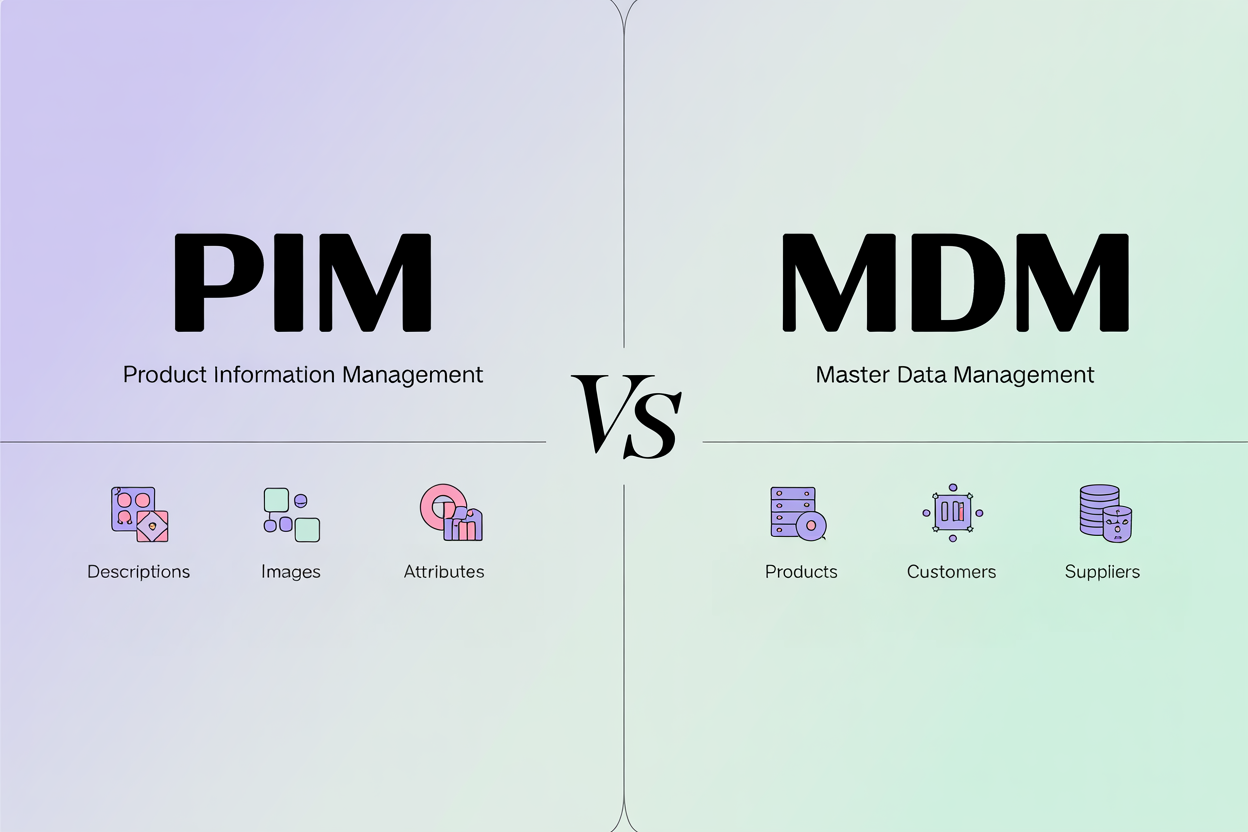
- Product Information Management (PIM) is a business-led system for enriching and distributing product content across sales and marketing channels.
- Master Data Management (MDM) is an IT-led discipline that governs all critical data domains across the enterprise: products, customers, suppliers, locations, and more.
- PIM is technically a domain within MDM, but in practice the two are separate systems with different tooling, users, and goals.
- Choose PIM if your challenge is product content quality and multichannel distribution. Choose MDM if the problem is data consistency across departments and systems.
- Many mid-size and enterprise organizations need both. AtroCore with AtroPIM delivers MDM and PIM in a single instance, removing the need to synchronize data between two separate platforms.
Companies running large product catalogs often hit the same wall: product data is inconsistent across channels, supplier records don't match what's in the ERP, and teams spend hours reconciling spreadsheets. Two systems are commonly proposed as solutions: PIM and MDM. The PIM vs MDM question comes up in most mid-size and enterprise data management projects, and the answer is rarely simple. The two are often confused with each other, sometimes treated as interchangeable, and occasionally pitched as competing alternatives. None of that is accurate.
What Is PIM?
Product Information Management (PIM) is a system that centralizes the collection, management, and distribution of product-related data. Its purpose is to ensure that product descriptions, specifications, images, and translations are accurate, complete, and consistent across all sales and marketing channels.
A manufacturer managing tens of thousands of products across an e-commerce platform, several marketplaces, print catalogs, and regional sales channels relies on PIM to keep that content coherent. Marketing and e-commerce teams make changes in the PIM, and those updates push automatically to all connected platforms. That eliminates duplicate work, reduces errors, and ensures products are represented consistently wherever they appear.
PIM is built for content depth. It handles rich, marketing-focused product data: taxonomies, descriptions, technical specs, digital assets, channel-specific attributes, and translations. The tooling is designed for the people who create and approve that content, not for IT departments. That business-led character is one of the defining traits that separates PIM from MDM in practice. Implementation is faster, costs are lower, and the primary driver is usually a marketing or e-commerce team, not an IT initiative.
A PIM system typically includes built-in DAM functionality for managing digital assets alongside product data, workflow tools for content approval and translation, and channel-specific publishing connectors for e-commerce platforms, marketplaces, and print. These capabilities are largely absent from standard MDM platforms.
What Is MDM?
Master Data Management (MDM) manages all critical business data across an organization. Where PIM focuses on product content, MDM covers a broader range of data domains: products, customers, suppliers, locations, financials, and any other entity that multiple systems need to share consistently.
MDM is typically IT-led. The need is usually identified by IT teams fielding increasing requests to collect, cleanse, and cross-reference data from multiple source systems. Business users describe the same problem differently: they talk about low trust in sales figures, inconsistent inventory counts, or supplier records that differ between the ERP and the CRM. Those are MDM problems.
A global company with separate databases for customer records, supplier information, and product catalogs uses MDM to consolidate those into a single source of truth. Sales, finance, logistics, and customer service all work from the same accurate, up-to-date records. MDM enforces governance rules, monitors data changes, tracks data lineage, and manages relationships between entities. It does not replace ERP or CRM systems. It sits alongside them and ensures the data flowing between them stays consistent.
MDM Data Domains
MDM manages several distinct data domains, each covering a different entity type:
- Product MDM -- core product identifiers: SKU, material number, base dimensions, fundamental hierarchies, and relationships used across ERP, CRM, and BI systems.
- Customer MDM -- unified customer records across sales, service, and billing systems.
- Supplier MDM -- consistent vendor data across procurement, finance, and logistics.
- Location MDM -- standardized site, warehouse, and regional data shared across operations.
Product MDM is the domain most closely related to PIM, and the source of most of the confusion between the two systems. Product MDM manages core, structured product data for internal consistency. PIM manages rich, marketing-focused product content for external distribution. They handle different aspects of the same product entity.
MDM Implementation Styles
MDM can be deployed in four main architectural patterns, each representing a different level of control over source systems:
- Registry -- a read-only index that creates a golden record for reporting without pushing data back to source systems. Low risk, fast to implement.
- Consolidation -- aggregates data from multiple sources into a central repository for analytics. Source systems remain authoritative.
- Coexistence -- the MDM hub and source systems both hold master data and synchronize bidirectionally. More complex but keeps existing systems in place.
- Centralized -- the MDM hub becomes the authoritative source. All other systems consume data from it. Highest governance control, highest implementation effort.
PIM does not map cleanly to any of these styles because it is not primarily a governance architecture. It is an operational content management system. That distinction matters when evaluating whether a single platform can serve both functions.
Key Differences Between PIM and MDM
The core distinction in any PIM MDM comparison is scope and purpose. PIM specializes in the richness of product content and ensures every product has complete, high-quality information for marketing and sales. MDM is concerned with the breadth of organizational data and maintains consistency across all key business domains. Framed as MDM vs PIM: MDM is wide but shallow on product content; PIM is narrow but deep.
| Category | PIM | MDM |
|---|---|---|
| Scope | Product data only | All enterprise data domains |
| Main purpose | Enrich and distribute product content | Single source of truth for all master data |
| Initiative type | Business-led | IT-led |
| Primary users | Marketing, e-commerce, catalog managers | IT, data governance, operations, compliance |
| Data type | Rich, channel-specific content, images, translations | Core structured data: SKUs, IDs, relationships |
| Data distribution | Omnichannel publishing to e-commerce, marketplaces, print | Internal system synchronization (ERP, CRM, BI) |
| Includes DAM | Yes, typically built-in | No |
| Setup complexity | Faster, works well with e-commerce and ERP | More planning, IT involvement, enterprise-wide |
| Pricing | Lower setup cost, SaaS or open-source options available | Higher upfront cost, typically customized for enterprise |
In practice, MDM manages core records so that every department works from the same foundation. PIM builds on that foundation to enrich product content and distribute it to customer-facing channels.
Is PIM Part of MDM?
This is one of the more technically accurate but practically misleading answers in the PIM vs MDM debate. Technically yes, with an important caveat.
PIM manages product information, and product data is one of the master data domains that MDM covers. So PIM can be described as a specialized subset of MDM that focuses exclusively on the product domain and extends it with marketing-oriented enrichment and distribution capabilities.
But in practice, the tooling diverges significantly. A standard MDM platform is not built for the workflows that marketing and e-commerce teams need: bulk content editing, translation management, digital asset handling, channel-specific attribute mapping, and omnichannel publishing. A PIM is not built to govern customer, supplier, or financial data. Treating them as interchangeable leads to gaps in both directions.
The clearest way to frame it: MDM covers product data at a governance level. PIM covers product data at a content level. Most enterprises that sell through multiple channels need both layers.
PIM, MDM, and Other Related Systems
PIM vs ERP. ERP systems manage transactional and operational data: orders, inventory, pricing, and production. They typically hold basic product identifiers but are not designed for rich content management or multichannel publishing. PIM and MDM complement ERP rather than replace it. MDM ensures the identifiers in the ERP match those in every other system. PIM takes those identifiers and builds the marketing content layer on top.
PIM vs DAM. A Digital Asset Management (DAM) system stores and organizes media files: images, videos, documents. PIM focuses on product data attributes and their distribution. In many modern PIM implementations, DAM functionality is built in or tightly integrated, since product content and product assets are managed together. AtroPIM includes built-in DAM as part of the AtroCore platform, so product records and their associated media are managed in the same system without a separate integration.
PIM vs PLM. Product Lifecycle Management (PLM) handles engineering and manufacturing data: CAD files, bills of materials, design revisions, and manufacturing specifications. It is used by engineering teams, not marketing teams. PLM covers the product development phase. PIM takes over when the product is ready to sell.
PIM vs PDM. Product Data Management (PDM) is a subcategory of PLM that manages technical documentation and engineering data. Like PLM, it operates earlier in the product lifecycle and has no overlap with the marketing and channel distribution functions of PIM.
Choosing Between PIM and MDM
The choice comes down to where the problem actually sits.
If the main challenge is large product catalogs, inconsistent content across channels, slow product launches, or the need to manage translations and digital assets at scale, PIM will have the biggest impact. Retailers, manufacturers, and distributors who frequently update assortments and sell through multiple online and offline channels get the most from PIM.
If the organization struggles with data inconsistencies between departments, such as customer or supplier records that differ between the ERP, the CRM, and the BI layer, MDM is the better fit. The same applies when compliance, audit requirements, or reporting accuracy demands a governed, traceable data foundation across the entire business.
Many large companies use both. The question is usually sequencing and budget, not either-or.
A useful rule of thumb: if the problem is visible to customers (wrong product descriptions, missing images, outdated specs on a marketplace), it is a PIM problem. If the problem is visible internally (sales and finance working from different customer records, procurement seeing different supplier data than logistics), it is an MDM problem.
How PIM and MDM Work Together
The two systems are complementary.
MDM creates the "golden record" for the core product entity, guaranteeing that base identification data, such as SKU, name, and category ID, is consistent across all internal systems. PIM then takes that governed product record and adds everything needed for selling: images, marketing copy, regional descriptions, translated manuals, and channel-specific attributes. It acts as the publishing engine for customer-facing channels.
A pure MDM solution may handle Product Master Data but typically lacks the dedicated workflows and enrichment tools that marketing and e-commerce teams need. Equally, PIM without MDM governance can produce a situation where product content is well-maintained externally while the underlying identifiers and relationships are inconsistent between internal systems.
A manufacturer might use MDM to ensure every product carries the correct global SKU and supplier relationship, while using PIM to create region-specific product descriptions, translated documentation, and high-resolution images. The MDM layer keeps the data honest. The PIM layer makes it useful to customers.
For organizations that need both, running two separate platforms introduces its own synchronization complexity. AtroCore with AtroPIM solves that by delivering MDM and PIM capabilities within a single instance. There is no data pipeline to maintain between the two systems because they share the same data layer from the start. AtroCore functions as the underlying platform, handling governance, data relationships, and integration with ERP and other enterprise systems. AtroPIM provides the product content management layer on top, with built-in DAM, configurable workflows, channel-specific publishing, and REST API access documented per OpenAPI standards. Both can be deployed on-premise or as SaaS, and the modular structure means organizations can start with what they need and expand as requirements grow.
Unlike most enterprise MDM platforms, AtroPIM is available as an open-source software with many advantages, which significantly lowers the entry cost and removes vendor lock-in. The underlying AtroCore platform extends beyond classic PIM and MDM to cover system integration and general business process management, making it a viable foundation for broader data management programs.
Common Misconceptions About PIM and MDM
"MDM covers product data, so we don't need PIM." MDM covers product data at a governance level, not a content level. It manages identifiers and relationships, not descriptions, images, translations, or channel-specific attributes. Relying on MDM alone leaves a gap that marketing and e-commerce teams will fill with spreadsheets.
"PIM is enough, we don't need MDM." PIM manages product content but does not govern the core data the rest of the business depends on. If customer records, supplier identifiers, and financial data are inconsistent across systems, PIM does not fix that.
"If we have an ERP, we don't need either." ERP systems hold transactional product data, typically SKU, price, and stock level. They are not built for rich content management or multichannel publishing. PIM and MDM address what ERP leaves unmanaged.
Real-World Examples
In projects we have implemented, the need for both PIM and MDM capabilities typically surfaces early. Organizations often start by requesting a PIM and discover mid-project that their core product data, the identifiers and relationships the PIM is supposed to enrich, is inconsistent across source systems. Fixing that is an MDM problem.
Activate Scientific, a European chemical manufacturer supplying over 140,000 specialized compounds to pharmaceutical and academic researchers, faced exactly this situation. Managing 150,000-plus SKUs with manual data synchronization between their ERP and Shopware e-commerce platform was creating daily delays and pricing errors. The solution combined PIM and MDM on a single AtroCore-based platform. MDM centralized product identifiers and supplier relationships. PIM enriched content and automated the daily export to Shopware. A supplier selection algorithm built on top of the governed data structure improved sales profitability by more than 20%.
First Stop Ayme, a French automotive services company with nearly 500 service centers and close to a million SKUs, ran into a different but related set of problems. Product data arrived from multiple suppliers in inconsistent formats. Attribute structures varied by source. Access permissions depended on supplier, product category, and manufacturer, making controlled data sharing difficult. The AtroPIM implementation centralized product data management and introduced automated import and export workflows, dynamic pricing support, and data quality validation. The result was faster product launches, better catalog accuracy, and improved cross-team collaboration between logistics, marketing, and technical staff.
Both cases show the same pattern: MDM governs the data foundation. PIM manages what gets built on top of it. Whether the question is framed as PIM vs MDM or MDM vs PIM, the answer in complex catalog environments is usually: both, in the right order.