


Key Takeaways
Design the model before touching any PIM/MDM config. Most data problems are model problems, not data problems.
Never flatten into one record. Category, Variant, Asset, Channel, Supplier, Price, and Unit of Measure are all distinct entities. Collapsing them is cheap to do and expensive to undo.
Attribute scope is the highest-stakes design decision. Classify every attribute as global, locale-specific, or channel-specific. Getting it wrong breaks the downstream publishing logic.
Three variant/bundle mistakes to avoid:
- Retrofitting variants onto a flat product structure
- Storing bundle composition as a notes field instead of a structured entity
- Defining variant axes without controlled vocabularies ("red" / "Red" / "RED" breaks faceted search)
Internal ID, SKU, GTIN, EAN, and MPN each play a different role, so never conflate them. Use a cross-system mapping table. Two records sharing a GTIN mean one is a duplicate; enforce this as a hard validation rule.
Core data lives in the base record. Locale and channel overrides live in separate linked records. Define completeness rules per combination: a missing German description should block publishing to the German webshop.
Version the model, assign ownership, and keep a living doc readable by both devs and business stakeholders. Without governance, the data quality problems you solved will gradually return.
What Is a Product Master Data Model?
Most product data problems are not data problems. They are model problems. The data is often there. It is just stored in the wrong shape, in the wrong place, without the right relationships. That is what a product master data model is meant to fix.
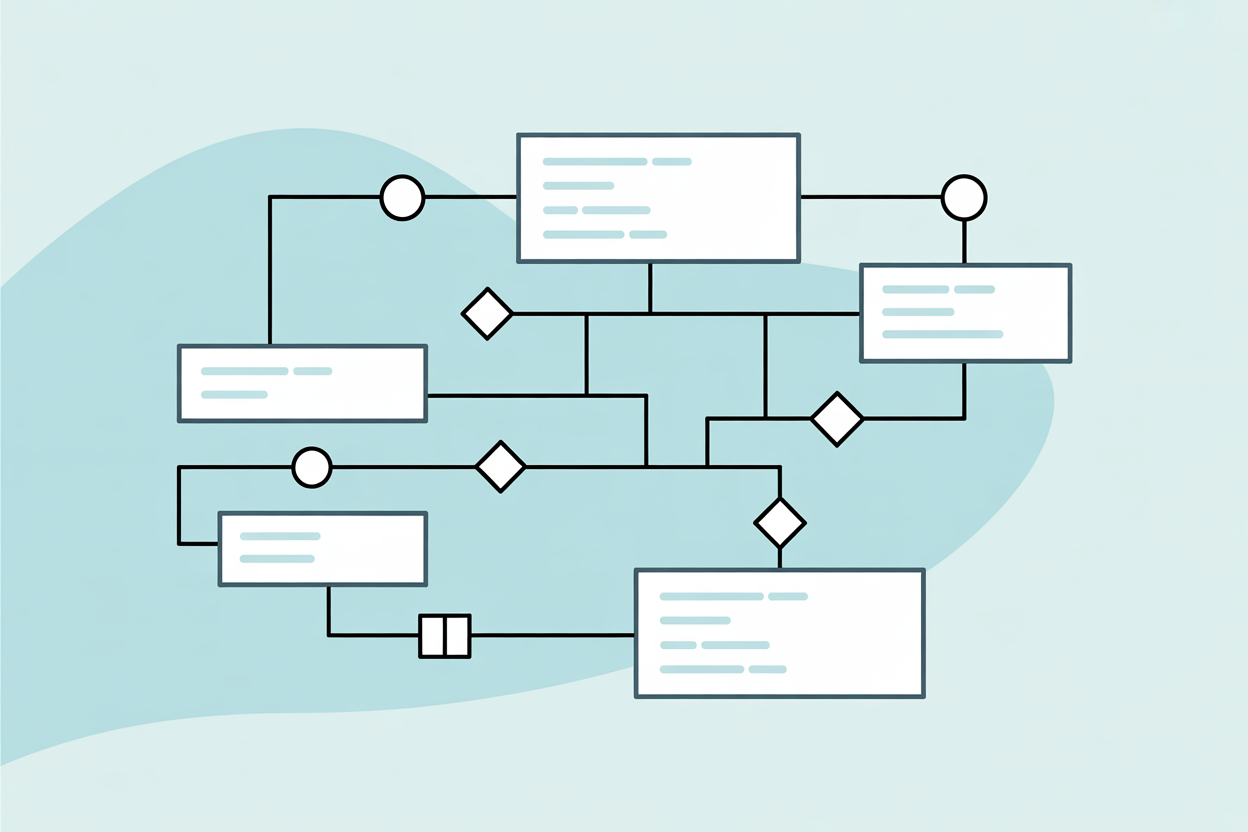
A product master data model is a formal blueprint. It describes the entities in your product domain, their attributes, and how they relate to one another. It is the architectural drawing for all your product information.
The product master data model is not the same as a database schema. A schema is the technical implementation. The data model is the conceptual layer above it. You design the model first, then implement the schema.
Without a clear model, product data tends to grow chaotically. Teams add attributes wherever they fit. Identifiers get duplicated. Channel-specific data bleeds into core records. The absence of an explicit model was almost always the root cause of data quality problems. This is especially true for companies managing tens of thousands of SKUs.
The product master data model is the foundation of any PIM (Product Information Management) or MDM (Master Data Management) initiative. Before you configure workflows, import pipelines, or publishing rules, you need to know what your data structure looks like.
Core Entities and Their Relationships
Every product master data model revolves around one central entity: Product. Everything else connects to it.
The most important related entities are:
- Category -- defines where a product sits in the catalog hierarchy and which attributes apply to it.
- Variant -- a specific version of a product, differing by one or more axes such as size or color.
- Asset -- a digital file linked to a product, typically an image, video, or document.
- Channel -- a sales or distribution outlet such as a webshop, marketplace, or print catalog.
- Supplier -- the entity that provides the product, with its own identifiers and data.
- Price -- can be modeled as an entity in its own right when multiple price lists, currencies, or customer groups are involved.
- Unit of Measure -- defines how the product is sold, packed, or shipped.
The table below summarizes how each entity relates to Product and what cardinality that relationship carries.
| Entity | Relationship to Product | Cardinality |
|---|---|---|
| Category | Product belongs to Category | Many-to-many |
| Variant | Product has Variants | One-to-many |
| Asset | Product has Assets | One-to-many |
| Channel | Product is published to Channel | Many-to-many |
| Supplier | Product is supplied by Supplier | Many-to-many |
| Price | Product has Prices | One-to-many |
| Unit of Measure | Product uses Unit of Measure | Many-to-one |
A mid-sized manufacturer of industrial sensors illustrates why entity separation matters. Each sensor belongs to a category, has multiple variants, links to a datasheet PDF, is sold through three channels, and is supplied by two vendors. Modeling all of this as flat text fields on a single product record makes the data unmanageable within months.
Attribute Architecture
Attributes are the individual data fields that describe a product. Designing the attribute architecture carefully is one of the highest-leverage decisions in the entire project.
Attribute types define what kind of value a field holds: text, number, boolean, date, enum, multi-enum, or relation. Choosing the wrong type creates problems downstream. Storing a weight value as text instead of a number makes filtering and unit conversion impossible later. Storing a country of origin as free text instead of an enum leads to "Germany", "DE", "Deutschland", and "germany" all appearing as separate values in reports.
Attribute groups organize fields into logical panels within the UI. Common groups include General, Technical Specifications, Logistics, and Marketing Content. For a product with 80 attributes, well-defined groups are the difference between a manageable editing interface and one that nobody wants to use. A Technical Specifications group for an industrial sensor, for example, might contain Operating Temperature, Ingress Protection Rating, Output Signal, and Measuring Range -- fields that belong together and are edited by the same person.
Scope dimensions determine whether an attribute value is shared globally or varies by locale or channel:
- Global -- one value across all locales and channels. Clean examples are GTIN, internal ID, and hazardous materials classification. These values are factual and universal by definition.
- Locale-specific -- value varies by language or region, such as product name, description, and legal disclaimer text.
- Channel-specific -- value varies by sales channel, such as an 80-character title formatted for Amazon versus a full descriptive title for the webshop.
This is the single design decision with the highest downstream impact. Getting the scope wrong means either duplicating data unnecessarily or forcing channel-specific content into global fields, which breaks publishing logic.
Attribute inheritance allows products assigned to a category to automatically receive the attribute set defined for that category. You define attributes once at the category level, and all products beneath it receive them. When a new "Operating Temperature" attribute is required for all products in the Industrial Sensors category, one change propagates to hundreds of products instantly.
Product Hierarchy and Classification
The product hierarchy is the category tree that organizes your catalog for both navigation and attribute assignment.
A flat structure with few levels is easier to maintain but provides less granularity for attribute inheritance. A deep structure gives more precision but requires more governance effort. In practice, three to five levels are enough for most B2B and B2C catalogs. A hierarchy like Components > Sensors > Pressure Sensors > Ceramic Pressure Sensors is specific enough to drive meaningful attribute inheritance without becoming unmanageable.
Categorization and classification are two distinct concepts that are often confused. Categorization places a product in a navigational tree (e.g., Electronics > Cameras > DSLR). Classification assigns a product to a standardized taxonomy like eCl@ss or GS1 GPC, which is often required for EDI or marketplace integration. Both can coexist in the same model, stored separately, serving different purposes.
Cross-category products are a real challenge. A product that belongs to two categories with conflicting attribute sets needs a clear rule. The most practical approach is to use a primary category for attribute inheritance and secondary categories only for navigation. How you resolve this at the hierarchy level directly shapes how variant axes are defined in the next step.
Variant and Bundle Modeling
Variant and bundle modeling is where many product master data models break down. It is worth spending real time on this during the design phase.
Simple products have no variants: one SKU, one set of attributes.
Configurable products have a parent record that defines the product concept and child records that represent each specific combination of variant axes. A T-shirt in sizes S, M, L, XL, and colors Red, Blue, and Green is one configurable product with twelve variants. The parent holds shared data: brand, material, and care instructions. Each child variant holds its own size, color, SKU, and stock level. This structure keeps the catalog clean and makes filtering by size or color reliable.
Variant axes must be defined as controlled vocabularies. You do not want "red", "Red", and "RED" treated as three different values. Beyond data consistency, uncontrolled variant axis values break faceted search and filter logic on the front end, meaning customers cannot reliably filter products by color, size, or material in your webshop.
Bundles are products composed of other products. A "Starter Kit" consisting of a sensor, a mounting bracket, and a cable is a bundle. The model needs a bundle composition entity recording which components belong to it and in what quantities. Whether the bundle is virtual (assembled at order time) or physical (pre-assembled and stocked as a unit) determines how pricing and stock logic work.
In projects with complex product ranges, we always recommend modeling variants and bundles explicitly before starting any configuration work.
The three most costly mistakes we see repeatedly are:
- launching with a flat product structure and retrofitting variants later
- treating bundle composition as a manual notes field instead of a structured entity
- defining variant axes without controlled vocabularies. Each of these mistakes is entirely avoidable at the model design stage and very expensive to fix after go-live.
Identifier Strategy
Identifiers are how your systems recognize and reference the same product. A weak identifier strategy leads directly to duplicate records and synchronization failures.
The table below summarizes the main identifier types, who assigns them, their scope, and their primary use.
| Identifier | Assigned by | Scope | Primary use |
|---|---|---|---|
| Internal ID | PIM / MDM system | Internal | System integrity, record linking |
| SKU | Business / operations team | Internal | Warehouse, order management |
| GTIN | GS1 | Global | Retail, supply chain, EDI |
| EAN | GS1 | Global | European retail, point of sale |
| MPN | Manufacturer | External | B2B sourcing, technical catalogs |
Each identifier plays a different role. Conflating them creates problems. A common failure pattern is using the ERP item number as the PIM internal ID. When the ERP system is replaced or when item numbers are restructured, every integration breaks.
The practical solution is a cross-system identifier mapping table. For every product record, the PIM stores its own internal ID alongside the ERP item number, the GTIN, and the MPN. Import and export mappings reference this table explicitly. A concrete example: a product arrives from the ERP with item number "ERP-00447". The PIM stores this in a dedicated ERP ID field. The webshop integration maps the GTIN. The distributor EDI feed maps the MPN. Each system speaks its own language, and the PIM translates between them without ambiguity.
If two records share the same GTIN, one of them is a duplicate. Making this a hard validation rule at the model level prevents duplicates from entering the system in the first place. A clean identifier model is also what makes channel-specific publishing reliable: when every product has an unambiguous identity across systems, pushing the right data to the right channel becomes a routine operation rather than a manual reconciliation task.
Channel and Locale Layer
The core product record holds data that is true regardless of where the product is sold or in what language. The channel and locale layer hold everything that varies.
Channel-specific data typically includes:
- A reformatted product title for a specific marketplace
- Images optimized for that channel
- Promotional text relevant only to one outlet
Locale-specific data includes:
- Translated names and descriptions
- Locale-appropriate units
- Country-specific regulatory text
Each layer lives in its own place: core data in the base product record, locale variants in linked translation records, channel-specific overrides in channel assignment records. Keeping these layers clean is what makes multichannel publishing manageable at scale. AtroPIM handles this separation particularly well, allowing teams to enrich and publish channel and locale layers independently without touching the core product record.
Completeness rules per channel/locale combination are a governance feature that belongs in the model itself — you define which attributes are mandatory before a product can be published to a specific channel.
A product missing its German description cannot be published to the German webshop. A product without a valid GTIN cannot be pushed to a retail marketplace.
Depending on the channel requirement, these rules can be hard blocks that prevent publishing entirely, or soft warnings that flag the gap and allow publishing with a conscious override. Both approaches have their place, and the model should support both.
Governance and Ownership Within the Model
A product master data model is not just a technical document. It is a governance framework.
Mandatory fields should be enforced by the system. Validation rules embedded in attribute definitions catch errors at entry, before they propagate downstream. A weight field should reject negative values. An EAN field should validate the check digit. A URL field should verify its format. A product title field can enforce a maximum character length per channel. Each of these rules eliminates an entire category of recurring data quality issues.
Versioning the model is something most teams overlook until they need it. When you add a new mandatory attribute or restructure a category hierarchy, existing records need migration. Treating the model as a versioned artifact with a changelog and migration scripts makes this manageable. Without versioning, a structural change to the model becomes a crisis instead of a routine operation.
Ownership means assigning clear responsibility for each part of the model: who can add new attributes, who approves changes to the category hierarchy, and who signs off on a new channel layer. Without defined ownership, the model drifts. New attributes get added without governance. Categories get restructured by different teams in incompatible ways. The data quality problems solved in the initial implementation gradually return.
Equally important is maintaining a living model document. This is not a database diagram locked away in a technical repository. It is a readable reference accessible to both developers and business stakeholders, describing every entity, attribute, relationship, and validation rule in plain language. A good model document is what enables the onboarding of new team members, supports external audits, and keeps cross-team alignment intact as the catalog evolves.
If you are starting a PIM or MDM project, the right first step is a data model audit: map your current entities, identify where data is stored inconsistently, and define the target model before touching any configuration. The quality of that model determines the quality of everything built on top of it.