


Key Takeaways
When a customer returns a product because it was "not as described," look at the content before you look at the product. Fixing a description costs far less than absorbing more returns in the future.
Channel mapping comes before content production
The same description that converts on your webshop will get suppressed on Amazon and ignored in a B2B portal. Define your channels and their requirements first, then produce content against them.
Two numbers worth tracking from day one
Watch your content completeness score for top-selling products: below 70% means measurable conversion loss before any SEO or ad spend. Watch your return rate filtered by reason, specifically "not as described."
Tooling and process both have a ceiling
- A style guide feels like overhead until the third writer joins. Then every hour not spent writing one comes back as corrections, inconsistencies, and rejected listings.
- Spreadsheets were never designed for multilingual, multi-channel product data at scale. The switch to a PIM pays for itself in corrections avoided.
Run audits quarterly, not once
A single audit is a snapshot. Quarterly audits are a competitive advantage. The gap between teams that do this and those that do not compounds over time.
What Is a Product Content Strategy?
You might be investing time and resources in blog posts and articles, hoping to bring in new visitors. And it works, people show up, but then they land on a product page that doesn't answer their questions, and they leave. Your blog is pulling people in, but your product pages are letting them walk right back out. This is often due too pure product content strategy or a total lack of such.
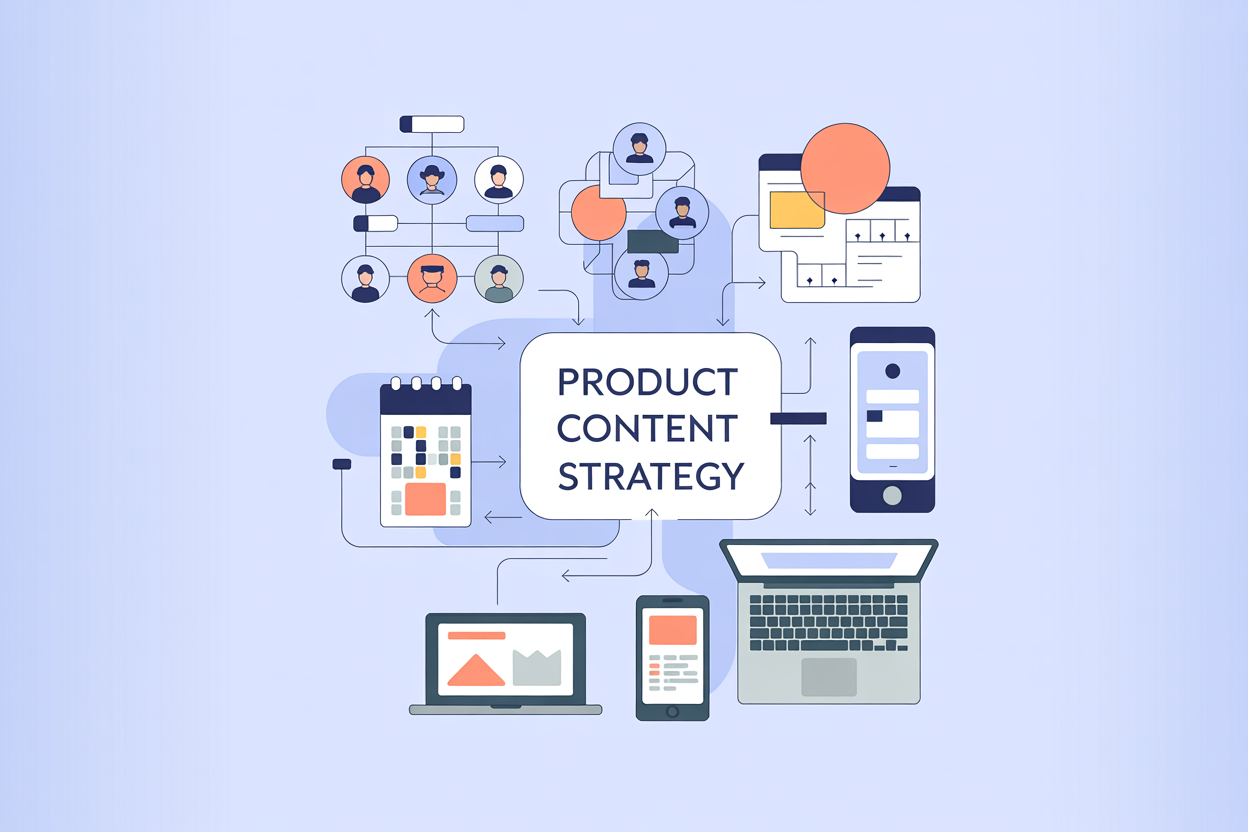
Product content strategy it is a systematic approach to creating, managing, and distributing product information across all sales and marketing channels. It covers everything from product titles and descriptions to technical specifications, images, videos, and supporting documents, so that the right information reaches the right buyer at the right time, in the right format.
Product content is extremely or very important when deciding to buy. Unclear or insufficient product information is one of the leading causes of e-commerce abandonment. Beyond lost sales, poor content actively generates costs through returns, customer service load, and reduced search visibility.
Audit Your Current Product Content
Before building anything new, understand what you already have. In projects we have implemented for hundreds of businesses, the audit phase almost always surfaces surprises: duplicate descriptions copied across product families, missing technical attributes, images that exist in one channel but not another.
A useful audit covers four areas:
- All product data across every active channel (webshop, marketplaces, print catalogs, B2B portals)
- Completeness of key attributes per product category
- Consistency of terminology, tone, and formatting
- Quality and availability of digital assets (images, PDFs, videos)
Let's make this concrete. Say you sell industrial sensors. Your audit comes back and tells you that 60% of your products have a short description, but only 20% have a long one. Half are missing certifications entirely. Every product has images, but they're all shot from the same angle. That's your baseline. And it tells you exactly where to start.
A good audit doesn't just hand you a list of problems. It tells you what matters most. That means grouping your gaps into categories like missing attributes, outdated copy, and absent media. It means giving each product or category a completeness score and flagging severity so your team knows where to start. Without that structure, you're just staring at a spreadsheet full of issues with no clear next move.
A structured spreadsheet works for smaller catalogs. For larger ones, a PIM system can generate completeness reports automatically. Either way, the output is the same: a clear, actionable baseline.
Define Your Product Content Goals
Your goals need to connect to actual business outcomes. Take a company that tracks return rates by category. They run a content audit and find that their highest-return category, power tools, has the shortest descriptions and no video content. So they set a specific goal: improve content completeness in that category and measure it against return rate over 90 days. That turns a vague intention into an accountable project.
Common goals include better organic search visibility, higher conversion rates, lower return rates, and faster time-to-market for new products. Once you have a goal, attach a measurable KPI to it. Chasing better SEO? Track keyword rankings and organic traffic to product pages. Focused on conversion? Watch add-to-cart and purchase rates. Trying to cut returns? Track return reasons over time and pay close attention to "not as described."
One thing that comes up constantly with our customers is conflicting priorities across departments. Sales wants more content, faster. Marketing wants a consistent brand tone. E-commerce wants SEO-optimized copy. A good strategy brings all of that under one shared framework so each team knows what to produce, for which channel, and to what standard. No stepping on each other.
Know Your Audience and Channels
Who is reading your product content? In B2C e-commerce, it is often an end consumer making an emotional and practical decision. In B2B, it might be a procurement manager comparing technical specifications across several vendors. The same product needs fundamentally different content depending on where it appears.
A practical example: a mid-range industrial pump. On Amazon, you lead with benefits, key specs in bullet points, and customer ratings context. On your own B2B portal, you provide full technical datasheets, installation documentation, and compliance certificates. In a print catalog, you compress everything to a 60-word description and one precise image.
Map your channels and define what each one requires before writing a single word. This channel map becomes a reference document that your team uses every time a new product is launched:
- Webshop: long description, lifestyle imagery, cross-sell links, SEO-optimized title
- Amazon / marketplaces: bullet-point benefits, keyword-rich title, A+ content, review context
- B2B portal: full technical specs, certifications, downloadable datasheets, compliance info
- Print catalog: compressed description (50–80 words), single precise image, item number
- Retailer syndication: standardized attributes, GS1-compliant data, channel-specific image specs
This map eliminates the guesswork of "what do we need for this channel?", especially at the worst possible moment, right before a launch deadline.
Build Your Product Content Framework
A framework defines exactly what content exists for each product and what standards it must meet. Think of it as the operating manual for your product content team.
Start by defining your content types:
- Product titles: rules for format, length, keyword placement
- Short descriptions: used in category listings and syndication feeds
- Long descriptions: full product page copy with SEO optimization
- Technical attributes: structured data fields specific to each product category
- Rich media: required image angles, video types, documents
- FAQs: answers to common pre-purchase questions, particularly valuable for high-consideration purchases where buyers hesitate before committing
A style guide ties these together. Without one, content quality deteriorates fast, especially when multiple writers, agencies, or translators are involved. The consequences are more serious than an inconsistent tone. Poorly formatted product titles can trigger listing suppression on marketplaces like Amazon or reduce search ranking on your own site. A good style guide entry removes ambiguity entirely: "Product titles follow the pattern: [Brand] + [Product Type] + [Key Differentiator] + [Model]. Maximum 80 characters. No promotional language. No ALL CAPS." That single rule eliminates a whole category of errors.
Attribute models and taxonomies define the data structure beneath the content. For a clothing category, required attributes might be: material composition, care instructions, size guide reference, and country of origin. Optional attributes might include sustainability certifications. Every category has its own model. This structure is what makes content reusable, filterable, and syndication-ready.
Centralize and Manage Content Efficiently
Spreadsheets break down fast once you have hundreds of SKUs, multiple languages, and several channels to manage simultaneously. Teams that rely on them for large catalogs spend a disproportionate amount of time on manual corrections, version conflicts, and hunting for the latest approved copy.
A PIM system solves this by acting as a single source of truth for all product content. Every description, attribute, and asset lives in one place. Changes are made once and propagate to all connected channels. AtroPIM handles this particularly well: it supports complex product structures with many variants and attributes, generates content completeness scores per product, and allows flexible channel-specific export profiles — all without requiring heavy IT involvement to configure.
When paired with a Digital Asset Management (DAM) system, you also get centralized control over images, videos, and documents. The workflow then looks like this: content is created or imported, reviewed and approved internally, then pushed to each channel in the required format. Depending on your setup, this can be largely automated.
Distribute Across Channels Consistently
Creating great product content is only half the job. Getting it to the right place in the right format without errors is the other half. Manual export and copy-paste processes introduce formatting errors, outdated content, and inconsistencies between channels. Automated syndication, driven by your PIM, eliminates most of this risk. For each channel, define an export profile: which fields are included, in what format, and with what character limits or transformations applied.
Localization goes far beyond translation.
Take a product sold in both Germany and Poland. German industrial buyers typically expect precise, formal technical language with full certification references. The same product marketed in Poland may benefit from a more benefit-oriented approach, with different measurement conventions and local compliance labeling. Missing these nuances doesn't just hurt conversion. In regulated product categories like electronics, food, and medical devices, incorrect local labeling can create direct compliance risk. Build localization into your framework from the start, not as an afterthought.
Measure, Iterate, and Improve
A product content strategy is not a one-time project. Track performance metrics per channel:
- Organic search rankings and traffic for product pages
- Conversion rates at the category and product level
- Return rates, specifically returns tagged as "not as described"
- Content completeness scores across your catalog
- Time-to-market for new product launches
In our experience, a content completeness score below 70% for your top-selling products is a clear signal to act. A "not as described" return rate above 5% in any category almost always points to a content gap rather than a product problem. These are the trigger points where we consistently see performance issues in client catalogs.
Beyond hard metrics, use qualitative signals. Customer reviews reveal gaps no dashboard will show you. Site search queries expose what buyers are looking for and not finding. These signals feed directly back into your framework and your next audit cycle.
If you are looking for one place to start, the audit is it. It costs nothing but time and immediately shows you where the highest-impact work lies. Schedule them at a minimum of quarterly for high-volume catalogs. The teams that treat product content as a living operational asset consistently build a durable advantage over competitors who treat it as a one-time task.