


Key Takeaways
- Keep your hierarchy to 3 to 4 levels. Deeper trees create maintenance debt and confuse both users and search engines.
- Name categories for how buyers search, not how your internal teams organize products.
- Separate taxonomy structure from attribute assignment. They solve different problems.
- Taxonomy without governance degrades fast. Define ownership and a change process from day one.
- A PIM system is the right place to maintain taxonomy at scale. Spreadsheets break under complexity.
Product taxonomy is the category structure that organizes your catalog. Done well, it helps buyers find products quickly, lets search engines understand your offering, and gives your operations team a clean foundation for filtering, reporting, and channel distribution. Done poorly, it creates findability gaps, forces buyers to abandon searches, and generates years of cleanup work.
Most taxonomy problems are not design failures. They are governance failures that started with a reasonable structure and then grew unchecked.
What product taxonomy actually includes
Taxonomy is not the same as attributes, and confusing the two causes real problems downstream.
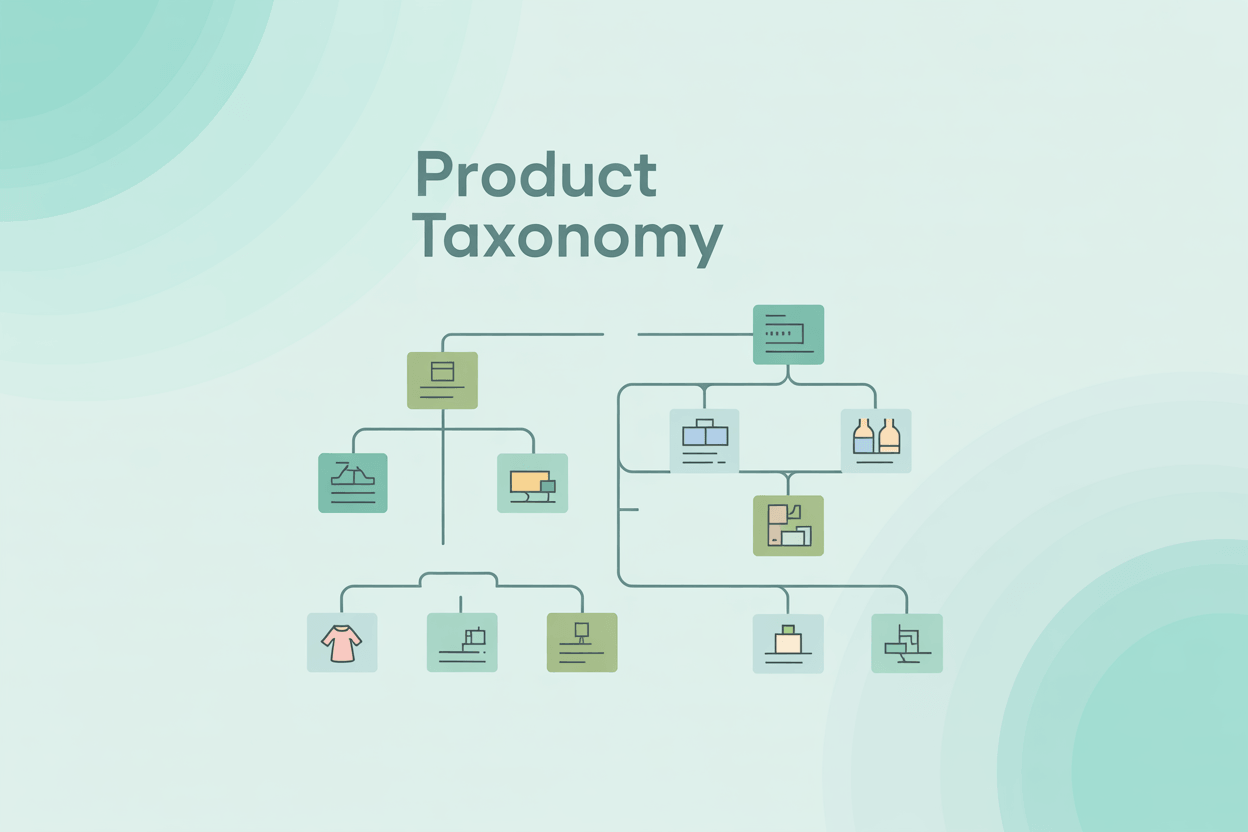
Your taxonomy is the hierarchical tree: parent categories, child categories, and the logical groupings that sit between them. A parent category like "Power Tools" groups multiple child categories like "Drills," "Impact Wrenches," and "Sanders." Attributes are the characteristics assigned to products within those categories, like voltage, material, or load capacity. Both matter, but they live at different levels of your product data model and require different decision-making processes.
A typical well-structured taxonomy for an industrial equipment manufacturer might look like this: Power Tools > Pneumatic Tools > Impact Wrenches. Each level narrows the product type. Attributes like drive size, torque range, and connector type then describe individual SKUs within Impact Wrenches. Mixing these layers, for example, creating a category called "High-Torque Impact Wrenches," collapses an attribute value into the structure. That seems harmless at first. Multiply it across a catalog of 40,000 SKUs and you end up with hundreds of semi-redundant leaf nodes that are nearly impossible to maintain.
How deep should your product taxonomy go
Three to four levels is the practical ceiling for most catalogs. Beyond that, users lose orientation and your data team spends significant time maintaining nodes that see almost no traffic.
A three-level tree works well for focused catalogs: broad category, product type, subtype. A fourth level is justified when product types are complex enough to warrant it, like safety equipment that breaks down by hazard type, then body zone, then certification standard. What rarely works is a fifth or sixth level added to accommodate edge cases or legacy SKU structures imported from an ERP. Those cases are better handled with attributes and filters.
The guiding question for every additional level is: does a buyer actually navigate here, or is this just internal organization logic?
If the answer is the latter, flatten it. Internal logic belongs in attributes, not in the hierarchy. Some catalogs with narrow product ranges actually work better with a flat taxonomy of two levels, where the top-level category connects directly to product types without intermediate groupings. The key is whether intermediate levels add real navigational value for the buyer, not whether they feel tidier on paper. Product variants, like sizes, colors, or configurations, should never become taxonomy nodes. They belong in the attribute layer.
Naming product taxonomy categories so buyers can use them
Category names should reflect how buyers describe products in search queries, not internal shorthand or industry jargon your team uses in warehouse operations.
In projects we implemented for distributors of electrical components, we often found categories labeled with codes or internal product family names that made sense to the procurement team but were invisible to buyers searching by application or standard. A category named "LV switchgear assemblies type B" does not match how a facilities manager searches. "Low-voltage distribution boards" does. The fix is not always a full restructure. Sometimes it is renaming existing nodes and adding synonyms as search aliases within your PIM.
Naming conventions to apply consistently:
- Use plural nouns for category names: "Circuit Breakers," not "Circuit Breaker."
- Avoid brand names in category labels unless you sell brand-specific product lines where the brand is the primary search term.
- Use the most common industry term, not the most precise technical term, unless your buyers are engineers who search by specification.
- Be consistent with capitalization and grammar across all levels of the tree.
Inconsistency in naming is the most common taxonomy problem we see in catalog audits, and it compounds fast. If "Safety Gloves" and "Protective Gloves" both exist as separate nodes, buyers and search engines will treat them as different things.
The relationship between taxonomy and SEO
Your category structure directly affects organic search performance. Each category node that resolves to a URL is a page that Google can crawl, index, and rank. A well-structured taxonomy creates a set of category pages with clear topical signals and clean breadcrumb trails. A bloated taxonomy with hundreds of thin leaf nodes creates crawl budget waste, keyword cannibalization, and duplicate content risks where parent and child category pages target nearly identical queries. Canonical tags can mitigate some of these issues, but they are a workaround for a structural problem, not a solution to it.
Baymard Institute research found that 33% of mobile sites fail to surface product categories as the top-level navigation items, which directly disrupts findability for users who arrive without a clear search intent and rely on category browsing to orient themselves.
For B2B catalogs specifically, category-level pages often capture mid-funnel search traffic. A buyer searching "pneumatic impact wrenches 1/2 inch drive" is looking for a category or filtered list, not a specific SKU. If your taxonomy does not create a URL structure that matches these queries, you lose that traffic before the visitor ever reaches a product page.
Category page content matters here too. A short descriptive paragraph on a category page, covering what the category includes and what specifications matter, improves rankings meaningfully and helps buyers confirm they are in the right place.
Category breadth and the role of faceted filtering
At the top level, aim for 7 to 12 categories. Below that, each parent node should have between 5 and 15 children. These are not hard limits but they reflect how buyers actually scan navigation menus and how search engines weight category depth.
When a parent node has only one or two children, the intermediate level is usually unnecessary. When it has 30 or more, buyers cannot scan it efficiently and the category probably needs restructuring into subcategories or relies more heavily on faceted filtering.
Faceted filtering and taxonomy serve related but distinct purposes. Taxonomy handles the primary navigational grouping. Faceted filters handle the variable attributes within a category, like size, material, standard, and price. The mistake is using taxonomy to do what filters should handle. When buyers need to narrow results by multiple overlapping criteria, that is a filtering problem, not a taxonomy problem. Keeping this separation also means your product taxonomy stays stable as product ranges grow, because new attribute values do not require new categories.
Attribute mapping and taxonomy alignment
Every category in your taxonomy should have a defined attribute set: the specific fields that apply to products in that category and no other. This is where the connection between taxonomy and PIM becomes concrete.
In AtroPIM, each category node can carry its own attribute group. When a product is assigned to a category, it inherits the relevant attributes automatically. This prevents the common problem of products missing key specification fields, which happens when attribute assignment is manual and inconsistent. For a manufacturer managing industrial components across dozens of product families, this structured inheritance is the difference between a clean data model and a catalog full of gaps.
The attribute set should be defined at the lowest applicable level. If all power tools share the same safety certifications fields, those belong at the "Power Tools" level. If torque specifications only apply to impact tools, those belong at the "Impact Tools" level. Assigning attributes too high in the hierarchy creates noise. Assigning them too low means they get duplicated across sibling categories. Either way, data completeness suffers, and incomplete product data is the single most common reason buyers abandon a B2B product page without converting.
Taxonomy governance: the part most companies skip
A product taxonomy built in one quarter can become a data maintenance problem within a year if no governance process exists. Products are added, categories multiply, and teams make local decisions that conflict with the original structure.
Governance does not need to be complex. It needs to define who can propose a new category or rename an existing one, what the approval process looks like before a change goes live, and how often the taxonomy gets audited for redundant or empty nodes. Those three things, documented and assigned to named owners, are enough to prevent the structural drift that breaks most product taxonomy implementations.
Our customers often come to us after running their catalogs for several years without this. They typically have category nodes with fewer than 5 products, duplicate nodes with slightly different names, and category names that no longer match current product offerings because the offering evolved but the structure did not.
The audit process is simple in a system like AtroPIM: filter categories by product count, flag nodes below a threshold, review against search analytics data, and merge or deprecate accordingly. Without a PIM, that audit is a manual exercise that almost never happens on schedule.
Taxonomy for multi-channel distribution
B2B manufacturers and distributors rarely publish their catalog in one place. An omnichannel product strategy means the same product data must be correctly classified across a webshop, ERP, distributor portals, and marketplaces like Amazon or industry-specific platforms that use their own taxonomy standards, including the GS1 Global Product Classification or eCl@ss.
The practical answer is to maintain one internal product taxonomy as the master data structure, the single source of truth for product categorization, then map it to external schemas as needed. Trying to build your internal taxonomy around GS1 or eCl@ss from the start almost always produces a structure that is too rigid for day-to-day product data management. The mapping layer handles the translation.
AtroPIM supports this with its channel management features. You define your internal taxonomy once, then configure category and attribute mappings per channel. When a product moves to a marketplace or a distributor feed, it carries the translated classification that channel expects, without touching the master structure.
Akeneo handles multi-channel distribution adequately for mid-market use cases but becomes expensive as channel count grows. Pimcore offers flexibility at the cost of implementation complexity. Salsify focuses on retail channels and works well for consumer goods but lacks depth for industrial B2B catalogs. AtroPIM's open-source model and modular architecture give manufacturers the flexibility to configure taxonomy logic and channel mappings without per-seat licensing constraints, which matters at scale.
Where taxonomy work actually lives
Spreadsheets work for catalogs under a few hundred SKUs. Beyond that, it becomes unmanageable. Spreadsheets cannot enforce hierarchy rules, do not support attribute inheritance, and have no change history. When two teams edit the same file, conflicts go undetected.
A PIM system is the right infrastructure for taxonomy at scale. It stores the category tree, enforces structural rules, connects categories to attribute sets, and tracks every change with a timestamp and user. For manufacturers or distributors managing thousands of SKUs across multiple languages and sales channels, the taxonomy lives in the PIM and the PIM feeds everything downstream.
That infrastructure pays off beyond the catalog itself. Supplier onboarding gets faster when new products arrive with the category mapping and attribute requirements already defined. Products slot into the right parent and child categories, inherit the correct attribute set, and are ready for review without a manual categorization step for every line item. Cross-sell and upsell logic also depends on clean taxonomy: when products are consistently categorized and their attributes are complete, reliable product relationship rules become possible: accessories that match a main product, compatible components, alternative specifications at a different price point. None of that works when categorization is inconsistent.
The question is not whether you need a PIM for taxonomy management. It is whether the pain of not having one has become visible yet.
Most companies reach that inflection point when their catalog grows past 2,000 to 3,000 active SKUs, or when a second sales channel requires a different product classification structure.
Getting the product taxonomy right before you scale is significantly cheaper than restructuring it afterward. The core structure, naming conventions, depth limits, attribute mapping logic, and governance process should all be defined before products are imported. A taxonomy migration after the fact, when thousands of SKUs are already assigned to an inconsistent structure, is one of the most time-consuming data cleanup projects a catalog team can face. Everything after a clean initial build is maintenance and iteration, which is manageable. Retrofitting a flat spreadsheet import into a governed hierarchy is not.