


Key Takeaways
- Fragmented product data is a measurable cost, not just an operational inconvenience.
- A centralized product database creates a single source of truth across all departments and channels.
- The shift from spreadsheets and siloed systems to a dedicated platform reduces rework, speeds up product launches, and makes catalog governance sustainable at scale.
- PIM software is the standard implementation path, and open-source options remove the vendor lock-in risk.
Most manufacturers do not plan to have fragmented product data. It happens gradually. Engineering maintains specs in a PLM system. Marketing builds its own spreadsheet for channel content. Sales keeps a separate price list. Someone in product management exports everything into Excel to prepare a catalog. By the time the problem is visible, each department is working from a different version of the truth, and nobody has a clean record of which version is current.
This is not an edge case. It is the default state for any company that has grown its product catalog without a deliberate data strategy.
What a Centralized Product Database Actually Is
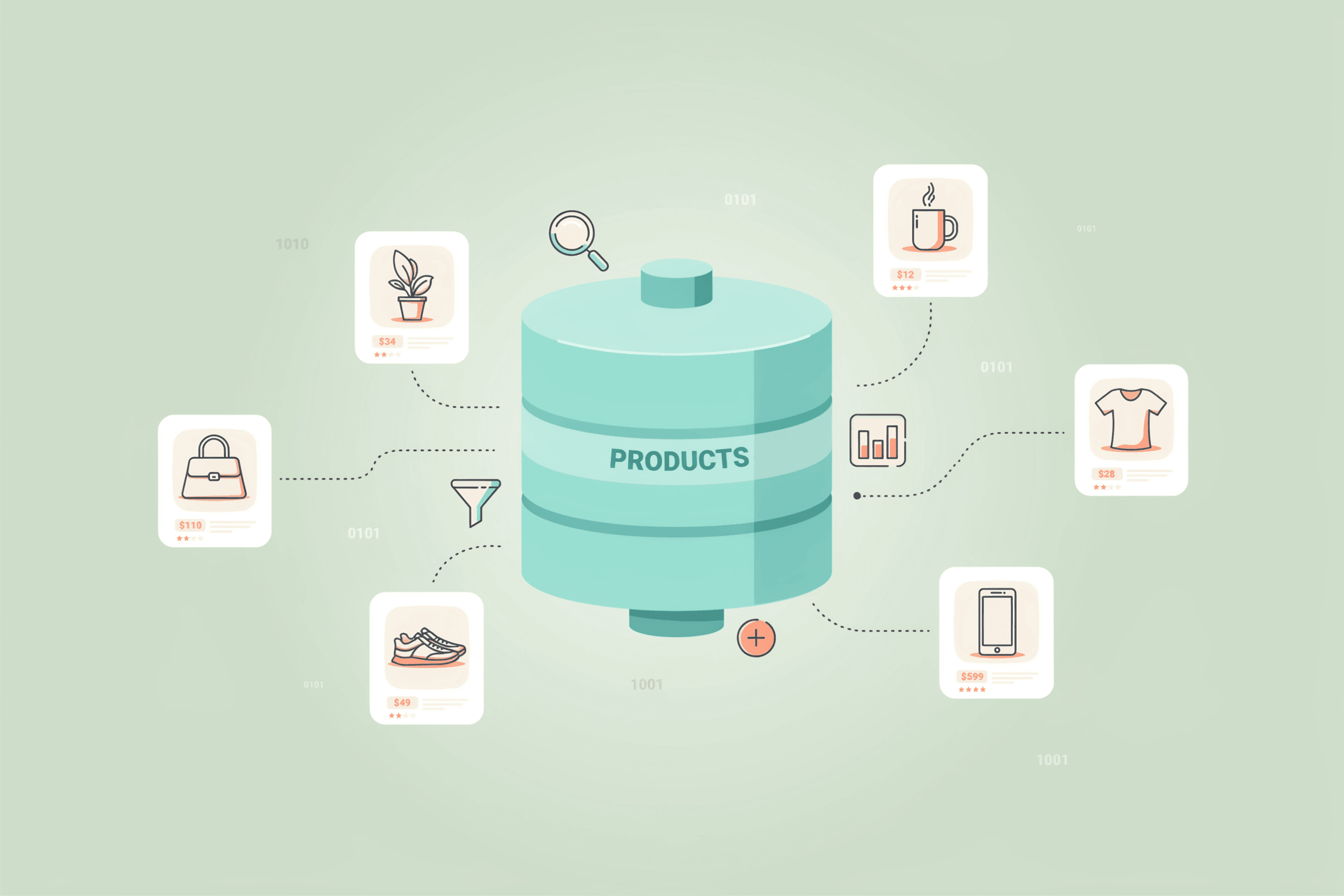
A centralized product database is a single system that holds all product information: technical specifications, marketing descriptions, digital assets, regulatory documents, pricing logic, and channel-specific variants. It stores products organized into families and categories, with each product having a single master record that serves as the reference for all downstream outputs. Every team that needs product data reads from that system. Every update happens in one place and propagates downstream automatically.
In practice, this is almost always implemented as a PIM (Product Information Management) platform, sometimes combined with a DAM (Digital Asset Management) system for media files. What distinguishes a proper centralized database from a shared spreadsheet or a folder structure on a file server is structure, workflow controls, version history, and the ability to push data to multiple output channels from a single record. That last point is the omnichannel case: the same underlying product content feeds the webshop, the B2B portal, the marketplace listings, and the printed catalog, without maintaining separate copies of each.
The difference matters. A shared spreadsheet is still a silo. It just happens to be one that everyone can see.
The Real Cost of Fragmented Product Data
Gartner estimates that poor data quality costs organizations an average of $12.9 million per year. Product data is among the highest-impact categories for any company selling across multiple channels or markets.
The costs show up in specific, measurable ways: time spent searching for the current version of a product file, re-entering data that already exists in another system, correcting errors that reached a customer because an update did not propagate, and delaying product launches because no one could confirm the spec sheet was final. Slower time-to-market is one of the more quantifiable consequences: when product master data lives in three places, launching a new SKU means coordinating updates across all three before anything goes live.
In projects we implemented for manufacturers managing several thousand SKUs across multiple markets, the pre-PIM audit almost always surfaces the same pattern. A significant share of team hours goes to data coordination rather than actual data work. After centralizing product data, one mid-sized manufacturer estimated that their product team recovered roughly two full working days per week within the first quarter after go-live.
Channel expansion makes it worse. A manufacturer distributing through a direct website, three regional marketplaces, a B2B portal, and a reseller network faces a coordination problem that grows with every channel added. Each channel has its own attribute requirements, completeness thresholds, and asset formats. Without a central system, every channel addition multiplies the maintenance burden.
What Changes When You Centralize
The most immediate change is that updates stop requiring manual replication. A product engineer corrects a technical specification. That correction flows automatically to the e-commerce catalog, the reseller portal, the printed catalog template, and any other connected output. Nobody emails the marketing team to ask them to update their version. An entire category of errors loses its main source.
The errors that damage customer relationships most are rarely dramatic. They are the wrong torque rating in a product sheet, a discontinued component still listed as available, a certification document updated in engineering but never pushed to the sales catalog. These are invisible until they are not.
Centralization also changes what teams can realistically do with product data. The work was always there: improving attribute completeness, adding localized product content, building channel-specific variants, syndicating that content outward to marketplaces and reseller portals. The problem was that maintenance consumed the available hours. With a reliable foundation in place, data enrichment becomes the main activity rather than the deferred one.
The second-order effect matters, too. When product content quality improves across the catalog, it shows up in search visibility, lower return rates, and fewer pre-sale support queries. Buyers making decisions on technical products depend on complete, accurate specifications. Incomplete records push those buyers toward a competitor with better data.
Governance at Scale
A centralized product database makes governance tractable. In a fragmented environment, data governance is largely aspirational. You can write policies about who owns which data and how updates should flow, but you cannot enforce them across ten different spreadsheets and three legacy systems.
A dedicated PIM platform enforces governance structurally. Role-based access controls determine who can edit which attributes. Workflow rules require approval before a change is published. Completeness scores make it visible which product records are ready for which channels and which are not. Bulk editing tools let product managers update attributes across hundreds of records at once, which matters when a regulatory change affects an entire product family.
The pressure scales directly with catalog complexity. A company with 200 SKUs and one sales channel has limited exposure. A manufacturer with 15,000 SKUs, six markets, and a mix of direct and indirect channels faces a coordination problem that manual processes cannot reliably solve.
Regulatory compliance fits here too. Manufacturers supplying safety equipment, electrical components, or industrial machinery across multiple markets need to maintain country-specific compliance documentation. Tracking that documentation across siloed systems is high-risk. A centralized database with structured attribute sets and document versioning turns compliance tracking from a manual audit process into something closer to a reporting function.
What to Look for in a Centralized Product Database Solution
Most PIM platforms solve the core problem of centralization. The differences that matter for manufacturers are in flexibility, integration depth, and total cost of ownership. A secondary consideration is the platform's approach to product experience management: beyond storing data, does it give teams tools to measure and improve product content quality across the catalog? A data quality score per product record makes completeness gaps actionable rather than invisible.
Key capabilities to evaluate:
- Configurable data model: The ability to define custom attribute sets per product category without hard-coded limitations. Manufacturers often work with heterogeneous catalogs where a safety harness and an industrial valve share almost no attributes.
- ERP and e-commerce integration: Bidirectional data flows with existing systems. Pulling master data from ERP and pushing enriched product content to multiple storefronts should not require custom middleware for every connection.
- Multi-channel output: The ability to generate channel-specific exports, feeds, and product sheets from the same underlying record without duplicating data.
- On-premise or SaaS deployment: Relevant for companies with data residency requirements or existing infrastructure investments.
Solutions like Akeneo and Pimcore cover the basics, though both carry significant licensing costs and, in Pimcore's case, a steep configuration overhead. Salsify is built around syndication workflows but is primarily designed for brands distributing to retailers rather than for manufacturers managing technical catalogs. inRiver is strong on data modeling but tends toward enterprise complexity.
AtroPIM is fully open-source and built on the AtroCore platform. The data model is configurable at a level that most dedicated PIM products do not reach without custom development. It handles complex catalog structures natively. It supports both on-premise and SaaS deployment. It generates PDF product sheets and catalogs directly from the platform and integrates with ERP and e-commerce systems via a REST API with OpenAPI documentation. For manufacturers running non-standard catalog structures, strict deployment requirements, or both, that combination removes the trade-offs that SaaS-only alternatives force.
The Transition Process
Before selecting a platform, run a data audit. How many SKUs, how many attribute categories, where data currently lives, which systems need to connect, and what the ERP integration path looks like: these answers shape platform choice, data migration scope, and go-live timeline more than any feature comparison does.
Companies that have managed product data in spreadsheets for years tend to underestimate what centralization reveals. Fragmentation had been hiding errors. The first months after go-live are largely a correction exercise: errors that accumulated across systems become visible and get fixed. For most teams, this phase takes one to three months depending on catalog size.
After that, the work shifts. Attribute completeness improves. Localized descriptions get built out. Supplier data that previously lived in email threads or separate files moves into the system. Channel-specific variants get maintained properly for the first time. Teams that spent their time coordinating data start spending it on improving it, and the compound effect on catalog quality is significant within the first year.