


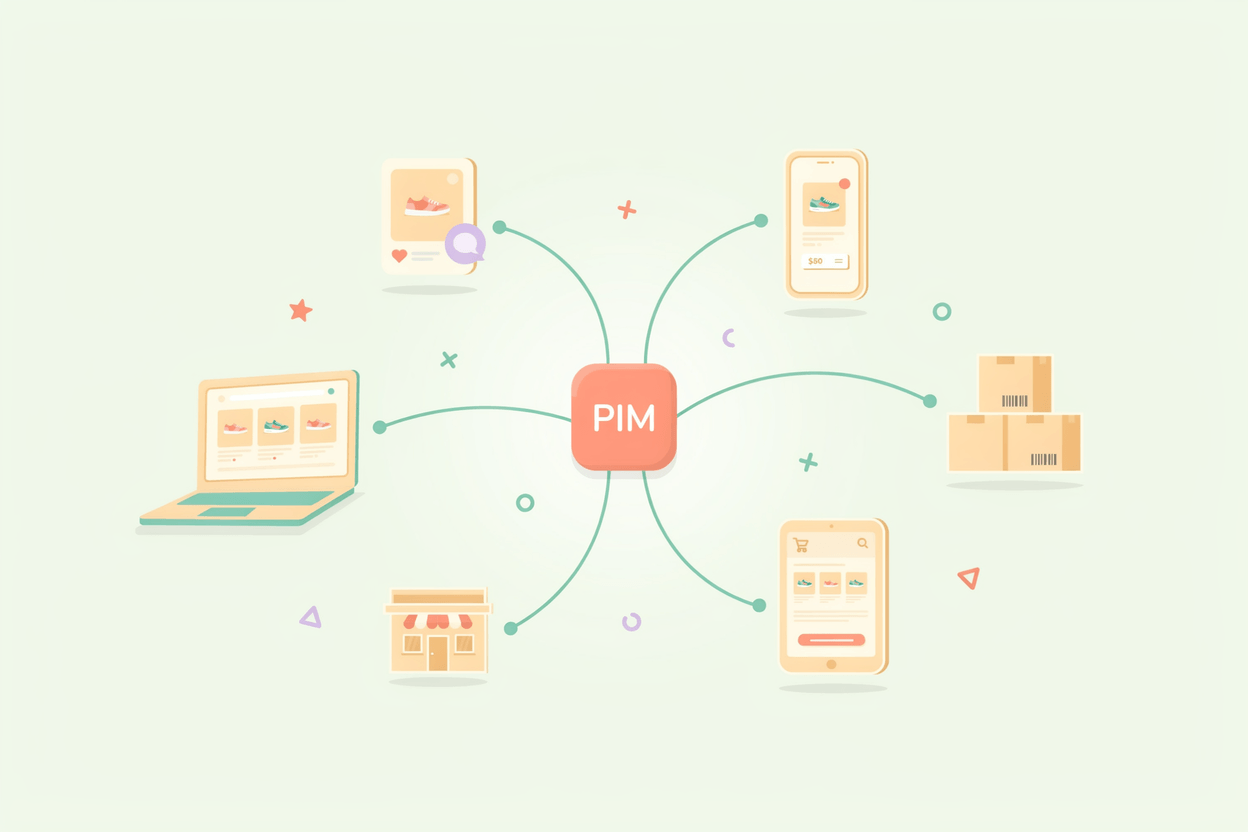
Omnichannel PIM, short for omnichannel Product Information Management, is the practice of centralizing all product data in a single platform and distributing it automatically across every sales channel: eCommerce sites, marketplaces, physical stores, and social commerce. For any brand running an omnichannel commerce strategy, it is the infrastructure that makes consistent product experiences possible at scale.
Today's customers don't think in channels. They browse a product on Instagram during their lunch break, check reviews on a marketplace app in the evening, and walk into a physical store the next morning expecting the sales associate to know exactly what they were looking at. More than 70% of consumers use multiple touchpoints during a single purchase journey, according to research covering 46,000 retail shoppers.
What Is Omnichannel PIM?
Product Information Management (PIM) is software that centralizes all product-related data: names, descriptions, technical specifications, images, pricing rules, certifications. Instead of product teams maintaining separate spreadsheets for the website, a different set of files for Amazon, and yet another for the print catalog, a PIM acts as the single source of truth from which all channels are fed.
An omnichannel PIM takes this further. It handles the full product content lifecycle: collection, enrichment, governance, and syndication, all from one platform. Write once, publish everywhere. A product description for a DTC eCommerce site can be long and detailed. The same product on a retailer portal might need a concise, attribute-heavy format. A mobile card requires a punchy headline and a thumbnail-optimized image. An omnichannel PIM manages all of these variants from one place, without manual duplication, automatically meeting each channel's specific requirements.
Multichannel means you have multiple channels. Omnichannel means those channels work as a unified system. The distinction matters because multichannel approaches leave channels siloed, each maintained separately, each diverging over time. Omnichannel PIM is what prevents that divergence.
Why Consistent Product Data Is a Customer Experience Problem
Inconsistent product information is a direct threat to revenue and brand trust. Research by Shotfarm found that 42% of consumers have returned an online purchase due to poor product content, and 25% have abandoned a cart for the same reason. Those aren't abstract numbers. They represent lost margin and damaged reputation, at scale.
The underlying cause is almost always the same: product data living in silos. Marketing manages the website copy. The logistics team maintains a separate database for warehouse purposes. The export team builds marketplace feeds manually. Every handoff is an opportunity for data to diverge. And in an omnichannel retail environment, divergence is visible to customers across every touchpoint of their journey.
In projects we've implemented for manufacturers in industrial and consumer goods, this pattern shows up consistently. Before centralizing product data, teams were managing up to a dozen separate product files across channels, with spec discrepancies between the website and marketplace listings causing a measurable share of returns. After connecting a PIM as the upstream source, product data syndication became automated, and return rates tied to product data errors dropped within the first quarter.
An omnichannel PIM eliminates these silos by establishing a single master record for each product. When a product attribute is updated, say a material change, a new certification, or a revised dimension, that change propagates automatically across every connected channel. Once, everywhere, immediately.
How Omnichannel PIM Powers Each Channel
eCommerce and DTC Websites
The website is typically the most content-rich channel, requiring long-form descriptions, multiple image angles, videos, comparison tables, and SEO-optimized copy. An omnichannel PIM lets content teams enrich product pages to this level of detail while maintaining the same core data that feeds leaner channels. Changes to pricing, availability, or specifications appear in real time without requiring a developer or a manual export. The result is a consistent product experience for every visitor, regardless of how they arrived.
Marketplaces (Amazon, eBay, Zalando, and Others)
Each marketplace has its own taxonomy, mandatory attribute fields, image size requirements, and content policies. Maintaining compliance manually across a dozen marketplaces for thousands of SKUs is not sustainable at scale. An omnichannel PIM with marketplace connectors automates this mapping, transforming the master product record into the precise format each marketplace requires and flagging missing attributes before submission. Product data syndication at this level, pushing accurate, channel-optimized content to multiple destinations simultaneously, is what separates brands that scale their catalog management efficiently from those that get stuck in manual exports. The business impact is real: campaigns using three or more coordinated channels achieve 287% higher purchase rates than single-channel campaigns, according to Omnisend's analysis of over 135,000 campaigns.
Physical Retail and Point of Sale
Brick-and-mortar still accounts for the majority of global retail sales, and product data accuracy matters just as much in-store as online. Shelf labels, POS systems, and in-store digital screens all pull from product data. When a PIM is connected to these systems, price updates and product changes flow through instantly. Think with Google data shows that omnichannel strategies contributed to around 80% of customer visits to physical stores, which means the quality of digital product data is directly driving foot traffic.
Print Catalogs and Sales Materials
Print is far from dead in B2B commerce and in industries like furniture, automotive parts, and fashion. An omnichannel PIM connected to print automation tools generates catalog-ready content directly from the product database, eliminating the version-control problems that come from managing print and digital content separately.
Social Commerce and Emerging Channels
Instagram, TikTok Shop, and Pinterest all require product feeds that are accurate, visually optimized, and regularly refreshed. An omnichannel PIM serves as the upstream source for these feeds, keeping social catalogs current without requiring a dedicated team to maintain each platform individually. As new channels emerge, shoppable video, voice commerce, AR, the same syndication infrastructure extends to cover them without a rebuild.
Data Quality, Localization, and AI in Omnichannel PIM
A PIM is only as valuable as the data inside it. Centralizing incomplete or inaccurate product information means distributing bad data more efficiently, which is worse than the status quo. That's why data governance is not a configuration step. It's a continuous practice that an omnichannel PIM has to support structurally.
Data quality covers three dimensions. Completeness means every product has all required attributes filled in for all active channels. A PIM defines channel-specific completeness rules, alerting teams when a product is missing an image for a marketplace listing or lacks a required certification. Consistency means attribute values are uniform across the catalog. Unit mismatches, inconsistent terminology, and formatting variations erode quality silently. A well-implemented PIM reduces manual data update time by up to 80%, freeing teams from the reconciliation work that creates these errors. Accuracy means the stored information reflects reality. A PIM enforces validation rules, flags outliers, and maintains audit trails so errors can be traced back to source.
Localization adds another layer of complexity that a manual process cannot handle. A product sold in the US needs descriptions in English, imperial measurements, and USD pricing. The same product for Germany needs German copy, metric units, and regional compliance text. An omnichannel PIM manages these localized variants from a single master record, with no parallel catalogs per region and no duplicated effort. Localization rules are configured once; syndication handles the rest.
AI is now accelerating all of this. Where content enrichment once required copywriters to manually produce descriptions for every product variant in every language, AI-powered PIM systems generate channel-adapted content at scale, translate with contextual accuracy, auto-tag images, and classify products into taxonomy structures automatically. AI-enhanced PIM implementations have been associated with up to a 30% reduction in product data errors, a 50% decrease in manual data entry time, and 99% consistency in product information across channels, contributing to a 15% rise in conversion rates for omnichannel retailers.
Beyond automation, AI shifts PIM from reactive to proactive. Rather than waiting for a data error to surface in a customer complaint or a failed listing, AI-enhanced systems identify patterns that predict quality issues before they reach the digital shelf.
Choosing the Right Omnichannel PIM
The right choice depends on catalog size, channel count, and internal technical capacity. For mid-market and enterprise companies with complex product data, international markets, or proprietary channel requirements, open-source platforms like AtroPIM offer fully customizable data models, API-first architecture, and the ability to build integrations for any channel without vendor lock-in. That flexibility is particularly valuable in niche verticals where off-the-shelf connectors don't cover the full distribution landscape. For companies with a more standardized channel mix, SaaS platforms offer faster time-to-value, though total cost of ownership rises steeply as complexity grows.
Regardless of platform, these capabilities should be non-negotiable:
- Channel-specific data modeling — different attribute requirements, validation rules, and output formats per channel without duplicating the master record.
- Native or API-based channel connectors — integrations with the platforms you sell on, not generic export/import cycles.
- Data governance and workflow management — structured approval processes for content enrichment and publication, with role-based access and audit trails.
- Localization support — the ability to manage language variants, regional compliance, and unit conversions from a single product record.
- Open architecture — API-first design that connects to existing ERP, DAM, eCommerce platform, and OMS without heavy custom development.
The Business Case
The ROI of an omnichannel PIM is felt across the business. Marketing spends less time correcting listings and more time on content enrichment that actually improves product experience. Operations shortens time-to-market from weeks to days when launching on a new channel. Companies with strong omnichannel customer engagement retain 89% of their customers, compared to 33% for those with weak cross-channel execution. Fewer returns, lower support volume, and faster channel launches compound over time into a meaningful cost advantage.
Richer, more consistent product content also converts better. Providing more accurate, complete, and consistent product information has been reported to increase conversion rates by 17 to 56%, according to Bluestone PIM's analysis of their customer implementations.
The number of channels, touchpoints, and formats will only grow. Brands that manage product data centrally and distribute it intelligently will expand into new channels rapidly. Product information is now a competitive asset, and the PIM is the system that determines how well it's used.