


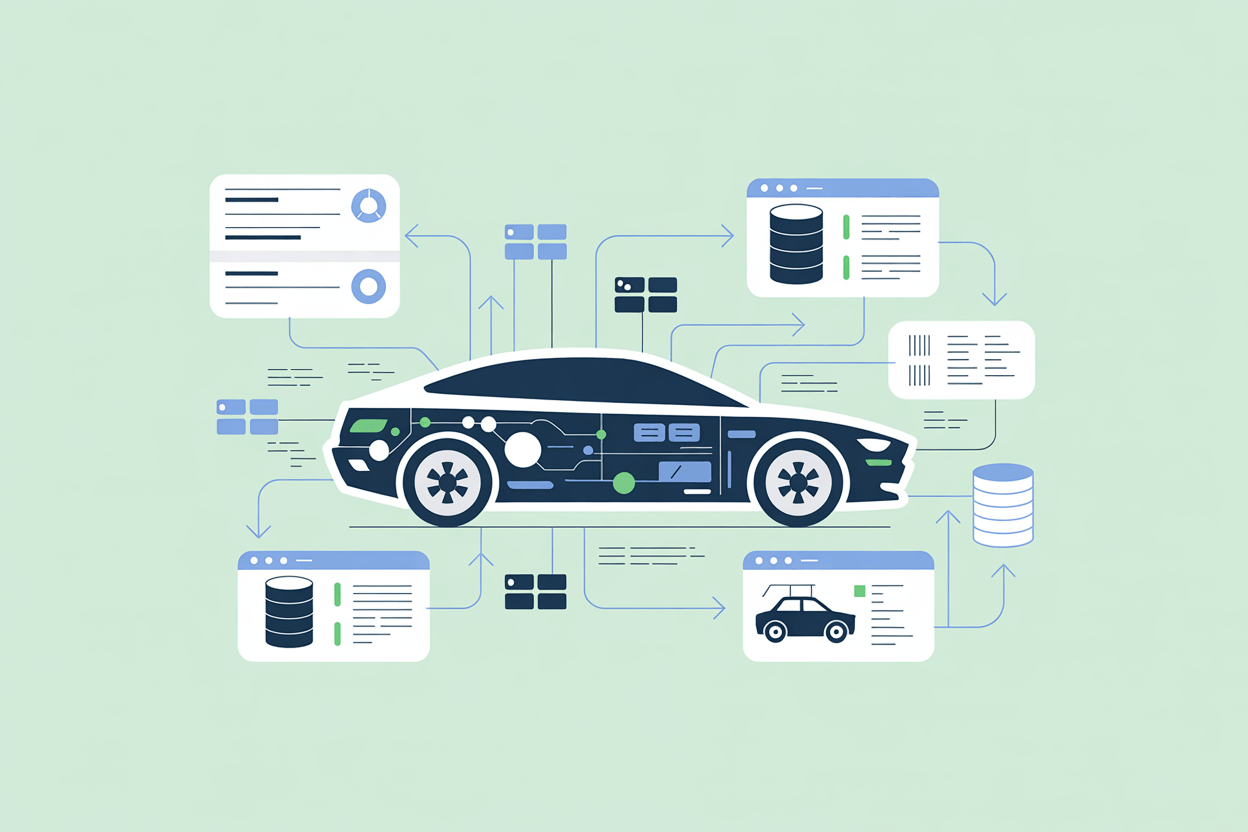
A single automotive parts manufacturer might maintain hundreds of thousands of active SKUs. Each part carries fitment data, technical specifications, regulatory attributes, images, CAD drawings, and pricing for multiple markets. Distributors expect it in ACES/PIES format. E-commerce platforms need it structured differently. ERP systems hold half of it, spreadsheets hold the rest, and the marketing team has its own version.
This is the data problem that automotive PIM software exists to solve.
What Is Automotive PIM Software?
Product Information Management (PIM) software is a system that centralizes, enriches, and distributes product data across sales channels and trading partners. In the automotive context, it handles the specific demands of parts catalog management: vehicle fitment data, OEM and aftermarket cross-references, industry data standards, multi-channel publishing, and regulatory compliance.
What makes automotive PIM structurally different from PIM in other industries is the fitment dimension. In consumer electronics or fashion, a product either exists or it doesn't. In automotive, every part exists in relation to a universe of vehicle configurations, and that relationship has to be explicitly modeled, validated against industry databases, and kept current as new vehicles enter the market and old ones retire. Generic PIM platforms are built around product attributes. Automotive PIM has to be built around product-to-vehicle relationships first, with attributes layered on top.
The term covers a range of use cases. OEM component manufacturers use PIM to govern technical specifications and supply structured data to downstream partners. Aftermarket parts suppliers use it to manage vehicle application data and syndicate product content to distributors, retailers, and e-commerce platforms. Distributors use it to consolidate catalog data from hundreds of brands and make it searchable and compliant for their own channels. The underlying data problems are similar across all three groups, though the workflows differ.
Why Automotive Parts Data Is Different
Most industries deal with product attributes: dimensions, materials, colors, and weights. Automotive adds a layer that has no equivalent elsewhere: fitment.
Every auto part must be matched to a specific combination of year, make, model, submodel, engine type, and trim. A brake caliper might fit 340 vehicle configurations. A filter might fit 1,200. Get it wrong, and the customer installs an incompatible part, files a return, and leaves a negative review. Get it right consistently, across a parts catalog of 500,000 SKUs, and you have a competitive advantage that is hard to replicate.
The Auto Care Association maintains the standards for this: ACES (Aftermarket Catalog Exchange Standard) for vehicle fitment data and PIES (Product Information Exchange Standard) for product attributes, digital assets, and pricing. For European markets, TecDoc serves a parallel function, providing a standardized data pool used by parts manufacturers and workshops across more than 140 countries. These standards are not optional for companies selling into major markets. Retailers, distributors, and e-commerce platforms require compliant data submissions as a condition of listing. Access to the official ACES/PIES databases ranges from $1,050 to $10,868 annually, depending on company size (source: Scube Marketing). That cost is the floor. The real investment is building the internal capability to produce and maintain compliant data at scale.
Beyond fitment, automotive product data carries additional complexity. Parts get superseded: an OEM replaces a part number, and all downstream catalog entries need updating. The same component often carries different part numbers under OEM and aftermarket identifiers, and cross-referencing between them has to be explicitly maintained. Hazmat flags, REACH compliance, country-of-origin declarations, and multilingual descriptions add further layers. For manufacturers selling across Europe, Asia, and North America simultaneously, the data management burden multiplies quickly.
Where Parts Data Breaks Down
In projects we implemented for automotive parts manufacturers, the most common starting point is a fragmented data landscape. Technical attributes live in the ERP. Marketing copy lives in spreadsheets or a shared drive. Images are stored on local machines or a generic file server. Vehicle fitment data is maintained manually in a separate tool, often by a single person who understands the ACES schema.
We worked with one filter manufacturer whose ACES fitment data was maintained by one engineer in a custom spreadsheet built over several years. When that person left, the company had no documented process and no tool that could validate the existing vehicle application records.
Onboarding to a new distributor partner — a process that should have taken two weeks — took four months while the team rebuilt the dataset from scratch.
That is an extreme case, but the underlying fragility is common. Parts compatibility data concentrated in one person's hands, in a format no standard tool can read or validate, is a structural risk that most manufacturers don't recognise until something breaks.
The downstream consequences are predictable: return spikes from fitment errors, slow distributor onboarding, parts catalog localization that requires a manual rebuild for each new market, and product launches delayed because content is not ready when parts are. These are structural outcomes of managing complex product data without a dedicated system.
What an Automotive PIM System Handles
An automotive PIM system acts as the single source of truth for all product content. It receives data from ERP and PLM systems, enriches it through internal workflows, and publishes it to downstream channels in the formats each channel requires.
The most automotive-specific function is fitment data management. Rather than storing vehicle application data in spreadsheets or legacy catalog tools, a PIM holds ACES-compliant fitment records in a structured relational model. VCdb lookups are built into the interface, qualifiers are managed explicitly, and part supersessions are tracked so that when a part number changes, every affected fitment record updates with it. Validation happens before data leaves the system, not after a distributor rejects a submission.
Parts catalog management at scale requires structured attribute handling. Automotive catalogs typically have deep category trees with significantly different attribute requirements at each level. A suspension component carries different mandatory fields than a filtration product or an electrical part. A PIM with conditional attribute logic enforces completeness per category, flags missing required fields, and handles attribute inheritance across product families — so that shared specifications do not need to be entered thousands of times across a product line. OEM part number cross-references, supersession chains, and compatibility notes all attach to the same part record, keeping the catalog internally consistent.
Linking assets to parts is where many manufacturers still rely on folder conventions and manual cross-referencing. Technical drawings, exploded diagrams, installation instructions, and multi-angle product images need to be attached to specific part records, not stored in a separate system with a loose reference. When a part revision changes a torque specification, the updated installation instruction needs to follow the part through every downstream channel. A PIM with integrated DAM handles those relationships structurally rather than through manual coordination.
Product data syndication is where the operational effort pays off visibly. TecDoc, ACES/PIES repositories, Amazon Automotive, dealer portals, distributor EDI feeds, and branded e-commerce platforms each require different data formats, completeness thresholds, and update schedules. Without a PIM, each channel accumulates its own version of the parts data, which diverges over time. A PIM manages channel-specific output transformations centrally, so a product update propagates correctly to every output. Standardized PIES data alone cuts catalog setup time by 30 to 50 percent when launching products on new platforms (source: Scube Marketing) — a figure that compounds quickly when onboarding multiple distribution partners in the same year.
Print output is a function that gets overlooked in PIM evaluations, but matters significantly for manufacturers with dealer networks. Catalogs for trade shows, seasonal dealer mailings, and OEM bid documentation have historically required manual builds from exported data, which creates version drift the moment any product detail changes. Native PDF generation from live PIM data eliminates that process entirely.
According to Fortune Business Insights, citing Net Solutions' State of B2B Commerce report, 76.7% of enterprises are aiming to adopt or upgrade PIM software to manage multichannel product data. The automotive and manufacturing sectors are among the fastest-moving, driven by distributor data mandates and growing direct-to-dealer digital channels.
What to Look For in Automotive PIM Software
Not all PIM platforms handle automotive use cases well. The two failure modes we see most often are platforms that cannot handle the data model complexity, and platforms that handle the data model but cannot produce the output formats the industry actually uses.
Configurable data models are the first thing to verify. Automotive parts catalogs do not fit generic product schemas. The platform needs to support custom entity types, attribute groups with conditional logic, and relationship types that go beyond basic parent-child hierarchies. Vehicle fitment data in particular requires relational structures, linking parts to vehicle configurations through explicit junction entities, with qualifier data attached, that most catalog-oriented PIM tools handle poorly or not at all. Before committing, ask vendors specifically how they model fitment relationships and test with a realistic sample of your catalog.
ERP and PLM integration matters because parts data originates in engineering and operations systems. A PIM that cannot receive structured data from SAP, Microsoft Dynamics, Odoo, or your PLM forces manual re-entry and recreates the same fragmentation problem the PIM was meant to solve. Integration should be bidirectional where needed: pricing and inventory come from ERP, enriched content flows back or out to commerce channels and distributor networks.
ACES/PIES output support should be verified in concrete terms, not accepted as a checkbox. The platform should be able to map internal fitment records to valid ACES XML, validate submissions against current VCdb and PCdb versions, and export PIES with all required segments populated, including hazmat and packaging data. Some PIM vendors offer automotive accelerators or connectors that handle this mapping. Others treat ACES/PIES as a custom integration project billed separately. The difference matters at budget time.
Scalability is a forward-looking criterion. A filter manufacturer with 80,000 SKUs today may double that range within three years as it expands into new vehicle segments or acquires a competing product line. The platform needs to handle that growth without performance degradation or architectural rework. And as regulatory data requirements grow, the data model needs to absorb new attribute categories without a rebuild.
AtroPIM is worth evaluating for manufacturers and distributors who need deep configurability without vendor lock-in. Built on the AtroCore platform, it supports custom entity types, complex attribute hierarchies, and explicit relationship management suited to automotive fitment data structures. It integrates with ERP systems, including SAP and Microsoft Dynamics 365, generates PDF product sheets and catalogs directly from live product data, and includes a built-in DAM as part of the core platform. It is open source, deployable on-premise or as SaaS, with modular paid extensions for additional capabilities. The REST API is documented per OpenAPI standards per instance, which matters for teams building custom integrations with TecDoc, dealer portals, or aftermarket marketplaces. The start-small-and-grow model makes it viable for mid-sized parts manufacturers who do not want to pay for a full-scale enterprise platform from day one.
Regulatory Data and What's Coming
One area gaining urgency in automotive is the EU Digital Product Passport. The DPP requires manufacturers selling into the EU to disclose material composition, sourcing, repairability, and environmental impact data at the component level. Battery regulations already being implemented. Broader automotive component categories are expected to follow as the EU's Ecodesign for Sustainable Products Regulation expands its scope.
What this means in practice: a brake pad manufacturer selling into European markets will need to track and publish material data, chemical composition, recyclability information, and supply chain provenance at the individual part level. That data does not currently live in most PIM systems because it has not been required. But it needs to live somewhere structured, versioned, and auditable. A PIM is the natural place for it, provided the platform supports extensible data models that can absorb new attribute categories as regulations evolve.
As Inriver notes in their 2026 PIM trends analysis, PIM platforms are moving from content hubs to governance engines, with version-controlled product attributes and full audit trails becoming compliance requirements rather than optional features. A rigid PIM that cannot accommodate new data fields without vendor customization becomes a liability as DPP obligations expand. This is worth factoring into platform selection now, before regulatory deadlines make it urgent.
For automotive manufacturers already managing complex attribute sets across thousands of SKUs, adding DPP data fields to an existing, well-structured PIM is a manageable extension. Doing it without a PIM, or with a PIM that requires custom development for every new data category, is significantly more expensive.
Choosing the Right Moment to Act
Most manufacturers we speak with know their product data situation is unsustainable. The question is usually when to fix it, not whether.
The answer is almost always: before the next major channel expansion, before a distributor mandates ACES/PIES compliance as a condition of continued listing, or before a regulatory deadline concentrates the cost of inaction. Implementing a PIM mid-crisis, with a return spike in progress, a distributor threatening to delist, or a DPP audit underway, is significantly harder than implementing during a period of normal operations.
A PIM does not make parts data easy. It makes the work of getting it right something you do once and maintain, rather than something every channel forces you to repeat from scratch.