


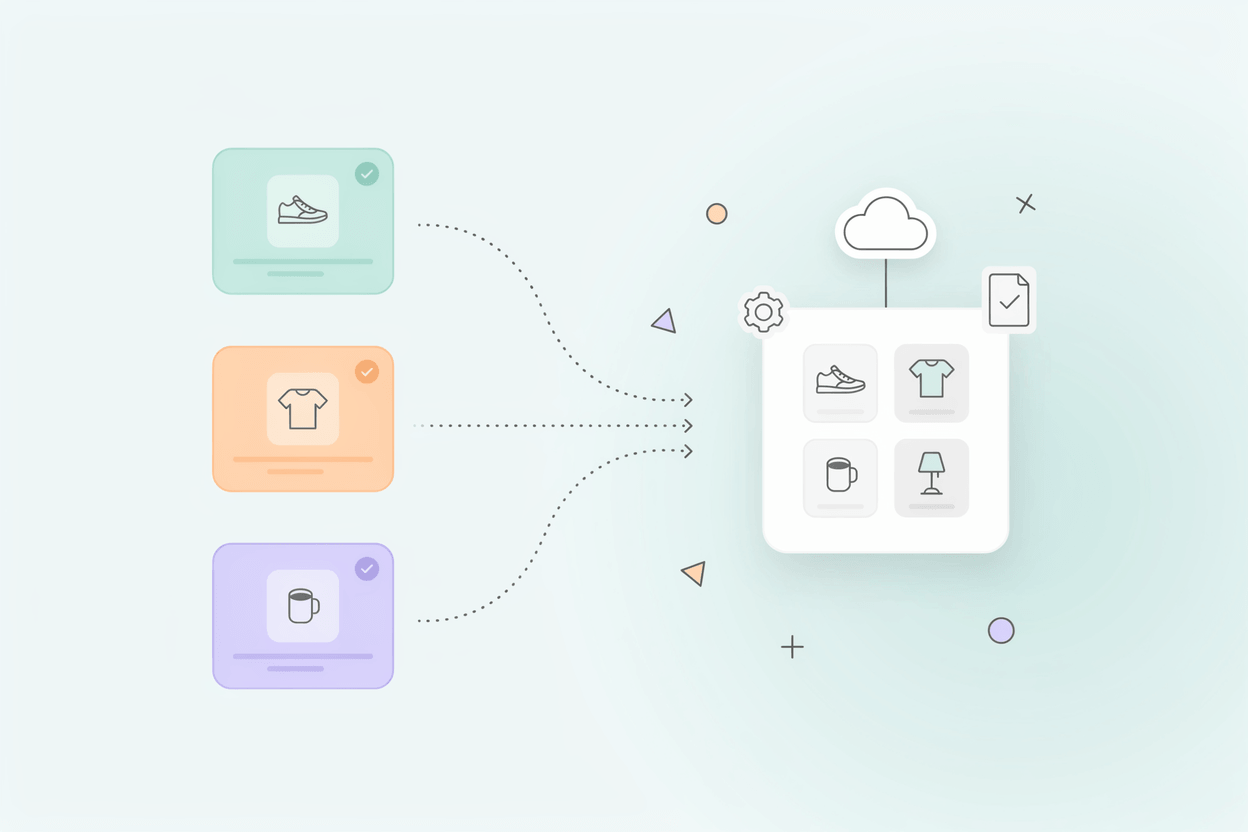
Bringing a new vendor into your systems sounds simple. Collect some data, set up a record, start buying. It rarely goes that way. Product data shows up in a dozen formats, half the fields are empty, and someone burns a week cleaning a spreadsheet before a single item goes live.
PIM supplier onboarding is the part of that process that handles product information. This article covers what it is, where it breaks, and the traps that bite after you think you've fixed it. Throughout, "vendor" means a supplier, a company you buy from.
What PIM Supplier Onboarding Means
Supplier onboarding, also called vendor onboarding, is the full process of setting up a new vendor so you can trade with them. It touches finance, legal, IT, and procurement. It covers banking details, contracts, compliance checks, and product data.
PIM supplier onboarding is the product data slice of that work. A PIM (Product Information Management) system is where you store, enrich, and publish product data. Supplier onboarding inside a PIM means getting a vendor's product information into your system in a structured, consistent, usable state.
That usually covers:
- Product identifiers like SKUs, GTINs, and manufacturer part numbers
- Attributes such as dimensions, materials, technical specs, and compliance data
- Media like images, datasheets, and manuals
- Category and classification data, so items land in the right place
The aim is a clean feed of vendor product data your teams and sales channels can trust.
Why It Matters
Bad supplier data doesn't arrive later. It arrives at onboarding, the moment a vendor's information first enters your systems. And data is at its worst right at creation. In research by Tadhg Nagle, Thomas Redman, and David Sammon, 47% of newly created records carried at least one critical error, the kind that causes problems downstream.
Almost half of new records are wrong from the start.
Small error rates don't stay small. The same researchers described a company whose customer data was only about 4% wrong. That thin error rate still worked out to roughly 570 lost sales opportunities a year, on the order of a million euros. A supplier catalog with a handful of bad specs behaves the same way. The errors sit quietly until they surface as returns, stockouts, or a wrong product on a live page.
You'll also see per-supplier onboarding costs quoted in the tens of thousands. Treat those as directional. They come from vendor estimates, not audited studies. The reliable signal is simpler: manual onboarding is slow and error-prone, and the errors get expensive to unwind once they've spread through your channels and your ERP.
Where Onboarding Breaks
Our customers turn to us with the same handful of problems. They existed long before any software entered the picture.
The first is format chaos. Vendor A sends an Excel file. Vendor B sends a PDF catalog. Vendor C sends a link to a portal with its own field names. Someone maps all of it to your structure by hand.
The second is missing and inconsistent data. A field that's mandatory for you is optional for the vendor. Units differ. One supplier writes "cm", another writes "centimeters", a third writes nothing at all.
Then there's no validation. Errors slip through because nobody checks the data against rules until a customer complains about a wrong spec.
The fourth is duplication. The same vendor appears twice under slightly different names, and now two master records fight each other. This is the core of vendor master data management: keeping one accurate, current view of each supplier and what they sell.
For a manufacturer sourcing components from hundreds of suppliers, these problems compound. Each new vendor adds more manual cleanup and more risk of a bad record reaching production.
The Failure Modes Most People Miss
Define your requirements, use templates, validate at entry, deduplicate, automate. That's the standard playbook, and it's correct. Most teams run their PIM supplier onboarding on it and still get burned, because a few problems only show up after onboarding looks solved. These are the ones worth naming.
Required-field validation gets gamed.
Tell a supplier a field is mandatory, and some will fill it with whatever passes the check. "N/A", "0", a single dot, "see datasheet". Your completeness dashboard turns green while the data underneath is useless. A presence check, meaning "is this field empty," is not validation. You need value-level rules per attribute: a type, a range, a list of allowed values, a pattern for part numbers. Then the odd manual spot-check to catch what the rules don't. The green dashboard is the trap.
Suppliers change their file format without telling you.
Mapping gets treated as a one-time setup. Then next month's file has a renamed column, an extra column, or two columns swapped, and a naive import loads the wrong values into correctly named fields. Nobody notices until a customer does. Compare each incoming file against the agreed structure and fail loudly on a mismatch, rather than trusting that last month's mapping still holds.
Locale and encoding corrupt data silently.
A German supplier writes "3,5" and means 3.5, not 35. A US-configured import reads it as thirty-five, and now a product carries a dimension that's off by a factor of ten. Encoding mismatches turn characters like "Ø" and "µ" into garbage inside technical specs. Set the number format and character encoding per supplier feed, and eyeball a few numeric fields by hand after the first import. This one is almost invisible until it isn't.
Nobody decided who owns which attribute.
Your data and the supplier's data will disagree. When they do, which one wins? If you never set that rule per attribute, every re-import overwrites your enrichments and your team redoes work it already finished. Most complaints that "the system keeps losing our edits" are a missing ownership policy, not a bug. A workable split: the supplier owns physical specs and identifiers, you own category, pricing, and marketing copy.
The real cost is updates, not the first load.
Everyone budgets the initial import. The recurring expense is the stream of price and specification changes over the vendor's life. Design onboarding as a one-off and you pay the full onboarding cost again every time a supplier sends a fresh catalog. Design for deltas from the start, so an update touches only what changed.
One more that shapes all of these: the pain isn't spread evenly across attributes. Name, SKU, and price map in minutes. The hours go into the category-specific technical and compliance attributes, things like voltage ratings, thread pitch, REACH and RoHS declarations, and hazardous-material flags. They differ by product family and are exactly where suppliers are least consistent. A generic global template doesn't help here. Templates built per category do. Onboarding a fastener supplier and a lighting supplier are not the same job, and treating them as one is why a "quick" onboarding turns into three weeks.
When PIM Supplier Onboarding Needs Dedicated Software
Small catalogs and a handful of suppliers can run on spreadsheets for a while. The math changes as you grow. Once onboarding eats hours every week and errors start reaching customers, a dedicated tool tends to pay for itself.
Signs it's time:
- You onboard vendors often and each one takes days of cleanup
- Product data arrives in many incompatible formats
- Errors reach your website, catalog, or ERP more than occasionally
- Nobody can say which vendor record is the correct one
A PIM system built for supplier onboarding gives you per-category templates, value-level validation, deduplication, and one place to enrich and publish vendor product data. Some, including open-source options like AtroPIM, let you model your own data structure and import workflows to match how your suppliers actually send data, rather than forcing your vendors into a fixed schema. That flexibility matters most for the category-specific attributes where the generic tools fall short.
The tool isn't the point. The outcome is: clean, consistent supplier product data that reaches your channels without a week of manual work each time.
What Good Looks Like
A vendor sends data in your template. The system validates the values on import, not just their presence. It flags the file if the structure drifted from what you agreed. Clean records land in one master profile, with clear rules for which attributes the supplier owns and which you do. The product goes live with correct specs, images, and classification. The next supplier follows the same path, and the next update touches only what changed.
Get that flow right, and PIM supplier onboarding stops being a bottleneck. It becomes a repeatable process that scales with the number of suppliers instead of straining against it.