


Key takeaways
- The PPWR legislation has applied since 12 August 2026. Packaging newly placed on the EU market needs technical documentation, an EU declaration of conformity, and producer identification on the pack.
- Most PPWR obligations are data obligations. Component weights, materials, substance declarations, and per-country registration numbers must exist per SKU and reach ERP, shops, and marketplaces in a consistent form.
- Several implementing acts arrived late, so some application dates linked to them will move. The proposed suspension of the authorised representative duty for EU producers is still not law.
- A PIM that models packaging as its own entity, linked to products and versioned over time, removes most of the spreadsheet work behind EPR reports and marketplace checks.
The EU's PPWR legislation, the Packaging and Packaging Waste Regulation (Regulation (EU) 2025/40), replaced Directive 94/62/EC. It is a regulation, so it applies directly in all 27 member states without national transposition. Its recitals state that 40% of plastics and 50% of paper used in the EU go into packaging, and that packaging makes up 36% of municipal solid waste. Eurostat counted 79.7 million tonnes of packaging waste in 2023, or 177.8 kg per inhabitant.
For a compliance lead, the legal text is the easy part. The hard part is that the facts needed to prove compliance sit in five or six systems that were never designed to agree with each other.
What The PPWR Legislation Requires Now And Later
The PPWR entered into force on 11 February 2025 and has generally applied since 12 August 2026. There is no grace period for packaging placed on the market after that date, even if it was produced earlier. Packaging already placed on the market before 12 August 2026 can be sold off.
These obligations already apply:
- Substance rules. The sum of lead, cadmium, mercury and hexavalent chromium stays capped at 100 mg/kg. Food-contact packaging may not contain PFAS at or above 25 ppb for any single PFAS, 250 ppb for the sum of PFAS measured by targeted analysis, or 50 ppm for total PFAS including polymeric PFAS.
- Conformity. Manufacturers must run a conformity assessment, keep technical documentation, and issue an EU declaration of conformity before placing packaging on the market. Documentation is kept for 5 years for single-use packaging and 10 years for reusable packaging.
- Identification. Packaging must carry the manufacturer's name, registered trade name or trade mark and postal address, plus a type, batch or serial number. For packaging manufactured before 12 August 2026, this information can go into accompanying documents.
- Traceability. Economic operators must name the suppliers and customers they exchanged packaging with, on request, for the same 5 or 10 years.
- EPR. Producers register in each member state where they first make packaging available. Distance sellers need an authorised representative for EPR in each destination state where the law requires one (Article 45). Online platforms must collect proof of registration before letting a producer sell to consumers.
Later deadlines change product design and, with it, the data you need to hold:
| Date | Requirement |
|---|---|
| 12 August 2028, or 24 months after the implementing act | Harmonised material composition label on packaging |
| 1 January 2030 | Packaging must reach recyclability grade A, B or C (C means at least 70%) |
| 1 January 2030, or 3 years after the calculation method act | Minimum recycled content in the plastic part of packaging, from 10% to 35% depending on type |
| 1 January 2030 | Maximum space ratio of 50% for grouped, transport and e-commerce packaging; weight and volume minimised |
| 1 January 2030 | Reuse target of 40% for transport packaging; restrictions on listed single-use formats |
| 2035 | Packaging must be recyclable at scale |
| 2038 | Grade C packaging no longer counts as recyclable |
| 2040 | Higher recycled content targets, up to 65% for single-use plastic beverage bottles |
EPR fees will also be modulated by recyclability grade. So the grade becomes a cost driver in your ERP, years before it becomes a market access condition.
Where The PPWR Legislation Stands This Autumn
The Commission published its formal guidance notice, C(2026)3702, in June. It updated its PPWR FAQ on 3 August 2026 with a section on enforcement right after the application date. The Commission's line is that enforcement should not disrupt trade flows or supply chains. The guidance also states that only one manufacturer exists at EU level for each packaging or packaged product, however long the supply chain.
The Commission's soft start on enforcement has no legal force. National authorities can still act, and marketplaces already do.
The secondary legislation is behind schedule. The implementing act on a common format for producer registers was due in February 2026. Market participants reported that a draft only appeared in August and drew thousands of comments. The labelling act slipped too. This matters because several PPWR dates are written as "a fixed date or X months after the act, whichever is later". A late act moves the deadline. So plan against the legal mechanism, and recheck the dates each quarter instead of copying them from a slide made in 2025.
National regimes are switching over at different speeds. Germany replaced its VerpackG with the VerpackDG on 12 August 2026. Existing take-back system contracts there remain valid only until 31 December 2026 at the latest, so many producers face a re-contracting deadline this quarter.
The authorised representative rule is the most confusing open point. In December 2025, the Commission proposed (COM(2025) 982) to suspend Article 45(3) until 1 January 2035 for producers established in the EU. The European Parliament rapporteur's draft in May 2026 narrowed the suspension to micro and small enterprises. Reports from June 2026 said Council talks had stalled over member state objections. Until something is adopted, the duty applies. And producers outside the EU were never covered by the proposal.
Marketplaces turned the EPR rules into a listing gate. They ask for a registration number per country of sale and suppress listings without one. Each platform implements this differently. Bol, for example, takes PPWR responsibility for the bol-branded shipping packaging it adds in its own fulfilment service, while the seller still answers for the product packaging. Multichannel sellers therefore manage different evidence for different channels.
PPWR Is A Data Problem Spread Across Systems
Every PPWR obligation reduces to a question about data. Which components does this SKU's packaging have? What material and weight is each one? Which supplier declared the PFAS status, and when? Who is the producer in Spain for this order? Where was it shipped, and how many units?
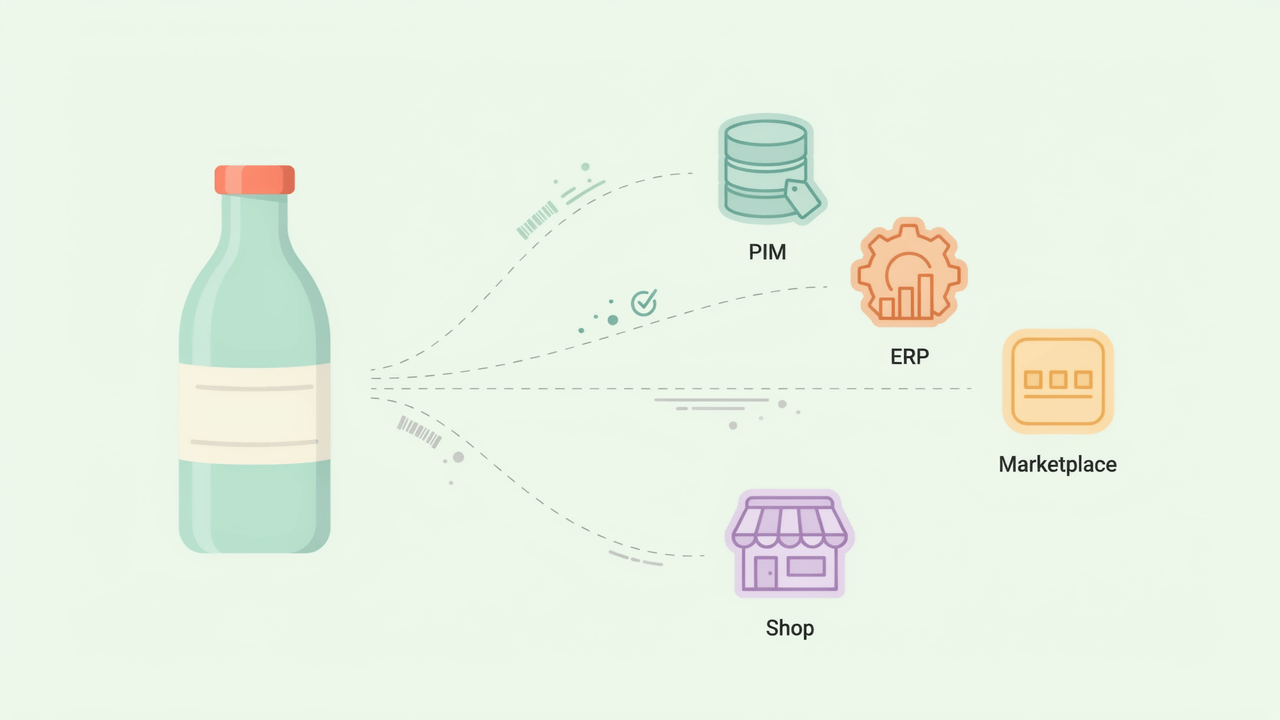
No single system answers all of these. Here is how the questions are distributed in a typical manufacturer's stack.
PIM: The Specification Of Each Packaging
The PIM is the natural home for packaging master data, because it already holds the product, its variants, and the attributes that go out to channels. For PPWR, the product record needs a packaging structure:
A product has one or more packaging levels: sales, grouped, and transport packaging. Each level consists of components, such as a bottle, a cap, a label, a sleeve, and an outer box. Each component has a material, a weight, colour or additives that affect sorting, a recycled content share, a recyclability grade once the delegated acts exist, and substance declarations from the supplier.
Two details decide whether this model survives contact with reality. First, packaging is many-to-many. One 250 ml PET bottle is used by forty SKUs, so it must exist once and be linked, or a weight change has to be made forty times. Second, packaging changes over time. A supplier switches to a lighter bottle in March. Your Q1 EPR report must use the old weight and Q2 the new one. Without valid-from and valid-to dates on the link, the report is wrong in one of the two quarters.
The PIM also holds the links to the declaration of conformity and the technical documentation per packaging type, and the localised texts that later feed the harmonised label and any QR code content.
ERP: Quantities, Countries And Money
The ERP knows what was sold, to whom, and where it was delivered. EPR reporting multiplies units placed on the market per member state by the component weight per material. The ERP has the first factor and rarely the second. Most reporting errors we see come from this join: sales by SKU and ship-to country on one side, packaging weights by SKU and date on the other.
The ERP also holds purchasing data for packaging materials, the producer role per legal entity, take-back scheme contracts, and EPR fees as cost. From 2030, fee modulation by recyclability grade turns a packaging design decision into a margin line, so finance will want that grade available in cost calculations.
E-Commerce Platforms And Marketplaces
The own shop and the marketplace feeds need the producer identity, the per-country registration number and, later, label information. Marketplaces must check registration before allowing producers to sell to consumers. If the number lives in a compliance team's folder and never reaches the feed, the listing goes offline in that country.
E-commerce packaging brings its own issue. The shipping box and void fill are packaging that you place on the market, and from 2030 they must meet the 50% empty space ratio. That packaging is often chosen at the pack station and never appears in any product record.
CRM: Roles And Requests In B2B
In B2B, the CRM holds the customer relationship, and PPWR adds data to it. Distributors ask whether you or they act as a producer in a given country. Retail customers request declarations of conformity and supplier traceability information. Answering these from email threads does not scale. Storing the role per customer and country, and linking requests to the documents sent, gives you the audit trail the 5- and 10-year retention rules expect.
WMS, Fulfilment, PLM And DAM
The warehouse system knows which carton size and filler went into each shipment, which feeds both EPR tonnage and the space ratio. Fulfilment providers must also make efforts to check the producer information they receive. PLM or packaging development tools hold the design data that later supports recyclability grading. DAM holds label artwork, which must eventually carry the harmonised material label.
The question an auditor asks is simple: show me the data behind this number. If the answer requires three people and a spreadsheet, the process will fail at the first packaging change.
Where Compliance Breaks In Practice
The failure points repeat across industries. Packaging weight is stored as a single number on the SKU, with no split by component or material, so EPR reports per material category are estimates. Packaging versions have no effective dates, so reports mix old and new specifications. Supplier declarations on PFAS and heavy metals sit in PDF folders, unlinked to the components they cover and without review dates.
Registration numbers and authorised representative details are kept outside the systems that generate channel feeds. Shipping packaging, pallet wrap and void fill are missing from all master data. And the producer role per country stays unclear between manufacturer, importer and distributor, which leads to double registration or none at all.
None of these are exotic. They appear because packaging was historically a procurement and logistics topic, while product data teams handled what the customer sees.
How A PIM Supports PPWR Compliance
It's quite common when the business's packaging weights live in an Excel file owned by quality or procurement. Sales come out of the ERP once a quarter. Someone joins the two with lookups, then fills in the forms for each take-back scheme. When a bottle gets lighter, the file is updated, and the history is lost.
In AtroCore PPWR projects implemented for manufacturers in cosmetics and household products, the first step was to stop treating packaging as product attributes. Packaging components became their own records, linked to products with quantities and validity periods. Supplier declarations were attached to components, with a review date. The ERP then received the weight per material per SKU and date range through an interface, so the EPR report became a query on existing data. Packaging changes stopped breaking reports, because each change created a new version instead of overwriting the old one.
A second pattern concerns multichannel manufacturers that sell through their own shop and several marketplaces. Registration numbers and authorised representatives were moved into the PIM as country-level data on the producer entity and included in the channel exports. Listing suppressions caused by missing numbers became a data quality check before export, instead of a support ticket after the fact.
The generic requirements for a PIM in this role are concrete:
A flexible data model, so packaging, components, materials, suppliers, and documents can be separate entities with relations. Versioning or validity dates on relations. Attribute-level completeness rules per market, so a product without a registration number for France is flagged before it goes live there. Workflows for supplier data collection. An API that the ERP, shop, and marketplace connectors can read.
AtroPIM, the open-source PIM built on the AtroCore data platform, fits this approach because its data model is configurable without custom code. Teams can add a packaging component entity, link it to products and suppliers, and expose it through the REST API to the ERP. Any PIM that supports custom entities and relations can do the same job. The data model is what decides the outcome.
Model packaging as its own object with versions. Everything else in PPWR reporting builds on that.
A PIM does not replace legal analysis. It will not decide who is the producer in Italy or whether an item counts as packaging. It also does not replace the ERP as the source of quantities. Its job is to make the packaging specification the single, versioned reference that every other system reads.
A Practical Sequence For The Next Two Quarters
- Confirm your producer role per legal entity and member state, including authorised representative needs for distance sales. Do not wait for the suspension proposal.
- Inventory packaging per SKU down to component level, including shipping and transport packaging. Start with the highest-volume SKUs, because they dominate EPR tonnage.
- Collect supplier declarations for substances and PFAS on food-contact components, and link each declaration to the component it covers.
- Build the PIM-to-ERP interface for weights per material with validity dates, and reconcile one past quarter against the reports you already filed.
- Add registration numbers and producer data to channel exports, with a completeness check per country.
- Assign an owner to track implementing acts on registers, labelling and recycled content calculation, and update the deadline table when each one is adopted.
Start the recyclability grading data model now, even with empty fields. The design-for-recycling criteria will arrive through delegated acts, and the products in your 2030 range are being designed today.