


Key Takeaways
- The product MDM data model is the architectural foundation of any master data management initiative. A weak model produces weak data, regardless of the platform.
- Every major entity must be modeled separately. Collapsing categories, variants, assets, or channels into one flat record is the most common and most expensive structural mistake.
- Attribute scope classification is the highest-stakes design decision. Misclassify an attribute and downstream publishing logic breaks across every system that consumes it.
- Survivorship rules and system-of-record assignments must be defined per attribute in the model itself, not resolved ad hoc during integration.
- Identifier strategy determines long-term integration stability. Never use an ERP item number as the internal MDM ID.
- Governance and ownership must be built into the model from the start. Models without defined data steward roles and ownership degrade predictably.
Most MDM (Master Data Management) problems are not data problems. They are model problems. The data is messy, yes, but the deeper issue is usually that nobody designed a coherent structure before the first record was imported. The platform gets configured, data gets loaded, and the structural gaps surface months later as integration failures, duplicate records, or classification chaos that nobody can untangle without a full rebuild.
A good product MDM data model prevents that. It is the architectural blueprint that determines how product data behaves across systems, not just how it is stored in one.
What the Product MDM Data Model Actually Defines
A product MDM data model defines entities, attributes, relationships, hierarchies, identifiers, and the rules that govern all of them.
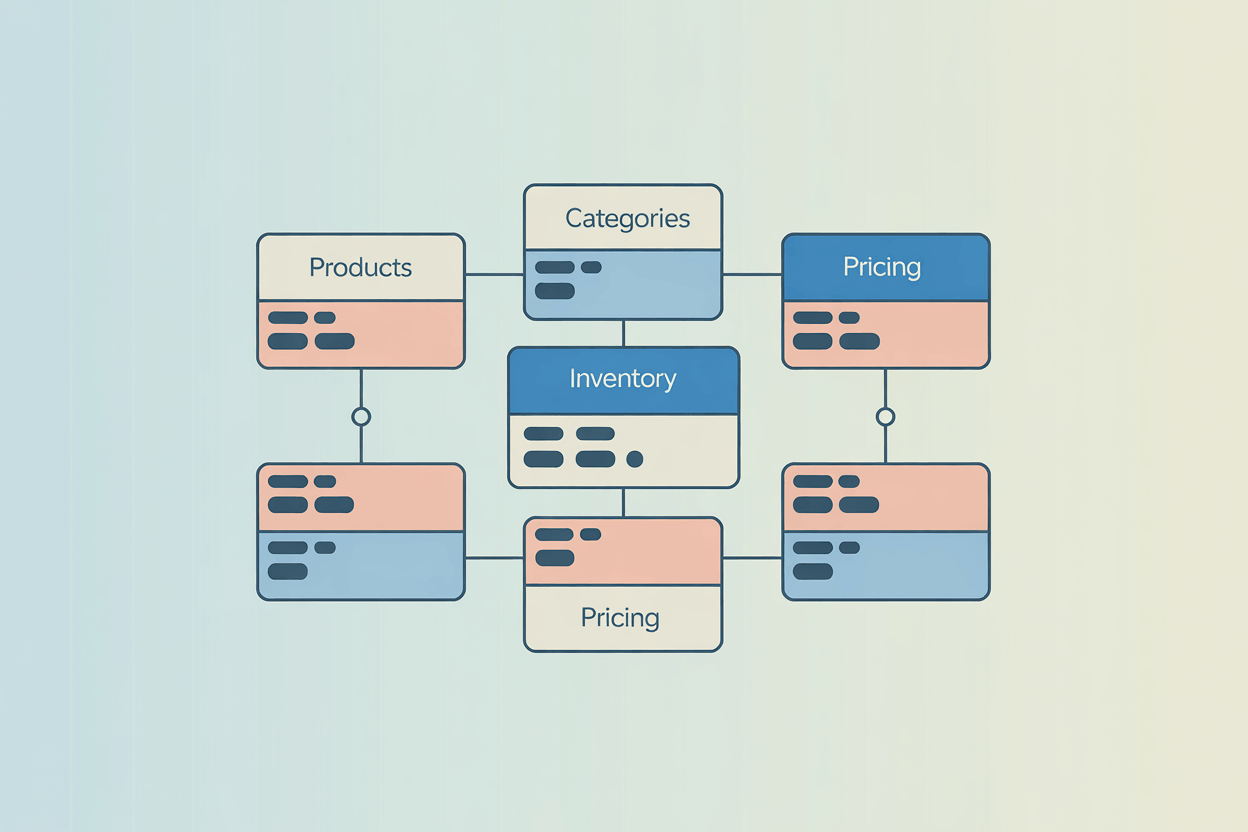
The central entity is the product record itself. Everything else connects to it. Category defines where a product sits in the hierarchy and which attributes apply. Variant captures specific combinations of axes like size or color. Asset covers linked digital files. Channel represents a sales or distribution outlet. Supplier carries its own identifiers and data. Price, when multiple price lists or currencies are involved, should be modeled as a separate entity rather than a flat attribute.
In projects we implemented for industrial equipment manufacturers, collapsing supplier data into the product record was the single most common source of synchronization failures. Once a supplier record changed in the ERP, every product referencing it had to be manually reconciled. The fix was always a structural one, not a data quality one.
Modeling these as distinct entities is more work up front. It is also what makes the model extensible as the business grows.
A note on scope: a product MDM data model governs operational and structural attributes. It is not the same as a PIM content model, which governs descriptive and commercial product content enrichment. Conflating the two creates governance ownership gaps. Both can coexist in a single platform, but the attribute ownership logic needs to be explicit about which domain each attribute belongs to.
Product Hierarchy and Relationship Design
The product hierarchy organizes the catalog for both navigation and attribute inheritance. Flat hierarchies are easier to maintain but offer less precision. Deep hierarchies give more granularity but require more governance effort.
In practice, three to five levels are enough for most B2B catalogs. A structure like Components > Sensors > Pressure Sensors > Ceramic Pressure Sensors is specific enough to drive meaningful attribute inheritance without becoming unmanageable. Going deeper than five levels rarely adds value and usually creates governance debt that accumulates quietly.
One distinction that matters here: categorization and classification are not the same thing. Categorization places a product in a navigational tree. Classification assigns it to a standardized taxonomy like eCl@ss or GS1 GPC, which is often required for EDI or marketplace integration. Conflating the two creates ownership gaps and makes it harder to evolve either independently. The most practical approach is a primary category for attribute inheritance and secondary categories only for navigation.
Relationships also need to go beyond simple parent-child structures. A well-designed product MDM data model should define Bill of Materials linkages for manufactured products, accessory and spare part relationships, and substitution or cross-sell links where relevant to the business. These are not decorative. They feed procurement planning, technical documentation, and after-sales processes directly.
Attribute Scope: The Highest-Stakes Design Decision in Product MDM
Every attribute in the model has a scope. That scope determines which system owns it, which locale applies to it, and which channel receives it. Misclassifying attributes is the most common source of broken publishing logic.
Product attributes fall into three categories. Global attributes apply to every instance of a product regardless of locale or channel: dimensions, weight, material composition, base identifiers. Locale-specific attributes hold translated or region-adapted content: product names, descriptions, legal disclaimers, unit labels. Channel-specific attributes carry values that differ by sales outlet: marketing copy for a webshop, condensed technical specs for a marketplace feed, print-ready descriptions for a PDF catalog.
A missing German description should block publishing to the German webshop. A product with incomplete logistics attributes should be blocked from shipping integration. These completeness rules must be defined in the model and enforced per combination, not applied as a single global threshold.
Equally important is defining which system is the system of record for each attribute. Product weight might be mastered in the ERP. Marketing copy might be mastered in the PIM. Pricing might come from a dedicated pricing engine. The product MDM data model must document this clearly, so that when two systems hold conflicting values, there is a rule for resolving it rather than a conversation.
AtroPIM handles this through configurable completeness rules tied to specific channel and locale combinations, and through a flexible attribute layer that supports both locale-specific and channel-specific overrides natively via its AtroCore foundation. For manufacturers distributing across multiple countries and sales channels, that distinction matters immediately.
Survivorship Rules and the Single Source of Truth
The goal of any product MDM data model is a single source of truth: one authoritative record for each product that all downstream systems consume. Getting there requires survivorship rules.
Survivorship rules define which source wins when two systems disagree about the same attribute. If the ERP says a product weighs 4.2 kg and the logistics system says 4.8 kg, the survivorship rule decides. That rule might be "ERP always wins for physical attributes" or "most recently updated value wins" or "manual steward review required above a defined discrepancy threshold." The rule itself matters less than the fact that it exists and is encoded in the model.
Without survivorship rules, teams resolve conflicts informally. Different integrations apply different logic. The golden record degrades into a contested record. And the golden record is already a misunderstood concept: it is not a goal to achieve once. It is the output of a model with enforced governance, continuously maintained by defined processes. It degrades the moment those processes lapse.
Data drift is the mechanism. Attributes change in one system without corresponding updates elsewhere. The ERP is updated with a new hazardous material classification. The product catalog is not. Six weeks later, a compliance audit surfaces the mismatch. That is not a technology failure. It is a model failure, specifically the absence of a defined owner and a change propagation rule for that attribute.
Variant and Bundle Modeling
Variant modeling is where many product MDM data models break down, usually because it was treated as a secondary concern during the design phase.
Simple products have one SKU and one attribute set. Configurable products have a parent record that defines the product concept and child records for each specific combination of variant axes. A pressure relief valve in three pressure ratings and four connection sizes is one configurable product with twelve variants. The parent holds shared data: material, certifications, base dimensions. Each variant holds its own pressure rating, connection size, SKU, and stock level.
Getting this wrong means the catalog fills with near-duplicate records, filter logic on the webshop breaks, and procurement cannot reliably identify which variant to reorder. Our customers in the safety equipment distribution space often come to us after exactly this scenario: flat records for every variant, no parent-child structure, and a search experience on the front end that surfaces six nearly identical products with no way to compare them.
Variant axes must use controlled vocabularies. Defining size as a free-text field means one record says "M", another says "Medium", and a third says "Gr. M". Those are three values that represent the same thing, and no system can aggregate them correctly. Controlled vocabularies, enforced at the model level, eliminate this before it starts.
Bundle modeling has its own failure mode: treating bundle composition as a notes field rather than a structured relationship. Structured bundle entities, linked to component product records with defined quantities, are the only approach that scales.
Identifier Strategy
Identifiers are how systems recognize and reference the same product. A weak identifier strategy leads directly to duplicate records and synchronization failures.
The main identifier types serve different purposes. The internal MDM ID is system-assigned and durable. It should never change, regardless of what happens to external systems. The ERP item number is operationally useful but tied to one system's logic. The GTIN or EAN is a global trade identifier. The MPN is the manufacturer's part number. Each plays a different role and must be stored separately in the product MDM data model.
The most common failure pattern we see: using the ERP item number as the MDM internal ID. When the ERP system is replaced or item numbers are restructured, every integration breaks. The fix is a cross-system identifier mapping table that stores the internal ID alongside all external identifiers, with strict validation preventing two records from sharing the same GTIN.
Two records sharing a GTIN mean one is a duplicate. That should be enforced as a hard validation rule in the model, not caught manually during a quarterly data audit. Initial duplicate rates of 15 to 40% are common in organizations implementing MDM for the first time. Most of those duplicates exist because identifier boundaries were never defined.
Data Governance Built Into the Model
Governance is often treated as a process layer that sits on top of the data model. That is the wrong order. In master data management, data governance decisions need to be part of the model design itself.
Ownership means assigning clear responsibility for each part of the model: who can add new attributes, who approves changes to the category hierarchy, who signs off on a new channel layer. Data stewards hold this responsibility at the attribute and entity level day-to-day. Without defined steward assignments, the model drifts. New attributes get added without review. Categories get restructured by different teams in incompatible ways. The product data quality problems solved during the initial implementation gradually return.
McKinsey's 2023 Master Data Management Survey found that 80% of surveyed organizations reported divisions operating in silos, each with their own data management practices. The product MDM data model is what cuts through that. But only if ownership is assigned at the model level, not left to informal coordination between teams.
Governance must also be measurable. Duplicate creation rate, incomplete record percentages by channel, product activation time, and integration failure rates are the KPIs that tell you whether the model is holding up in production. These should be monitored continuously, not surfaced in a pre-launch audit or an annual review.
Equally important is maintaining a living model document. Not a database diagram locked away in a technical repository. A readable reference accessible to both developers and business stakeholders, describing every entity, attribute, relationship, survivorship rule, and validation constraint in plain language. That document is what keeps cross-team alignment intact as the catalog grows and supports external audits when they arrive.
What a Weak Product MDM Data Model Costs
The cost is not abstract. A building materials distributor managing 40,000 SKUs without a structured variant model ends up with near-duplicate records for each size and finish combination. Procurement buys the wrong variant because the catalog cannot reliably filter. Returns go up. Inventory planning becomes manual. None of that shows up in a data quality report as a "model problem." It shows up as operational overhead with no obvious root cause.
At the data level, duplicate SKUs inflate procurement and inventory costs. Incomplete logistics attributes generate shipment errors. Inconsistent classification blocks marketplace listings and EDI transactions. Missing or incorrect hazardous material codes create compliance exposure.
Industry analysis consistently puts poor data quality costs at 15% to 25% of revenue for enterprise organizations. Most of that is traceable to structural decisions made, or not made, during model design.
Starting a PIM or MDM project with a data model audit is the most reliable way to avoid rebuilding later. In practice, that means mapping every entity currently in use, identifying where data is being stored flat that should be structured, auditing the identifier strategy for conflicts and missing mappings, and documenting system-of-record assignments per attribute before touching any configuration. AtroPIM is configurable enough to reflect a well-designed model directly, including complex hierarchy structures, multi-channel attribute layers, and cross-system identifier mappings. That flexibility is only useful if the model already exists.