


Key Takeaways
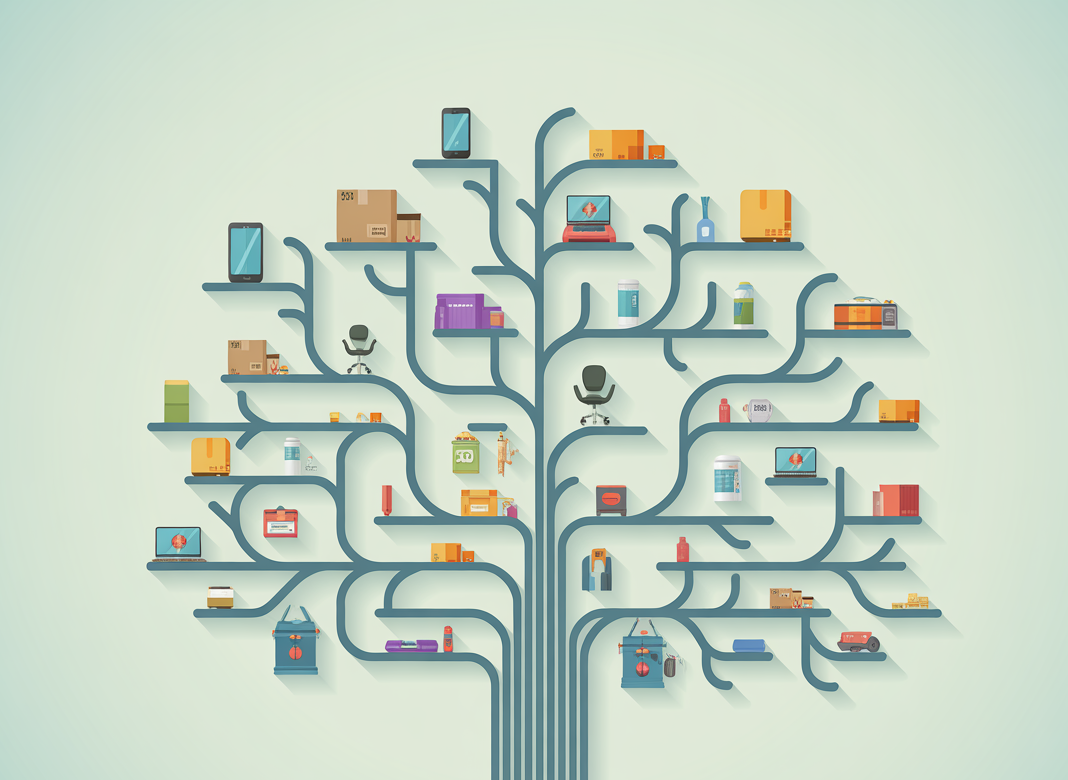
Product hierarchies organize your products internally using types, classifications, lines, and families. This is different from the categories customers see. A good hierarchy makes life easier for everyone: operations run smoother, reports are more accurate, and managing product lifecycles becomes straightforward. Most companies do well with 3-5 hierarchy levels. It's about finding the sweet spot between detail and simplicity
Modern PIM systems use hierarchies to inherit data automatically, which means way less manual data entry and fewer mistakes. Your hierarchy needs regular care and feeding to stay useful as your business evolves.
Understanding Product Hierarchy Components
Product hierarchies are the internal filing system for your products, organizing them in ways that make sense for your business, not necessarily how customers shop.
Getting these building blocks right makes everything else easier.
Product Types
Product types sit at the top of your hierarchy. They're the big buckets that group products by what they fundamentally are: finished goods, raw materials, components, services, digital products, and so on. This matters because different types of products need different treatment in your systems.
Let's say you manufacture furniture. Your finished furniture pieces need to go through final assembly and quality checks before shipping. Your upholstery materials need supplier management and just-in-time ordering. Hardware components have their own procurement cycle. Assembly services are tracked completely differently. By separating these at the product type level, you're not trying to force square pegs into round holes in your inventory or accounting systems.
Product Classifications
Classifications let you group products by what they have in common. Maybe it's the materials they're made from (wood, metal, fabric). Maybe it's how they're made (machined, molded, assembled). Or it could be regulatory stuff (food-grade, medical-grade, hazardous materials) or which business unit owns them.
Here's where this gets practical: imagine you need to pull a report on all products requiring FDA approval. Or you're dealing with a recall and need to find everything that uses a specific component. Or new environmental regulations kick in, and you need to identify affected products fast. Good classifications make these scenarios manageable instead of nightmarish.
Product Lines
Product lines are where business strategy meets product organization. These are collections of related products aimed at similar markets. Think budget line, premium line, seasonal offerings, each with its own pricing, marketing approach, and target customers.
A tech company might run a budget line for price-conscious buyers who just need the basics, a premium line for enterprise clients who want all the bells and whistles plus support, and a seasonal line for holiday releases. Each line has different profit margins, goes through different distribution channels, and competes in different ways.
Product lines help organize products and track their performance. Which lines are growing? Which needs more investment? Which should you phase out? Product lines give you the structure to answer these questions and make smart resource allocation decisions. Your marketing budget can follow your strategic priorities. Your R&D team knows where to focus. Your sales team can specialize and really understand their customers' needs.
Product Families
Product families group products that share DNA: same platform, same components, same underlying technology. This is where you see real efficiency gains in development and manufacturing.
Take smartphones as an example. You've got your base model, then variants with different storage and colors, plus all the compatible accessories: cases, chargers, earbuds, the works. In manufacturing, you might have machines built on the same chassis but with different configurations or capacities.
Why does this matter? Because your engineers design the core functionality once, then create variants by tweaking features. This cuts development time and testing. Shared components mean fewer unique parts to track and order. Common platforms let you respond faster to market opportunities. And those compatible accessories? They lock customers into your ecosystem.
Planning Your Product Hierarchy Structure
Here's the truth: creating a hierarchy that actually works takes some upfront thinking. You need something that handles today's needs but won't box you in tomorrow. Let's break down how to get there.
Assess Your Business Requirements
Start by talking to the people who'll actually use this thing. Your operations folks need a structure that mirrors how products move through manufacturing and fulfillment. Finance needs something that lines up with how they track costs and run P&L reports. Sales wants alignment with customer segments and territories. Product development needs to see technological relationships and platforms.
Don't skip the boring regulatory stuff either. If you're in pharma, you need traceability from raw materials all the way through to finished products. Medical devices? You need crystal-clear component relationships for FDA submissions. Food and beverage operations have to track allergens and ingredients across product families. Build this in from the start, since trying to retrofit it later is painful.
And think about your systems. Your ERP needs this hierarchy data for inventory and financials. Your PLM system uses it for bill-of-materials and change control. Your CRM might use product lines for sales forecasting. If these systems can't talk to each other because the hierarchy doesn't fit, you're in for a world of hurt.
Analyze Your Product Portfolio
Take a hard look at what you've actually got. Products developed by the same team usually share design DNA. Products made on the same equipment have similar cost profiles. Products sold through the same channels face similar market dynamics.
Map out how products relate to each other. Which ones serve as platforms for multiple variants? What gets sold as bundles? Where are the accessories that complement your main offerings? These relationships should show up in your hierarchy. They're not just nice to know; they drive real business decisions.
Don't forget about lifecycle stages. You need spots for products still in development, active products that need day-to-day management, items being phased out that still need warranty support, and discontinued products you're keeping around for compliance or historical reporting. Each stage has different needs.
Define Hierarchy Levels
Most companies find their sweet spot at three to five hierarchy levels. This is enough structure to be useful without creating unnecessary complexity.
Set clear rules for each level. At the top, product types might be defined by "fundamental business nature." Classifications could use "manufacturing process" or "regulatory category." Product lines might follow "target market segment", while families use "shared technology platform." The key is making it obvious where things belong.
Your naming system matters more than you'd think. Some companies go with hierarchical codes: 01-05-003 means product type 01, line 05, family 003. Others prefer something more readable, like FG-PREM-SMART (Finished Goods, Premium Line, Smartphone Family). Pick something that makes sense to humans while keeping your systems happy.
And here's a practical tip: a product should usually belong to one type, one classification, and one line. Families can be more flexible. A product might legitimately fit into multiple families if it's part of different ecosystems. Just make the rules clear so people aren't guessing.
Balance Flexibility and Structure
Build for what you need now, but leave room to grow. If you're numbering product types 01-99, great, but will you really never have more than 99 types? Think about new markets you might enter, new technologies you might adopt, and new business models you might try.
What about the weird stuff? Limited editions might fit within existing families with a special attribute rather than needing their own branch. Prototypes could sit in a special classification until they're market-ready. Build-to-order products might need dedicated treatment or might work within standard families with configuration options. Figure out your approach to these edge cases upfront.
And plan for product retirement. Discontinued products don't just disappear. You've got warranty obligations, spare parts to manage, and regulatory retention requirements. Some companies keep a separate branch for legacy products. Others use status flags to mark things as inactive while keeping the structure intact for historical reporting. Either way, have a plan.
Best Practices for Efficient Product Hierarchies
Keep It Simple and Logical
- Use the simplest structure meeting your requirements, since each additional level adds maintenance overhead and increases error chances
- Apply consistent logic throughout your hierarchy: if organizing one line by material type, use similar logic elsewhere
- Make relationships between levels clear and intuitive so users can predict where products belong
- Avoid over-engineering with unnecessary complexity that creates confusion rather than clarity
Align with Business Processes
- Design your hierarchy to mirror how products actually flow through your organization from development to manufacturing to sales
- Structure families and lines to facilitate supply chain management by grouping products that share suppliers, manufacturing facilities, or distribution channels
- Enable accurate cost allocation by aligning hierarchy levels with how costs are tracked and analyzed in your financial systems
- Support product lifecycle management by building in attributes that track development stage, market readiness, and retirement planning
Establish Clear Ownership and Governance
- Assign clear responsibility for hierarchy maintenance to a specific team or role
- Create formal approval processes for structural changes, adding new product lines, families, or types, which require review
- Document hierarchy logic thoroughly with clear definitions, classification criteria, and examples for each level
- Provide comprehensive training for all teams that create or manage product data
- Conduct regular refresher training to maintain data quality and ensure consistent application of standards
Enable Cross-Functional Use
- Design your hierarchy to serve multiple departments simultaneously: operations, finance, sales, and product development all have different needs
- Balance granularity to support both detailed operational analysis and high-level strategic reporting with drill-down and rollup capabilities
- Ensure compatibility with financial reporting structures so product lines map cleanly to business units or profit centers
- Consider international operations if applicable, since global organizations need structures accommodating local requirements while maintaining corporate consistency
Build in Attributes and Metadata
- Define standard attributes at appropriate hierarchy levels rather than repeating them for every product
- Use inheritance strategically to avoid data redundancy. Products should automatically inherit attributes from parent levels unless explicitly overridden
- Include technical specifications, certifications, and compliance information at the level where they apply to minimize duplication
- Track product lifecycle status to enable reporting and filtering based on whether products are in development, active, phase-out, or discontinued stages
- Store shared marketing content, regulatory approvals, and quality standards at family or line levels for consistency
Plan for Multi-Dimensional Views
- Recognize that products may legitimately belong to multiple structures simultaneously
- Create matrix structures where business needs require them, and maintain parallel hierarchies organized by different dimensions
- Enable flexible filtering and grouping across different hierarchy dimensions so users can analyze products by any combination of type, classification, line, and family
- Support both primary and secondary classifications when products genuinely fit multiple categories
- Allow cross-categorization without forcing artificial mutual exclusivity where it doesn't make business sense
Product Hierarchies in PIM Systems
This is where things get really interesting. A good PIM system takes your hierarchy and turns it into a data management powerhouse. The magic word here is "inheritance", and it'll save you countless hours of tedious data entry.
Data Inheritance and Efficiency
Define an attribute once at the family level, and every product in that family can inherit it automatically, eliminating repetitive data entry.
Picture a furniture company with a "Modern Dining Chairs" family that has 20 variants in different colors and materials. With a proper PIM hierarchy, you enter the core specs: dimensions, weight capacity, and assembly requirements once at the family level. Each color variant inherits these automatically. You only need to specify what's actually different: the color and material.
The time savings are huge. Instead of managing thousands of individual data points across hundreds of products, you're managing a fraction of that at higher levels. And when something changes? Update it once at the family level, and every child product updates instantly. No hunting through spreadsheets, no risk of missing a product, no inconsistencies.
Consistency and Data Quality
Inheritance improves both efficiency and accuracy. When products inherit attributes, you physically can't have one SKU showing different dimensions than another SKU in the same family. The data comes from the same source.
This matters more than you might think. Ever had a customer complain because your website shows one spec and your catalog shows another? Or your sales team is working with outdated technical sheets? Hierarchy-based inheritance eliminates these headaches.
Plus, you can set up validation rules at each level. Your PIM won't let a product family go live without certain required attributes. No product reaches customers missing critical information because the system enforces completeness at the hierarchy level.
Workflow and Collaboration
Hierarchies make teamwork easier, too. You can give product line managers control over their entire line, family managers authority over specific families, and limit individual product editing to the people who need it.
Need to update all products in line for a new regulation? Work at the line level instead of touching hundreds of individual products. Launching a new seasonal collection? Copy an existing family, tweak it for the season, and you're done. No rebuilding from scratch.
Different teams can work simultaneously without stepping on each other's toes. Marketing handles product line messaging while technical teams manage family-level specs. The hierarchy naturally divides the work while keeping everything connected.
Localization and Channel Management
Here's where it gets even better for companies selling in multiple markets or through different channels. You can keep your core product info at the family level while adding market-specific or channel-specific variations without duplicating everything.
Say you're selling globally. Your core specs stay in English at the family level. Then you add localized descriptions, local measurement units, and region-specific certifications at the market level. The hierarchy ensures your fundamental product data stays consistent while accommodating necessary differences.
Same deal for different sales channels. Your e-commerce site might need different descriptions than your wholesale catalogs or Amazon listings. Handle these variations efficiently within the hierarchy instead of maintaining separate product databases for each channel.
Modern PIM systems like AtroPIM support all these hierarchy concepts: types, classifications, lines, and families, so you can structure your data for maximum efficiency.
Maintaining Your Product Hierarchy
Even the best hierarchy needs regular attention. Your product portfolio changes, your strategy shifts, and what worked last year might not work now. Here's how to keep things running smoothly.
Regular Audits and Cleanup
Set up a schedule to review your hierarchy: quarterly or twice a year usually works. Look for the obvious problems: products that seem to be in the wrong place, families that have ballooned to 200 members (probably too broad), lines that no longer match your actual business strategy.
Pay attention to the orphans - products that don't quite fit anywhere. These aren't necessarily mistakes. Sometimes they reveal gaps in your hierarchy. Sometimes they're legitimately unique products. But either way, you need to deal with them so they don't create confusion.
Clean out the deadwood, too. If a product family has no active products left, consider archiving it instead of cluttering your active structure. Keep your hierarchy focused on what's actually happening in your business right now.
Process for Changes
Make it clear how new products get added. Product managers shouldn't be guessing where things belong. Give them decision trees or quick reference guides that walk them through the classification.
When products change significantly, such as through a new version with different specifications or a major reformulation, make sure you have a clear process. Decide whether the new version replaces the existing product in the hierarchy or becomes a new member of the family. These decisions influence reporting and historical data, so they should never be made casually.
And when products get discontinued, think through the implications. Do you need to keep tracking them for warranty support? Spare parts? Regulatory compliance? Some companies move them to an archive branch. Others just flip a status flag. Either way, have a plan that keeps historical reporting intact.
Measuring Effectiveness
Track some basic metrics to see if your hierarchy is pulling its weight. How long does it take to add a new product now versus before? Are your hierarchy-based reports giving you reliable insights? Is your system performance holding up?
But don't just look at metrics, talk to people. Do they find the hierarchy intuitive? Can they locate products easily? Are you getting lots of questions about where things belong? User feedback often spots problems before they show up in your data.
Watch for warning signs that you might need a bigger overhaul. If you're creating exceptions all the time, if new products rarely fit cleanly, if your business strategy has shifted significantly — these are clues that your hierarchy fundamentals might need rethinking.
Version Control and Change Tracking
Keep a record of major changes, especially structural ones. When did you add that new product line? When did the classification criteria change? When did you do that big reorganization? This history helps you understand your data and supports system migrations down the road.
Use proper version control for your documentation, too. As you update definitions and naming conventions, keep the old versions. You'll thank yourself later when you're trying to figure out why products were classified differently two years ago.
Think about historical reporting when you make changes. If you restructure product lines, do you need to remap old data to the new structure? Or keep parallel views for year-over-year comparisons? These affect how you track business performance over time.
Conclusion
A solid product hierarchy is one of those things that doesn't get a lot of glory, but it makes everything else work better. Get it right, and your operations will run smoother, your reports actually make sense, and your team spends less time hunting for information and more time doing valuable work.
The upfront effort pays off. It means less time on data entry drudgery, more accurate reporting, faster product launches, and teams that can actually collaborate without tripping over each other. Modern PIM systems like AtroPIM amplify these benefits by automating the inheritance and consistency pieces.
Just remember: your hierarchy is a living thing. What works today might not work in two years. Keep an eye on it, maintain good governance, and stay responsive to how your business is changing. The companies that do this well treat their hierarchy as a strategic asset, not just an administrative chore.
So where do you start? Take a look at how you're organizing products now. Maybe you're starting from scratch, maybe you're fixing something that's gotten unwieldy. Either way, get your stakeholders involved, write down your logic so everyone understands it, and put governance in place to keep things from devolving into chaos. Your future self will thank you.