


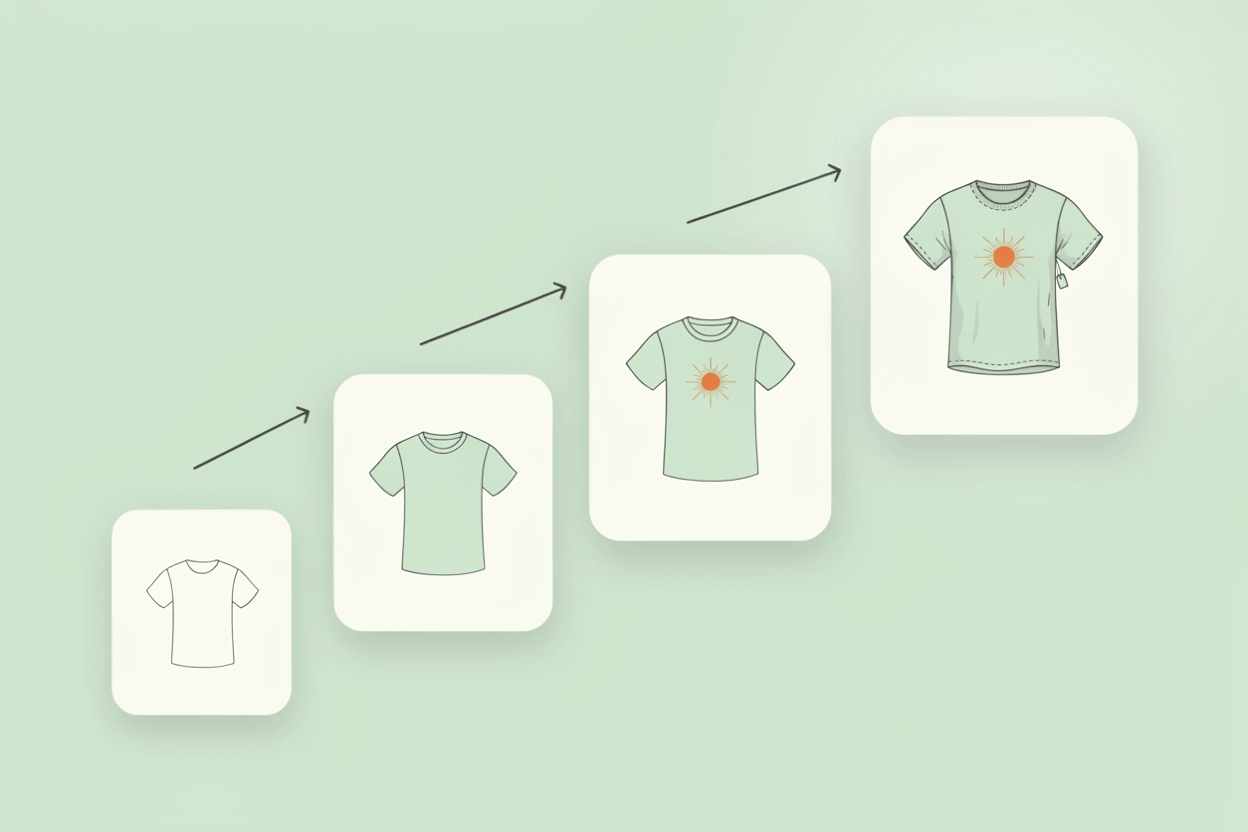
A new product moves through a fixed sequence before it reaches customers, from the first idea to a full launch and the review afterward. The stages of new product development are those phases. Each one exists to answer a single question before you spend more: whether the product is worth continuing.
Most teams can list the stages, but far fewer manage them differently, and that is what commonly causes launch failures.
This article takes the stages one at a time. For each, it sets out what the stage is for, how to run it well, and the mistake that most often derails it. It builds on a broader view of the new product development process and concentrates on the practical management that most materials leave out.
Key Takeaways
- The stages run from a first idea to launch and the review that follows. Killing weak ideas early is the cheapest thing you will ever do.
- Each stage of new product development has its own failure mode. Early stages fail on optimism, development fails on scope, launch fails on missing information.
- Product data runs through every stage. Start building it at the concept stage, not the week before you go live.
- Match your effort to the stage. Cheap and fast at the start, careful and expensive only after the risky assumptions hold up.
Why The Stages Exist
Development gets split into stages so you can spend a little early, learn as much as possible, and commit real money only after the riskiest assumptions have held up. The structure keeps small bets small and holds back the large ones until the product has earned them.
Each stage ends in a decision to go, stop, or rework, and that decision is where the value sits. A stage that cannot produce a genuine no adds nothing beyond a status update, and it lets weak products drift toward launch on momentum alone.
The reason for that caution shows up in the launch data, where a peer-reviewed study of 83,719 new SKUs across 31 consumer-goods categories found that about one in four had stopped selling within a year of launch, rising to roughly 40% by year two (source: Marketing Letters). Running the stages properly is how you keep your product out of that share.
The classic version of the model runs through seven stages: idea generation, screening, concept development and testing, business analysis, product development, test marketing, and commercialization. The names differ from one company to the next, but the order rarely changes.
Stage 1: Idea Generation
Ideas are the cheapest input in the whole process, so gather more than you think you need.
The best ones rarely come from a brainstorming afternoon. They come from support tickets, sales calls, warranty claims, and the reasons customers gave for returning the last product. A manufacturer sitting on two years of "wrong fit" return notes is sitting on a product brief and usually does not know it.
Manage this stage by giving ideas somewhere to live. A shared, searchable list beats a dozen private notebooks. And write down enough context that the idea still makes sense in six months, when the person who had it has moved on.
The watch-out here is treating idea generation as a one-time event. Good ideas arrive on their own schedule. Keep the intake open.
Stage 2: Screening
Screening is the discipline that stops cheap ideas from wasting expensive time later.
Set your criteria before the ideas arrive, not after. A short set is enough to start:
- Strategic fit. Does it match where the company is actually going?
- Market size. Is the potential worth the effort, roughly?
- Feasibility. Can you build and source it with what you have?
- Margin. Is there money in it once the true costs land?
Score each idea against those criteria instead of arguing it out in a room, where the loudest voice wins, and the quiet good idea dies. Keep a log of what you rejected and why. Ideas come back with new context, and the old reasoning saves you from fighting the same fight twice.
The cheapest idea to kill is the one you catch before you have spent anything on it. Every stage after this one costs more to unwind.
The real trap is approving too much. Teams look at a batch of concepts, find none of them obviously terrible, and wave most of them through. "Not obviously bad" is not a standard. Let the criteria do the cutting.
Stage 3: Concept Development And Testing
Turn the survivors into something a person can react to. A sketch, a mockup, a rough prototype, a fake landing page. Anything concrete enough to pull an honest reaction out of a real buyer.
Then test it with those buyers, not with colleagues. Colleagues are polite and want you to succeed, which makes their feedback close to useless. Ask questions that can come back as a no. "Would you buy this at this price?" tells you far more than "do you like it," because the first one has a cost attached and the second is free to agree with.
A compliment is free. A pre-order is not. Ask the question with a cost attached.
This stage is where most avoidable failures get their start. MIT Professional Education ties a large share of flops to teams building solutions for a need that was never really there (source: MIT Professional Education). Ten honest conversations with target customers, held before you commit a budget, are the cheapest insurance you will find anywhere in the process.
Stage 4: Business Analysis
Now put numbers on the concept. Cost, expected volume, margin, break-even, and the people and tools you need to pull it off.
Write your assumptions down as assumptions. Name the handful of things that have to be true for the product to hit its numbers, then ask how you would know if they were false. An assumption that is both shaky and impossible to test is a warning, not a rounding error to bury under an optimistic forecast.
Run more than one scenario. A single rosy projection tells you what you are hoping for. Two or three tell you the range you are actually betting inside.
Stage 5: Product Development
Build it. Engineering, sourcing, and design come together here, and this is usually where the money goes.
Two things quietly wreck timelines. The first is scope creep, where every stakeholder adds one more feature and the schedule stretches to swallow them. Lock scope behind a written change process so a new feature is a decision someone signs off on, not a default that slips in.
The second is the belief that data and content can wait until the product is done. They cannot, and that belief sets up the mess in the next stage. Every attribute, spec, image, and translation you leave until the end becomes a bottleneck exactly when you have no slack left.
Stage 6: Test Marketing
A finished product is not yet a sold product. Test marketing is where you put it in front of a limited, real audience before you commit to everyone.
A soft launch or a staged rollout catches problems in a small group and turns what could have been a public failure into a quiet fix. Keep a rollback plan ready. Knowing you can pull back changes how boldly you can move forward.
This stage also gives you the first real data on how customers read your product. Watch what they misunderstand. Confusion at this scale is cheap to fix. The same confusion after full launch is expensive.
Stage 7: Commercialization
This is the full launch. Marketing, sales, supply chain, and support all move around one date and one accurate set of product information across every channel.
The failure mode here is coordination, not the product. The item is ready, but its information is scattered across spreadsheets, inboxes, and one person's memory, so the launch date slips while someone assembles a clean dataset for each channel. Manage this stage by treating "the data is ready" as a real gate, checked against a list, not a hopeful assumption.
The Stage People Skip: Post-Launch Review
The stages do not stop at launch, though attention usually does. Track sales, returns, reviews, and support tickets against the numbers in your business case, and be honest when the two disagree.
Return reasons are the most useful signal you will get after launch. They tell you exactly where the product or its description let a customer down. Feed that in two directions at once: into the screening criteria for your next idea, and into the product data for this one.
Where Product Data Runs Through Every Stage
Product information is not a launch-week task. It is a thread that runs from the concept stage all the way to the review, and the teams that treat it that way avoid the scramble the rest live through.
Our customers usually turn to us after they have felt the scramble. The product was finished on time. Then the launch stalled for weeks because specs, images, translations, and compliance details lived in a dozen files that nobody could reconcile. A PIM system fixes that by giving product data a single home, so teams build the information up during development and every channel pulls from one consistent record. Tools like AtroPIM exist for exactly this readiness problem, and for companies whose challenge reaches past listings into supplier and master data, a broader platform like AtroCore covers the same ground more widely.
A short list to run before you set a launch date:
- Every required attribute is filled for every SKU and variant, not most of them.
- Images and media meet each channel's format and size rules.
- Translations and region-specific details are done, not pending.
- Compliance and safety information is verified, not assumed.
- One source feeds all channels, so a correction lands everywhere at once.
The cost of getting this wrong shows up after launch, in returns. US shoppers are on track to send back around $850 billion of merchandise in 2025, with an estimated 19.3% of online sales returned (source: National Retail Federation). Returns have many causes, and product data is only one of them. But it is one you control, and for a brand-new product it matters more than usual.
For a brand-new product, the first version of your data is the only version customers have to judge it by. There is no sales history to fall back on.
Running The Gates Without Killing Momentum
Stages only work if the gates are real. A gate that always says yes is not a gate.
Decide upfront who makes the go or no-go call, and give that person the authority to say stop. Gates fail in two directions. Approve everything, and you flood the next stage with weak concepts. Turn every gate into a month-long committee, and you strangle the good ideas along with the bad ones. Aim for fast decisions with clear criteria, then move.
And respect a no-go. Killing a project at a gate is the system working, not the team failing. The rejection log makes that easier, because a killed idea is filed, not buried.
Match Your Effort To The Stage
The single habit that separates teams who ship well from teams who don't is calibration. They spend almost nothing at the idea stage, a little on concept testing, and real money only once the risky assumptions have survived contact with actual customers.
So before you pour effort into a stage, name the failure you are guarding against. If the risk is that nobody wants it, the money belongs in research and validation, and no amount of polish later will save it. If the products are strong but launches drag on scattered data and post-launch returns, that is an execution problem, and it is the one a system for your product information is built to fix.