


Key Takeaways
- Compliance data is a design input now. Three EU regulations define information that must be available when a product is placed on the market, and collecting it after design freeze causes rework.
- Many launch delays we see in physical products come from missing or inconsistent product data. The product itself is ready. Its record is not.
- A Product Information Management (PIM) system starts paying off at the sourcing stage, when supplier data, variants, and channel requirements begin to multiply.
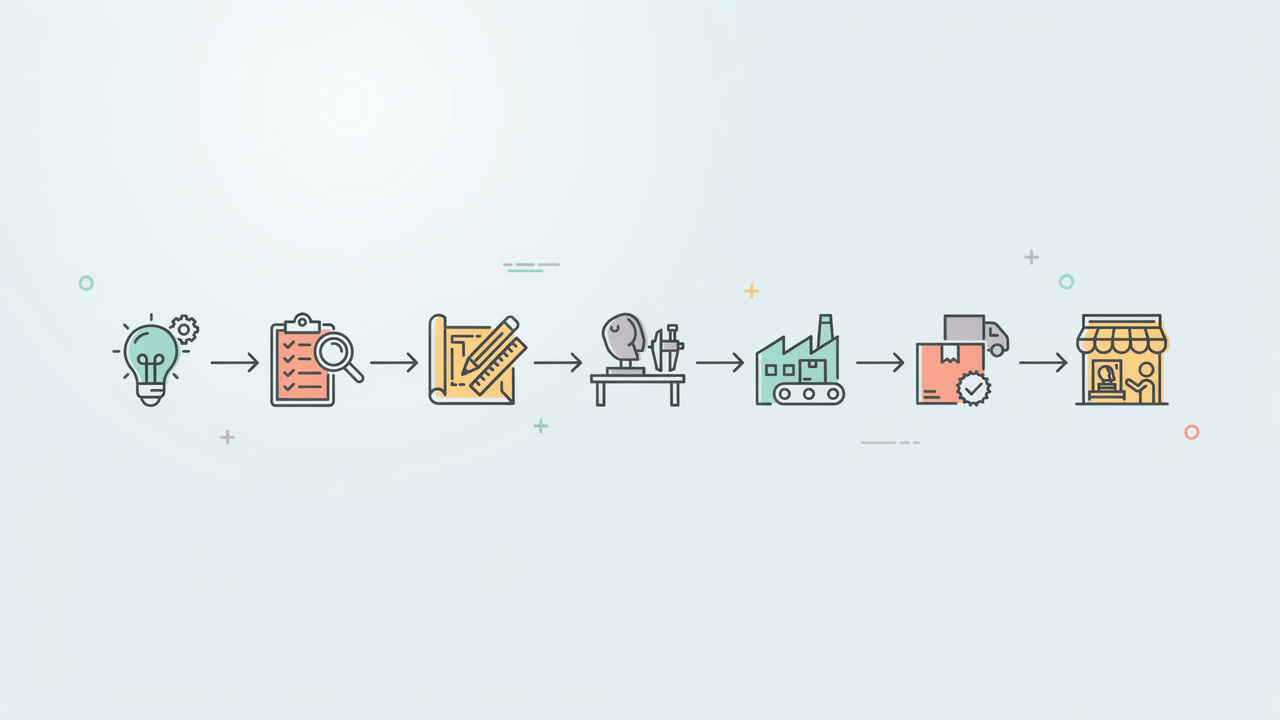
Why The Classic Stage-Gate Model Needs A Data Track
Stage-gate remains the default structure for physical products: stages of work separated by go/kill decisions. The model works. Its gate criteria track cost, schedule, and technical risk. They rarely ask whether the company can produce a complete, correct product record for every target market.
Three regulations make that question unavoidable.
The Ecodesign for Sustainable Products Regulation (ESPR), Regulation (EU) 2024/1781, entered into force on 18 July 2024. It sets performance and information requirements product group by product group through delegated acts. Products covered by a delegated act will need a digital product passport, linked to a unique product identifier through a data carrier such as a QR code. The regulation also required the Commission to set up the central passport registry by 19 July 2026.
The General Product Safety Regulation (GPSR), Regulation (EU) 2023/988, has applied since 13 December 2024. Its Article 19 requires every online or distance sales offer to show the manufacturer's name and postal and electronic contact details, the EU responsible person if the manufacturer sits outside the EU, information that identifies the product (including a picture and its type), and warnings or safety information in a language consumers can easily understand.
The Batteries Regulation, Regulation (EU) 2023/1542, requires a battery passport from 18 February 2027 for EV batteries, light means of transport (LMT) batteries and industrial batteries above 2 kWh. From the same date, portable batteries built into products must be readily removable and replaceable by the end user, subject to listed exemptions.
If a product ships in 2027 and contains a battery, its removability gets decided at the design stage in 2026.
Each of these rules turns a data question into a gate question. The stages below show where.
Stage 1: Idea Generation And Opportunity Screening
Good ideas for physical products often sit in data the company already owns. Return reason codes, warranty claims, service tickets and spare part sales point at real failures and real demand. Competitor teardowns add the rest.
Screening in 2026 needs one extra filter: regulatory scope. Check which EU product group the idea falls into and whether a delegated act under ESPR is adopted, in preparation, or not yet planned. A product with a three-year development cycle can see requirements arrive mid-project. ESPR generally gives companies at least 18 months after a delegated act enters into force before its requirements apply. That window is shorter than many hardware development cycles.
So an idea in a group with a pending delegated act carries a cost the screening should record: a design that may need to meet durability, repairability, or information requirements that are not final yet.
Stage 2: Concept Development And Feasibility
This is where the product gets target specifications, a cost estimate, and a first architecture. It is also the cheapest point to define the product's data scope.
A data scoping step lists every regulation that applies, every attribute those regulations require, and who in or outside the company supplies each value. For a cordless garden tool sold online in the EU, that list covers at least GPSR, the Batteries Regulation, and any applicable sector legislation. Typical items on the list:
- Identity data for market placement: manufacturer, trade name, contact addresses and, for non-EU manufacturers, the EU responsible person.
- Safety information and warnings, per language of each target market.
- Material composition and substances of concern, which usually come from suppliers.
- Identifiers at the right level: model, batch, or individual item, depending on what the passport rules for the product group require.
- Battery data, where a battery is included, covering chemistry, capacity, and removability design.
The output is an attribute model. It sounds bureaucratic. It saves weeks later, because every team downstream fills the same fields instead of inventing their own.
Stage 3: Business Case
A business case for a physical product usually covers unit cost, tooling, volume forecasts, and margin. In 2026, it should also carry the cost of the product record: supplier declarations, testing and certification, translations, passport hosting, and the staff time to keep all of it current.
Sourcing strategy belongs here too. Dual sourcing reduces exposure to supply disruption and tariff changes. It also doubles the material declarations, certificates, and test evidence the company must maintain for the same product. Put both sides into the numbers.
Stage 4: Design And Engineering
Design and engineering decide most of what the product record will say. Regulations now reach into this stage directly.
Take battery removability. Under Article 11 of the Batteries Regulation, a portable battery counts as readily removable when the end user can take it out with commercially available tools. Specialised tools only count if they come free with the product. Proprietary tools, thermal energy, and solvents do not qualify. A glued battery pack in a handheld device is a design decision that becomes a compliance problem in February 2027.
ESPR works the same way for other product groups. Its delegated acts can set requirements on durability, reparability, recycled content, and substances of concern. Each of those is a design parameter first and a data attribute second.
The practical risk in this stage is the handoff between systems. Engineering data lives in CAD and PLM: the bill of materials, dimensions, tolerances, materials. Commercial and compliance data lives in spreadsheets, ERP, and e-commerce platforms. When a value changes in PLM, copies elsewhere go stale.
Define now which system owns which attribute. PLM owns engineering truth. PIM system owns the enriched, market-ready product record. ERP owns prices and stock. Write this down before the prototype, because changing ownership later means migrating data mid-project.
Stage 5: Prototyping And Testing
Prototypes produce evidence: test reports, certificates, measured values that replace estimates. Each piece belongs in the product record, linked to the exact model or variant it covers, with an issue date and a validity date.
GPSR requires manufacturers to keep technical documentation for 10 years after the product is placed on the market. A test report saved in a project folder on a shared drive rarely survives 10 years, two reorganisations and one system migration. Attach it to the product record.
Generative AI is now common in this stage for simulation and test planning, and later for writing product texts. The risk is specific: a model asked to write a product description will fill gaps with plausible numbers. A wrong battery capacity or load rating in a listing is a safety and liability problem. A workable rule is that AI drafts texts only from verified attributes, and a person approves the result before it reaches any channel.
Stage 6: Sourcing And Supplier Onboarding
Supplier data is where product records usually break. Material declarations arrive as PDFs, spreadsheets in different templates, or emails. Units differ. Some fields stay empty until someone chases them.
Our customers often turn to us with exactly this problem. One manufacturer received component data from dozens of suppliers, each in its own spreadsheet layout, and a coordinator spent days per product retyping values into the central file. After the move to a PIM with defined import mappings per supplier and validation rules on required fields, incoming data either passed the checks or went back to the supplier with a list of what was missing. Retyping stopped. The coordinator's time went to chasing the gaps.
Ask suppliers for data at the attribute level, in a fixed template, and ask early. Contracts with new suppliers should state which values they must deliver, in what format, and how fast they must report a change in materials.
Stage 7: Pilot Production And Validation
Pilot runs check that production units match the declared values. Measured weight, energy use, and dimensions from real units replace prototype numbers. Update the record, and keep the history.
This stage also fixes the identifier level. Passport requirements can apply per model, per batch, or per item, depending on the product group. Item-level identifiers affect the production line: serial numbers must be generated, printed or engraved, and linked to the record. QR codes and labels go onto packaging artwork, which usually has long lead times.
Component substitutions during ramp-up are a quiet risk. A buyer swaps a housing plastic for an equivalent grade from another supplier to fix a shortage. The material data changes. If the change does not reach the product record, the passport and the declarations are now wrong.
Stage 8: Launch Preparation And Product Data Readiness
Launch preparation for a physical product now means preparing dozens of versions of the same record: own web shop, marketplaces, distributor feeds, print catalogues, each in several languages, each with its own mandatory fields and formats.
GPSR Article 19 makes part of this legally required. Every online offer, on every channel, has to carry the manufacturer details, product identification, and safety information. If a distributor lists the product without the warnings, the gap sits in your data supply as much as in their listing.
A useful launch gate asks one question per channel: is every mandatory attribute filled, approved and translated?
This is the stage where a PIM system does its most visible work. It holds the attribute model from Stage 2, the supplier data from Stage 6 and the validated values from Stage 7, and produces channel-specific exports from one record. AtroPIM, for example, is an open-source PIM with a configurable data model, so teams can add attributes such as passport fields or GPSR contact data as their requirements change, and check completeness per channel before release.
Checks worth running before the launch gate:
- Completeness per channel and language, measured against that channel's mandatory fields.
- Consistency between the PIM record and PLM for every engineering value.
- Validity of every linked certificate on the planned launch date.
A product that fails any of these is not ready to launch, whatever the marketing calendar says.
Stage 9: Commercialization And Lifecycle Management
After launch, the record keeps changing. Firmware updates, spare parts, component changes, new markets and new languages all touch it. A digital product passport must stay available for a period set by the delegated act for that product group, so the data outlives the sales period.
Recalls test the whole chain. GPSR requires manufacturers to notify affected consumers directly where they can be identified and sets rules for the content of recall notices. Finding every affected unit fast depends on the identifiers and version history built in earlier stages.
Close the loop. Returns, service tickets, and reviews from the launched product feed Stage 1 of the next one.
Trends And Risks For 2026 Worth Planning Around
Regulatory dates move. The EU is running several simplification packages that amend existing product rules, and some proposals postpone specific obligations. Plan with the dates in the current consolidated legal text, and build the data model so that adding or removing an attribute does not require a software project.
Delegated acts under ESPR are still arriving product group by product group. A company with products in several groups will face different passport requirements on different dates for years. A single attribute model with product-group-specific extensions handles this better than separate solutions per regulation.
Generative AI speeds up content creation and increases the cost of unverified data. The faster texts get produced, the faster a wrong value spreads across channels.
Supply volatility pushes companies toward more suppliers and more component alternatives. Each alternative is a variant in the product record, with its own declarations.