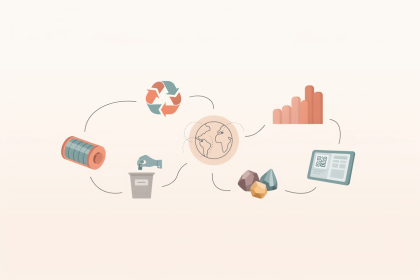

Extended Producer Responsibility Definition
Extended Producer Responsibility (EPR) is a policy principle that makes the company placing a product on the market responsible for that product after consumers are finished with it, including its collection, recycling, and safe disposal, not just for making and selling it. The aim is to shift the cost and burden of end-of-life waste away from taxpayers and local authorities and onto the producers who put the product into circulation.
How does EPR work in practice?
Rather than each producer running its own collection service, businesses in a given sector usually pay fees into a scheme that handles waste on their behalf. These schemes, often called producer responsibility organisations, use the fees to fund the collection, sorting, and recycling of products once they become waste. Two features are common across most systems:
- Registration and reporting: producers must register with the relevant authority and report how much they place on the market
- Fees: producers pay based on the volume and, increasingly, the recyclability of what they sell
Because fees can be tied to how easy a product is to recycle, EPR also creates a financial incentive to design products with their end of life in mind, a mechanism sometimes called eco-modulation.
What products does EPR cover?
EPR is applied to product categories that are costly or difficult to manage as waste. Common examples include packaging, electrical and electronic equipment (WEEE), batteries, vehicles, and, increasingly, textiles. The exact categories and rules vary by country, though within the EU they are being progressively harmonised through regulations such as the PPWR for packaging.
Who counts as the "producer"?
This is often less obvious than it sounds. The producer is not always the manufacturer. It is typically the business that first places the product on the market in a given country, which could be an importer or a distributor. Defining a single clear producer for each product matters because it determines who registers, reports, and pays the fee, and prevents the same item being charged twice or slipping through unaccounted for.
Why does EPR matter?
EPR is one of the main tools governments use to fund recycling systems and reduce landfill without drawing on public budgets. By linking a producer's costs to what happens to their product at end of life, it pushes businesses toward more durable, repairable, and recyclable design, the same goal pursued by the ESPR, and is a core mechanism for moving from a "take, make, dispose" model toward a circular economy. For businesses selling across multiple markets, EPR also means tracking obligations, fees, and reporting requirements separately in each country where their products are sold.