


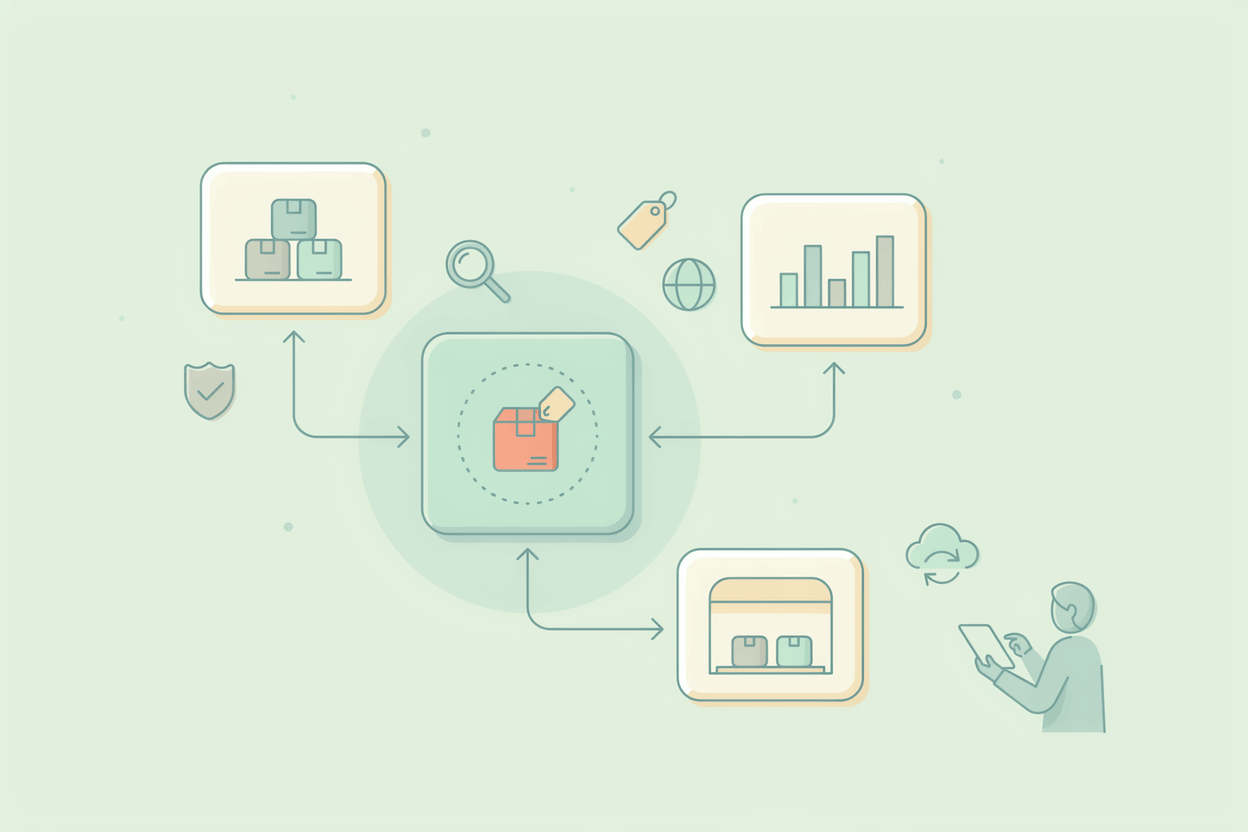
B2B product data is not the same problem as B2C product data. A retailer selling consumer goods needs clean titles, good images, and a short description. A manufacturer selling industrial components needs technical attributes, compatibility tables, documentation, regulatory certificates, classification codes, and customer-specific views: sometimes in five languages, across three sales channels, updated every time a supplier changes a spec. Product information management in a B2B context has to handle all of that. A generic PIM built for retail typically doesn't, and B2B manufacturers and distributors hit those limits fast.
Why B2B Product Data Is Harder
B2C data fails at the description level. B2B data fails at the structural level.
B2B products exist in hierarchies: product families, models, variants. Each level carries different attributes. A component has compatibility relationships with other components. A product sold in Germany needs different documentation than the same product sold in the US. A distributor sourcing from 80 suppliers gets data in 80 different formats. Left unmanaged, that data ends up in silos: one version in the ERP, another in a spreadsheet that only one person updates.
More than two-thirds of companies surveyed have no effective product data strategy in place, according to Forrester Consulting's 2024 State of B2B Ecommerce Report.
That's not purely a software problem. It's an organizational one. But a PIM system still has to accommodate the organizational reality. If the system can't model the complexity of your product structures, data governance doesn't help much.
B2C data problems are mostly about completeness and consistency. In B2B, the harder question is structure: what relationships exist between products, which attributes are mandatory for a given market, and what "correct" even means for a specific product in a specific context.
Product data scattered across ERP records, shared drives, and supplier spreadsheets doesn't become usable just because you've deployed a PIM. The system has to be capable of becoming a real single source of truth, one that every team and every downstream channel can actually rely on.
What Manufacturers Need from a B2B PIM
Complex product hierarchies.
A product family contains multiple models. Models contain variants. Each level inherits some attributes and carries its own. A PIM that treats every SKU as a flat record forces manufacturers to duplicate data. When specs change, that duplication means updating multiple records instead of one. That's where time-to-market slips. Proper variant management and hierarchical modeling make it possible to update one record without cascading errors across the catalog.
Technical attribute depth.
Consumer goods might have 20 attributes. A manufactured component might have 200, and many of them need validation rules: voltage ranges, weight tolerances, thread standards, IP ratings. These attributes need structured data types, not free-text fields, or downstream systems can't use them reliably. Product enrichment workflows, where different teams fill in different attribute groups, only work if the data model can enforce completeness rules per field, not just per product.
Classification standards.
In manufacturing, product classification matters operationally. Standards like ETIM, eClass, and UNSPSC determine how products are categorized across distributor catalogs, procurement systems, and customer ERP integrations. A PIM solution for manufacturers needs to support these standards natively or make it straightforward to map to them. A custom workaround every time adds up fast.
Multi-language and market-specific content.
A product sold across multiple markets often needs more than translated descriptions. Certain attributes are mandatory in one country and irrelevant in another. Certification requirements differ. A PIM that handles localization only at the text level creates structural problems the moment market-specific attribute sets diverge.
Documentation and DAM integration.
Spec sheets, CAD files, safety data sheets, certificates of conformity: these are part of the product record, not attachments bolted on after the fact. In projects we implemented for manufacturers, one of the most common early requests was to link documentation directly to product variants, not just product families, because different variants carry different certificates. That's not possible in systems where the asset management layer is shallow.
Regulatory and compliance data.
Depending on the sector, manufacturers may need to manage RoHS declarations, REACH compliance, CE marking, or PPWR-related product passport data. This information lives in the PIM because it's tied to the product, and it needs to be auditable.
What Distributors Need from a B2B PIM
The core challenge is supplier data onboarding. A distributor sourcing from dozens or hundreds of suppliers receives product data in formats ranging from EDI feeds and supplier portals to PDF spec sheets and Excel files. Getting that data into a consistent internal structure, with the right attributes, in the right categories, without losing what came from where, is the daily operational reality.
A PIM for distributors needs strong import tooling. Configurable mapping, transformation rules, and the ability to track data provenance: which supplier sent which data, and when. CSV upload alone doesn't cut it once supplier count grows past a handful.
Catalog management is the second major requirement. Distributors often run multiple storefronts or serve customers through different channels: a B2B portal, a printed product catalog, an EDI-connected procurement system, or a marketplace. Each channel has different formatting requirements. The same product might need different attribute sets, image formats, or descriptions depending on where it's going. That's the data syndication problem: publishing accurate, channel-specific product content at scale without rebuilding it from scratch each time.
In projects we implemented for distributors, a recurring pattern was that teams were managing channel-specific exports by hand, maintaining separate spreadsheets for each destination. Moving that logic into the PIM, with configurable channel views and automated export formatting, typically delivered the biggest efficiency gains.
Where Generic PIM Tools Fall Short
Most cloud PIM software works well in a controlled environment with a clean catalog, a reasonable SKU count, and a single primary channel. The problems show up when:
- The data model needs to be customized beyond what the out-of-box configuration allows
- Integration with ERP is not just an export but a bidirectional sync with business rules
- The number of attributes per product exceeds platform limits or degrades performance
- Compliance requirements demand audit trails on who changed what and when
- The organization needs to self-host for data residency or security reasons
SaaS PIM platforms are built to be deployed fast and used by non-technical teams. That's a reasonable trade-off for omnichannel retail at mid-market scale. It becomes a constraint when a manufacturer needs to add a custom entity type, or a distributor needs attribute visibility rules tied to a customer segment. Neither is supported by most out-of-box data models.
The challenge with PIM is rarely the platform itself. It's whether the platform can actually accommodate how the business works, not just how the vendor imagined it would.
Open-source and modular platforms handle this differently. Because the data model is configurable at the architecture level, not just through a UI, they can adapt to the organization's structure. AtroPIM is built on that principle: the entity model, attribute types, and relationship structures are all configurable, so manufacturers and distributors can shape the system around their actual data.
ERP Integration Is Not Optional
In B2B, the ERP is the operational source of truth. Product data doesn't originate in the PIM. It starts in engineering systems, supplier feeds, and the ERP. The PIM's job is to receive that data, enrich it, and distribute it to downstream channels.
That makes ERP integration the first question to ask when evaluating a B2B PIM solution, and one of the most common points where a PIM implementation stalls. Not "does it have an API?" (every modern system does) but: how does data flow between the two systems, what triggers synchronization, and who owns which attributes?
In practice, the ERP owns inventory status, pricing logic, and base product identifiers. The PIM owns marketing descriptions, digital assets, technical content, and channel-specific formatting. Beyond what the ERP tracks, the PIM extends across the product's commercial lifecycle: localization, compliance documentation, and syndication to sales channels. The handoff between them needs to be defined in the data model, not managed manually. When it is manual, it breaks.
Key Requirements Before You Evaluate
In B2B, data governance is harder than it looks. Product teams, marketing, technical writers, and legal all contribute to different parts of a product record. Without role-based field-level access control, data quality degrades as teams step on each other's work. So governance isn't just an audit checkbox. It's a daily operational requirement.
For B2B manufacturers and distributors, these questions separate the right tool from the wrong one:
- Can the data model support product hierarchies with inherited and level-specific attributes?
- Does it support industry classification standards (ETIM, eClass, UNSPSC) natively or via configurable mapping?
- How does supplier data onboarding work: what import formats are supported and how are transformation rules managed?
- Can channel-specific outputs be configured without custom development for each new channel?
- What are the ERP integration options: API, file-based, or both?
- Is self-hosting or private cloud deployment available for data residency requirements?
- How is data governance handled: who can edit what, and is there an audit trail?
Most generic platforms fail on the first question. Without native hierarchical modeling, every downstream workflow (enrichment, syndication, localization) gets harder to maintain as the catalog grows. If you want to see how a modular, open-source approach handles these requirements in practice, you can explore a shared demo or book a guided session at atropim.com.