



Very few PIM vendors publish transparent pricing. Most require you to fill out a form, sit through a demo, and wait weeks for a proposal. This is not accidental. The gap between what a PIM appears to cost and what it actually costs is wide, and it widens further the more complex your implementation gets.
PIM costs typically range from approximately €5,000 per year for basic SaaS plans to over €200,000 for enterprise on-premises systems, including implementation and licensing fees. However, the license or subscription fee is rarely the largest amount on the final invoice. Implementation costs usually start at €10,000 if implementation is needed.
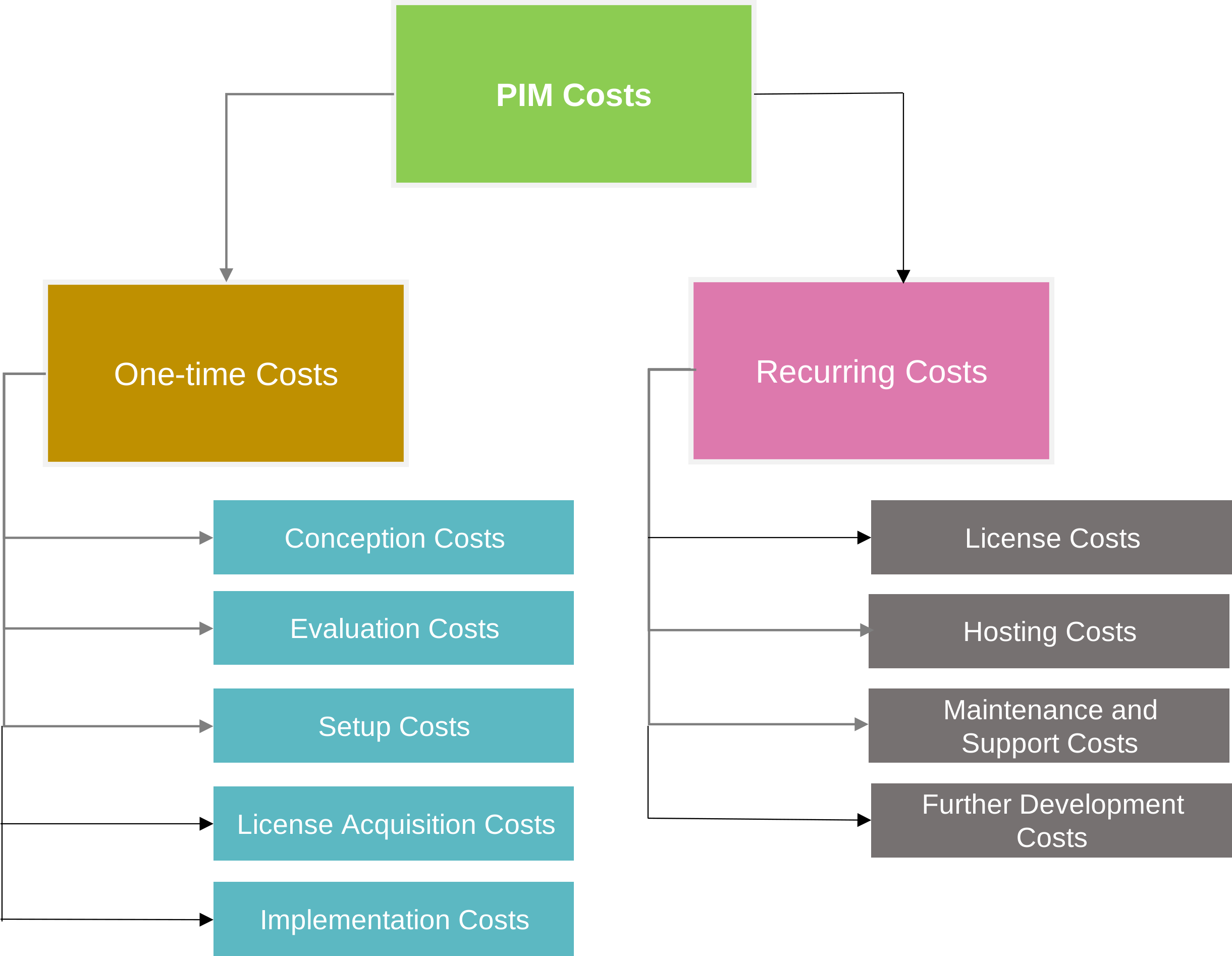
PIM costs fall into two large blocks: one-time investments and ongoing costs. Both matter, but companies consistently underestimate the second.
One-Time PIM Investments
One-time costs include everything from pre-project consulting through to implementation and initial license acquisition.
Conception and Evaluation Costs
Before any software is selected, most mid-sized and enterprise companies spend time defining what they actually need. This phase includes deciding who will use the system, what data it needs to manage, which business processes it should support, and whether on-premise, SaaS, or open-source fits the organization. If this work is done internally, there are no direct costs. If an external PIM consultant is involved, costs start quickly.
Consultant fees for this phase alone can reach €10,000. A structured two-day workshop on PIM requirements typically starts at €2,000. Evaluation work, where a shortlist of vendors completes questionnaires and presents to the team, commonly costs €4,000 or more when a consultant is present to assess fit.
These costs are optional in the sense that you can skip outside help. But for companies that have never implemented a PIM before, the cost of choosing wrong is almost always higher than the cost of getting advice.
One cost that rarely makes it onto any budget template: internal staff time. Every hour your product managers, IT leads, and department heads spend on requirements workshops, vendor demos, and evaluation scoring is a real cost, even if no invoice arrives. For a mid-sized manufacturer with a cross-functional team involved in selection, this can easily total several weeks of combined effort before a contract is signed.
Design Costs
Once a platform is selected, the design phase translates business requirements into a technical blueprint. This includes decisions about your product data hierarchy, how your ERP and PIM will divide responsibilities for master data, how workflows across teams will be reflected in system configuration, and which output channels need to be connected. Getting this wrong is expensive to fix later. External consultants who specialize in PIM architecture charge for this phase separately from implementation, and those costs compound if the design needs rework mid-project.
Implementation Costs
Implementation is nearly always the largest single cost category, and it is the one most often underestimated.
PIM implementation cost depends entirely on your requirements. At enterprise scale, implementation costs are typically equal to or greater than the first year of license fees. For a manufacturer running a complex product catalog across multiple channels and ERP integrations, the project scope expands accordingly.
Typical implementation cost drivers include:
- Data migration from existing systems, which typically costs between $5,000 and $30,000+ depending on how clean the source data is
- ERP, marketplace, and e-commerce integrations, each requiring scoping, development, and testing. Custom connectors can add $3,000 to $20,000+ per connection
- Workflow configuration, role setup, and process automation, which expand significantly with complex approval chains or multi-team publishing processes
- Custom feature development for requirements outside standard platform capabilities
- Employee training and system launch
In projects we have implemented, data migration is consistently the item most underestimated at the budgeting stage. Companies often discover during migration that their existing product data is more fragmented and inconsistent than assumed. That cleanup work adds time and cost.
Open-source PIM solutions carry no license fee, but they are not free. Implementation costs apply regardless of license model. If the wrong platform is chosen, those implementation costs can exceed the full cost of adopting a different solution from scratch.
Ongoing PIM Costs
Ongoing costs are where PIM budgets most often go wrong. They are regular, they compound, and vendors rarely surface them clearly upfront. License fees are the most visible part of this, but rarely the largest.
PIM software pricing comes in two license structures: rental licenses, paid monthly or annually, and purchase licenses, which are a one-time payment. Purchase licenses sound simpler, but they rarely include the right to software updates and upgrades. In many cases, vendors require a separate maintenance and support contract to access them. Always verify what update rights are included before signing.
License pricing typically depends on the number of users, the number of SKUs, the number of supported languages, which software modules are required, and how many output channels the system serves. For SaaS deployments, license costs are rolled into the subscription. For on-premise deployments, they recur separately. Some software modules are licensed and billed independently, which can meaningfully increase the ongoing total.
Maintenance and Support Costs
For on-premise deployments, annual maintenance fees typically run 15% to 25% of the original license cost. SaaS deployments include this in the subscription. Open-source deployments vary by provider.
The factors that most influence support pricing are response time commitments, whether developer support is included, and whether a dedicated contact person is part of the package. Some vendors offer tiered support packages where faster response times and direct access to engineers cost significantly more than the base tier.
Further Development Costs
No PIM implementation stays static. Business requirements change, product data structures evolve, new channels are added. Further development is usually billed at standard daily rates, and the effort required for the same change varies significantly between platforms. A workflow adjustment that takes one day in a well-architected system can take five in a rigid one. Most standard SaaS plans do not support platform-level customization, though some enterprise SaaS tiers do at additional cost. This is one of the strongest arguments for choosing a platform that is configurable without requiring a developer for every change.
Hosting Costs
All PIM software runs somewhere: your own data center, rented server infrastructure, or a cloud environment. SaaS deployments include hosting in the subscription. For on-premise deployments, enterprise solutions sometimes require multiple servers, which can push infrastructure costs above €2,000 per month. Self-hosted open-source deployments on cloud infrastructure typically run €200–€800 per month depending on catalog size and traffic, before factoring in IT staffing or managed service costs.
Hidden PIM Costs Worth Knowing Before You Sign
Integration and connector fees. Custom ERP or e-commerce connectors typically cost $3,000 to $20,000+ per integration. Pre-built connectors are sometimes included in a base subscription, sometimes not. Always confirm which integrations are included and which require additional development.
Configuration complexity. As implementations grow more complex, setup work that seemed covered by the base package starts generating separate charges. Workflow adjustments, custom data models, and non-standard output configurations are common examples where costs appear that were not in the original scope.
Module and feature gating. Not all PIM packages are equivalent. Some vendors offer all-inclusive pricing. Others charge separately for additional modules, output channels, or user roles. A line-by-line review of what is and is not included before signing is not optional.
AI and automation add-ons. AI-powered features such as automated content enrichment, smart categorization, translation assistance, and data quality monitoring are increasingly available across PIM platforms, but rarely included in base plans. Some vendors bundle them into higher tiers. Others sell them as separate modules. If AI-driven enrichment is part of your workflow, verify exactly what tier unlocks it and what it costs before you compare headline prices across platforms.
Scaling surcharges. Most SaaS PIM plans tier by SKU count, user seats, or channel volume. Growth that pushes you into the next tier can meaningfully increase your annual cost overnight. A catalog that grows from 20,000 to 60,000 SKUs, or a team that expands from five to fifteen users, can trigger tier jumps that were not part of the original budget model. Ask every vendor for the pricing at the next two tiers up before you sign at the current one.
Change management and training. Getting staff to actually adopt a new system takes time and structured effort. Initial training is usually scoped into the implementation project, but ongoing training for new hires is not. Some vendors charge for refresher sessions. Others provide only documentation. The harder-to-quantify cost is the productivity dip during the 3–6 month adoption window, which is real even when no invoice is attached to it.
Vendor lock-in and exit costs. Proprietary data formats and limited export functionality are a practical form of lock-in. If you select a platform and later discover it cannot meet your requirements, switching means paying for a second implementation while absorbing the sunk cost of the first. Before signing any multi-year contract, get clear answers on data portability, export options, and what early termination costs.
Our customers turn to us after discovering that the platform they initially selected looked cheaper on paper because key modules were sold separately or integrations required custom API work not covered by the implementation quote. By the time those costs appeared, switching was expensive but staying was more expensive.
What Influences PIM Pricing
SKU count is the single most reliable proxy for cost. Most SaaS vendors tier their pricing directly around it, and the jump from 10,000 to 100,000 SKUs can double the annual subscription. Know your current count and your projected growth over the next two to three years before any vendor conversation starts.
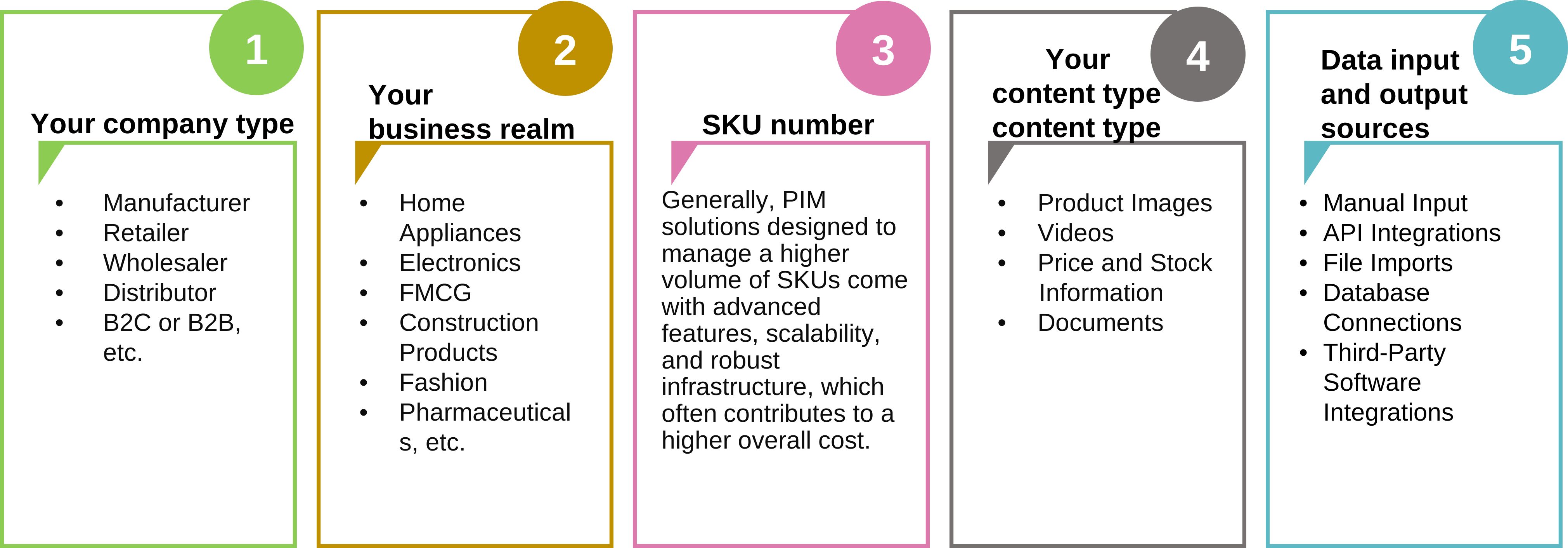
Integration complexity moves the needle almost as much. A PIM connected to one ERP and one e-commerce platform is a fundamentally different project from one feeding 15 marketplaces, a print catalog system, and a distributor portal. Each connection adds scoping, development, and testing time. Custom connectors for non-standard systems can cost $3,000 to $20,000+ per integration.
Data type matters more than many buyers expect. A catalog of 5,000 SKUs with HD video assets, multilingual descriptions, and technical specification sheets creates a heavier data management burden than 50,000 simple product records. Storage limits, DAM capabilities, and localization requirements all feed into the final price.
A mid-sized industrial equipment manufacturer with 15,000 SKUs, an ERP integration, and three distribution channels will have a fundamentally different cost profile from a distributor syndicating to 20 marketplaces with a multi-language catalog and HD asset library.
PIM Costs vs. ROI: The Business Case
Organizations that implement PIM report a 16% average increase in sales from improved product content quality and a 21% average reduction in return rates from more accurate product data. They also report a 29% faster product launch cycle and 30% less time spent on manual data enrichment tasks.
For a mid-sized manufacturer running $4 million in annual product revenue, a 16% content-driven uplift represents $640,000. The labor savings from reduced manual enrichment across a five-person team are real but secondary. The larger financial return almost always sits on the revenue side, not the efficiency side.
How PIM Costs Evolve Over Time: TCO by Year
PIM pricing is not static. Total cost of ownership follows a recognizable pattern across most implementations, and understanding it helps you model budget needs beyond year one.
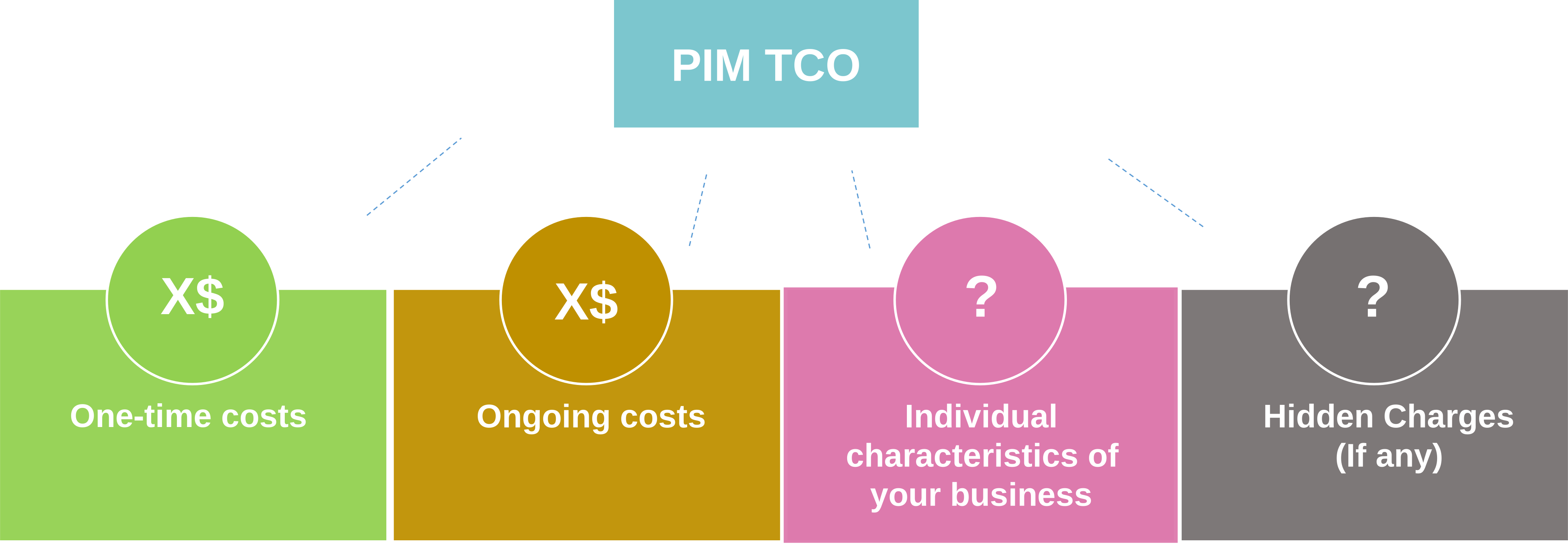
Year one is the most expensive. Implementation, data migration, integration setup, and initial training all land in this window. This is where the majority of one-time costs are concentrated, and where surprises most often emerge.
Years two and three stabilize. Ongoing license fees, maintenance, and incremental development continue, but the heavy project costs are behind you. Teams are productive in the system. The per-year cost drops significantly from year one.
Years four and five can spike again. Catalog growth pushes you into higher pricing tiers. New sales channels require additional integration work. Team expansion adds user seats. Markets or regions you didn't originally scope for require localization. None of these are failures; they're signs the system is doing its job. But they need to be in the budget model from the start.
For most mid-sized manufacturers and distributors, total cost of ownership over three years is a more useful planning number than the annual license fee. A SaaS platform at €30,000–€50,000 per year looks very different once year-one integration and onboarding costs are factored in alongside the subscription.
Questions to Ask Every PIM Vendor
Most vendor conversations start well before the relevant cost questions come up. Going in with specific questions forces answers you would otherwise get only after a proposal is on the table.
On licensing and scaling: ask exactly what is included in the base price: features, user seats, SKU limits, and output channels. Also ask what triggers a price increase. Get the next two pricing tiers in writing before committing, so you can model growth scenarios without surprises. Vague answers on either question are a signal worth noting.
On integrations and implementation: find out whether connectors to your ERP, e-commerce platform, and key marketplaces are bundled or billed separately, and whether custom API development is handled by the vendor or passed to a third-party partner at additional cost. If implementation is not included in the contract, clarify who owns it, what the timeline looks like, and how scope overruns are handled.
On support: standard and premium support mean very different things depending on the vendor. Ask specifically about response times, available channels, and whether a dedicated contact is included at your pricing tier or costs extra.
On exit terms: a vendor confident in their platform will have a clear, documented answer on data portability and export options. Proprietary formats and restricted export functionality are a practical form of lock-in worth identifying before you sign. Multi-year contracts often carry better pricing but less flexibility. Know the auto-renewal clauses and early termination costs before you agree to anything.
PIM Pricing Compared: SaaS vs. On-Premise
Few PIM vendors publish pricing publicly. The table below reflects the realistic cost ranges for SaaS PIM pricing and on-premise licensing across a representative set of platforms. Vendors with non-public pricing have leeway for negotiation, which is worth understanding when entering any commercial conversation.
Among the platforms below, AtroPIM is the only one available in both deployment models: as a SaaS subscription and as a zero-license on-premise installation, with implementation starting from €10,000 in either case. That gives it the lowest total cost of entry of any enterprise platform in this comparison.
| Platform | Implementation costs | License costs |
|---|---|---|
| SaaS | ||
| Plytix | not offered | from € 6,000 / year |
| AtroPIM | from € 10,000 | from € 5,000 / year |
| Akeneo | from € 30,000 | from € 25,000 / year |
| Pimberly | from € 30,000 | from € 30,000 / year |
| Pimcore | from € 30,000 | from € 34,000 / year |
| inRiver | from € 50,000 | from € 50,000 / year |
| On-Premise / Enterprise | ||
| AtroPIM | from € 10,000 | none |
| Centric PXM (formerly ContentServ) | from € 100,000 | from € 100,000 / year |
| Stibo Systems | from € 150,000 | from € 150,000 / year |
| Informatica | from € 200,000 | from € 150,000 / year |
| Syndigo (formerly Riversand) | from € 100,000 | from € 80,000 / year |
The right platform is not the cheapest one. It is the one whose total cost of ownership over three to five years is the lowest for your specific scale, technical requirements, and integration complexity. A platform that looks cheaper on paper but charges per user, gates integrations behind paid modules, and locks your data in will outprice a higher starting point within two years.