


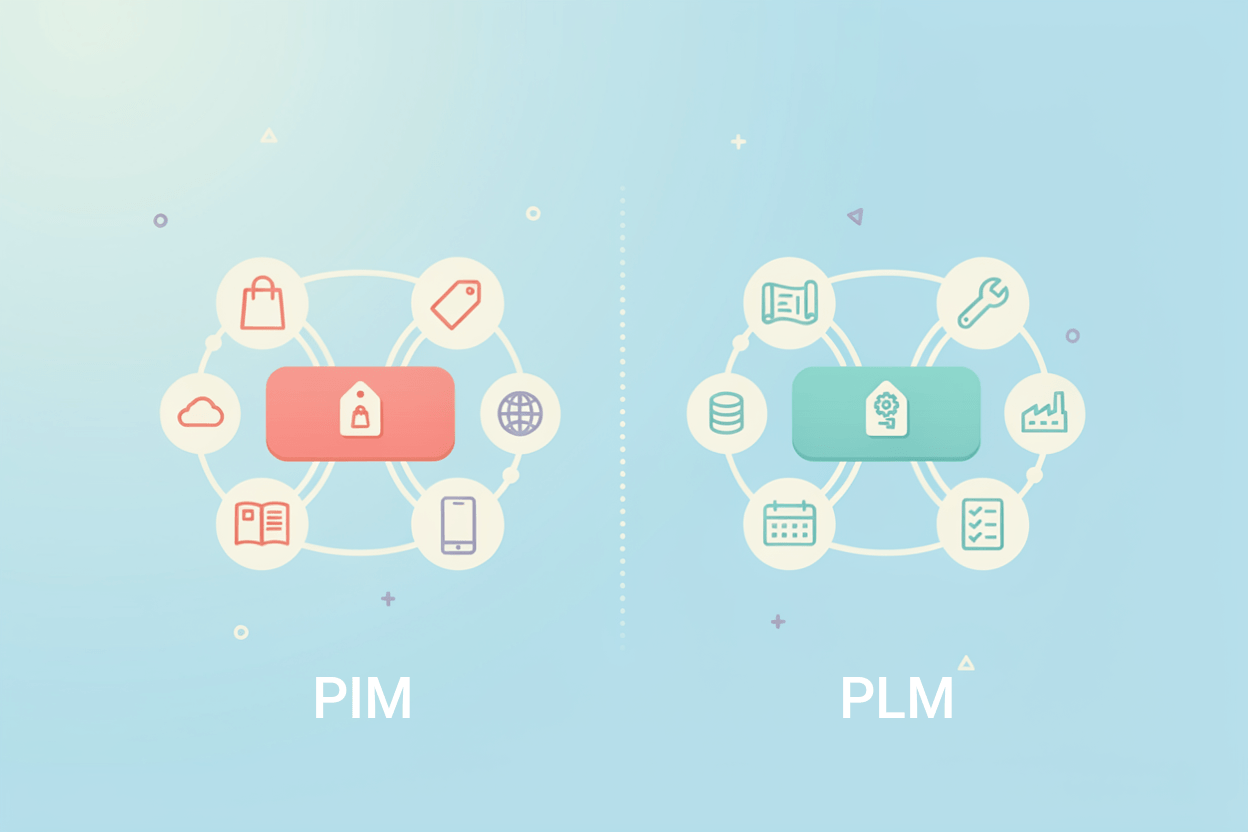
The distinction between PLM and PIM comes down to a straightforward division of labor. Product lifecycle management governs how a product is built, while product information management governs how it is sold. That framing resolves most of the common confusion, but the practical differences start to matter as soon as you evaluate software or try to connect two systems that already hold overlapping data.
This article explains what each system does, where their responsibilities overlap, which vendors lead each category, and how to link them so your product information no longer lives in several disconnected places at once.
What PLM Does
Product Lifecycle Management follows a product from the first sketch to the day it leaves the catalog. Engineers, R&D, quality, and manufacturing teams work inside it. It stores CAD files, bills of materials, revisions, engineering change requests, and compliance records. The job is to control how a product gets designed and built.
A PLM system answers one question well: how a product is made and what changed since the last version. When an engineer swaps a component or tightens a tolerance, the PLM logs it and keeps the full history. That history is the reason regulated industries like aerospace, automotive, and medical devices treat PLM as non-negotiable.
The PLM software market reached about USD 47.9 billion in 2025 and is forecast to hit USD 93.1 billion by 2033, according to Grand View Research.
What PIM Does
Product Information Management picks up where marketing and sales start. It centralizes the data customers actually see: product names, descriptions, attributes, images, videos, translations, and content shaped for each channel. Marketing, e-commerce, and sales teams live in it every day.
A PIM does not care how a product was engineered. It cares that every channel shows correct, complete, and consistent information. You maintain the data once and publish it everywhere, from a webshop to a print catalog to a marketplace feed.
The PIM market is smaller but growing faster. It stood at USD 5.48 billion in 2025 and is projected to reach USD 20.66 billion by 2034, a compound annual growth rate of 15%, per Fortune Business Insights. E-commerce complexity is the main driver.
The Core Difference In One Line
PLM answers how a product is made. PIM answers how a product is sold.
The overlap in stored data is the main source of confusion between the two, yet the real distinction lies in timing and audience. PLM governs the development phase and the technical record, while PIM governs the commercial phase and the customer-facing record. A single item may originate in PLM as a part number with an engineering tolerance and later surface in PIM as a product bullet point that a shopper reads before buying.
Where PIM And PLM Overlap
Both store product data. Both control access, run approval workflows, and track versions. That shared ground is exactly why buyers sometimes purchase one system expecting it to do the other's job.
It rarely works, since classic PIM will not run engineering change management, while a PLM will not push marketing copy to Amazon in the right format with the right images and localized text. Force either one into the wrong role and you rebuild the data mess you bought software to remove.
How PIM And PLM Work Together
The two systems are supposed to work in sequence. Technical data created in PLM moves downstream into PIM, where it becomes channel-ready content. Data that typically crosses that bridge includes:
- Technical specifications and attributes pulled from the bill of materials
- Compliance and certification data tied to each part
- Measurements, weights, and dimensions derived from CAD
- The base product structure and variant relationships
Most of the trouble comes from moving the data by hand. Someone exports a spreadsheet, edits it, and imports it into another system. Engineering then releases a revision; the copy nobody updated falls out of date, and sales quotes a specification that changed weeks ago. In our projects, the problem almost always starts at this handoff rather than inside either system. The fix is a direct, automated connection between PLM and PIM instead of a shared folder.
PLM Solutions Worth Knowing
These are the major vendors, not the whole field, and each leans toward particular industries. SAP, Oracle, and Autodesk also sell PLM, and plenty of niche tools serve specific sectors.
Siemens Teamcenter is one of the most widely deployed PLM platforms, strong in complex manufacturing and deeply tied to Siemens engineering tools. It suits large organizations with heavy CAD and simulation needs.
PTC Windchill focuses on the digital thread, linking product data across CAD, ERP, and IoT so information stays connected from design through service. PTC also offers Windchill+ as a cloud version for teams moving off on-premise setups.
Dassault Systèmes covers PLM through ENOVIA on its 3DEXPERIENCE platform, popular in automotive and aerospace where design, simulation, and lifecycle data sit in one environment.
Aras Innovator takes a different route with a low-code, highly configurable model and a free-to-use core. Manufacturers that expect their processes to change often tend to like how far it bends without custom code.
PIM Solutions Worth Knowing
The PIM field is also wider than any short list, spanning enterprise governance tools, commerce-focused SaaS, and open-source platforms. A representative sample across those three groups:
Informatica and Stibo Systems come from the master-data world. They suit large enterprises that need heavy governance and data quality across many domains, with product data as one piece of a bigger picture, and they carry enterprise pricing to match.
Salsify and inriver are commerce-focused SaaS products built around enrichment, syndication, and digital-shelf analytics. They remove hosting and maintenance work, and in return you work within a data model the vendor controls.
Akeneo has a large partner ecosystem and managed SaaS editions. Its open-source Community Edition has wound down since 2023 as Akeneo moved to paid SaaS, with CE support ending toward 2026, so the open-source route now leans on forks and third-party support (source: Webkul).
AtroPIM is an open-source PIM system built on top of AtroCore, an open-source Business Application Platform that combines PIM, MDM, DAM, and system integration in one place. It connects to external systems, including PLMs, through a REST API, and offers customized integrations. As with any self-hosted tool, you run and maintain it yourself or buy support.
Integrating PLM And PIM In Practice
The same pattern shows up across manufacturers. Engineering data lives in a PLM, order and pricing data in an ERP, and the product descriptions that customers actually read sit in a pile of spreadsheets that several people edit. None of it agrees, so a dimension in the PLM does not match the one on the website, and no one is sure which figure is correct.
Before the two systems are connected, the result is slow listings and constant rework. Every new product means copying specifications by hand from the PLM export into marketing files, then fixing the same errors on every channel. Connecting the PLM to a PIM through an API changes the flow. Technical attributes and measurements sync from the engineering source, the marketing team enriches each record with descriptions and assets on top, and completeness checks show what is still missing before anything publishes.
A clean integration comes down to a few decisions:
- Map which fields are mastered in PLM and which in PIM, so nothing gets edited in two places
- Pick the trigger for a sync, whether a released revision, a status change, or a schedule
- Use the REST API or automated import feeds instead of manual CSV exports
- Keep digital assets moving alongside specifications, not stranded in a separate silo
Because AtroPIM sits on a configurable platform, the same instance can also hold supplier data, technical documentation, and other records that usually fall between PLM and ERP. That reduces the number of half-connected systems a small team has to babysit.
What To Watch Before You Buy
Not every company needs both systems. A pure manufacturer with a short SKU list and no online sales may only need PLM. A distributor who designs nothing but sells across many channels needs PIM, not PLM. The gray zone is the manufacturer who both builds and sells across channels, and that group almost always needs the two connected rather than one doing double duty.
The vendor market is also drawing its own conclusion. On February 25, 2025, Centric Software, a Dassault Systèmes subsidiary and a PLM vendor, announced an agreement to acquire the PIM and PXM provider Contentserv for an enterprise value of about €220 million, folding product information management into a PLM portfolio (source: Dassault Systèmes). When a PLM company buys a PIM company, that is a fair signal about where the boundary is heading. The two jobs stay distinct, but the wall between them keeps getting lower.