


Without a clear product hierarchy, a complex catalog becomes an operational liability. Data gets duplicated. Attributes fall out of sync. Updates that should take minutes take days because there is no structural logic to propagate changes through. These are not edge cases. They are predictable outcomes of flat or inconsistent catalog structures.
Product hierarchy best practices address this directly. They define how categories, product families, variants, and SKUs relate to each other, how attributes flow between levels, and how the structure scales without breaking.
What a Good Product Hierarchy Actually Does
A product hierarchy organizes a catalog into levels: typically product categories, subcategories, product families, and individual variants. The operational value is attribute inheritance. Attributes defined at a higher level flow automatically to every product beneath it.
If you manage a clothing catalog and update the material attribute at the T-Shirt family level to "100% Organic Cotton," that change propagates to every size and color variant under that family in one step. Without a hierarchy, the same update means touching every individual SKU.
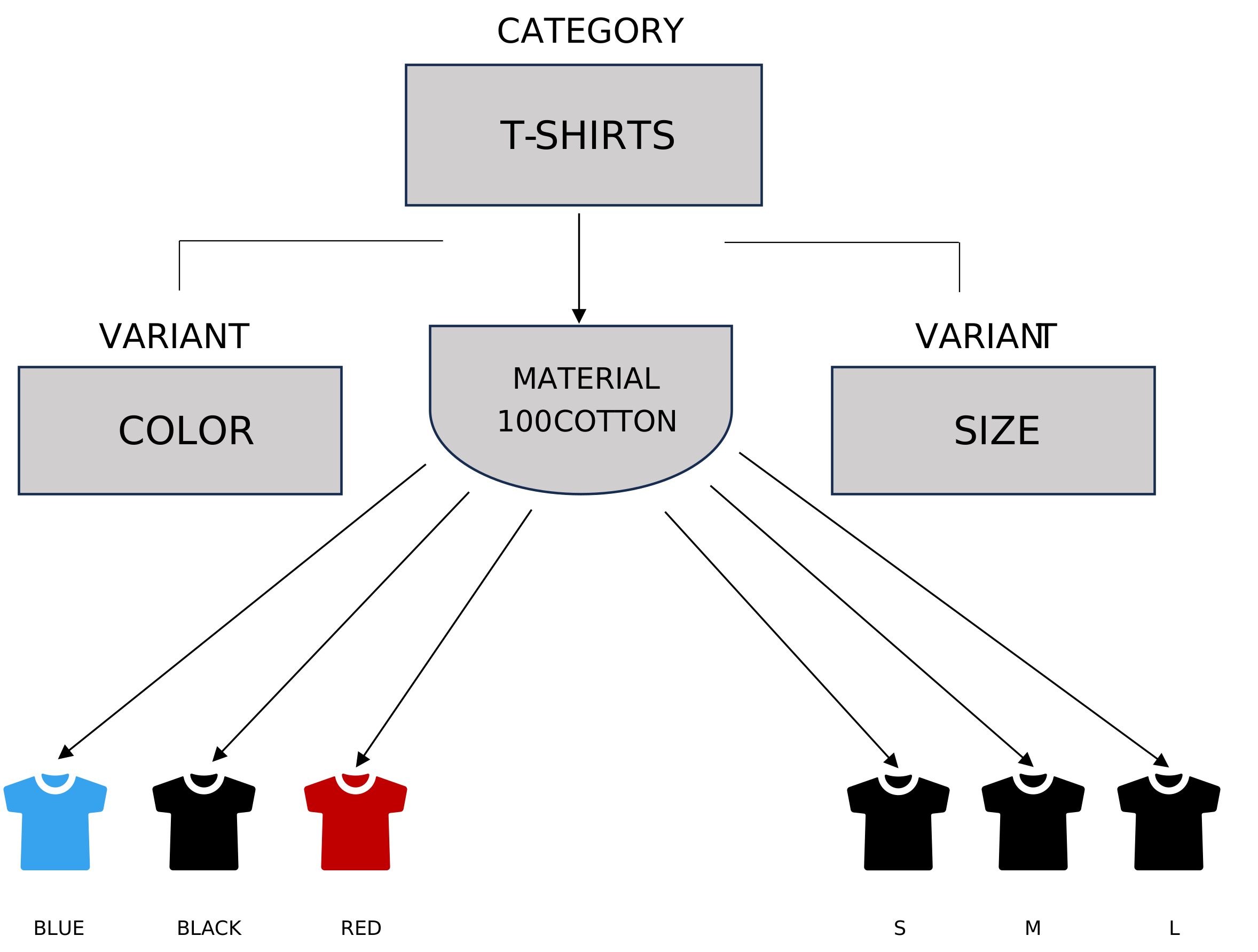
Inheritance also accelerates content production. When shared attributes are already populated at the parent level, creating a new variant means filling in only what distinguishes it, not rebuilding a full product record from scratch.
But inheritance is only useful when it is intentional. The first product hierarchy best practice is deciding which attributes belong at which level before you start building.
Define Hierarchy Depth and Category Structure Before You Build
A common mistake is adding hierarchy levels reactively, one at a time, as edge cases appear. That produces a product catalog structure that is technically multi-level but logically inconsistent: some categories go three levels deep, others go five, with no documented rule explaining why.
Before building, map out the maximum depth your catalog genuinely needs. For most manufacturers, three to four levels covers the majority of use cases:
- Level 1: Product category (e.g., Power Tools)
- Level 2: Product family (e.g., Angle Grinders)
- Level 3: Product model (e.g., 115mm Angle Grinder, 700W)
- Level 4: Variant (e.g., specific SKUs by voltage or accessory kit)
Once that structure is defined, it becomes the template for the entire catalog. Every new product line gets placed into the same logic. Exceptions are managed explicitly, not by bending the structure.
The depth rule also prevents over-categorization. Too many category levels slow down search re-indexing, make navigation harder for downstream systems, and create maintenance overhead that outweighs any organizational benefit.
Establish Consistent Naming Conventions Across All Levels
Naming conventions are where product hierarchy best practices fail most visibly. A well-structured hierarchy with inconsistent naming is nearly as hard to manage as no hierarchy at all. Different teams use different abbreviations. New products get names that break existing patterns. Variant identifiers collide.
The rule is simple: one naming standard, applied without exceptions, documented from day one.
For product categories and families, use human-readable names that reflect the product type, not internal jargon. For SKUs, build the naming convention left to right, general to specific. A useful pattern for manufacturers:
[Product Type]-[Model]-[Key Variant Attribute]-[Sub-variant]Example:AGRND-115-700W-KIT1
This makes SKUs self-describing. A warehouse picker, a product manager, and an ERP system can all interpret the code without a lookup table.
Apply the same logic to attribute names. If one team calls it "PackagingWidth" and another calls it "PkgW," they are creating two attributes where one should exist. Consistent attribute naming is part of the same governance problem as consistent product naming, and the fix is the same: document the standard and enforce it at the point of entry.
Use Parent-Child Relationships to Control Attribute Inheritance
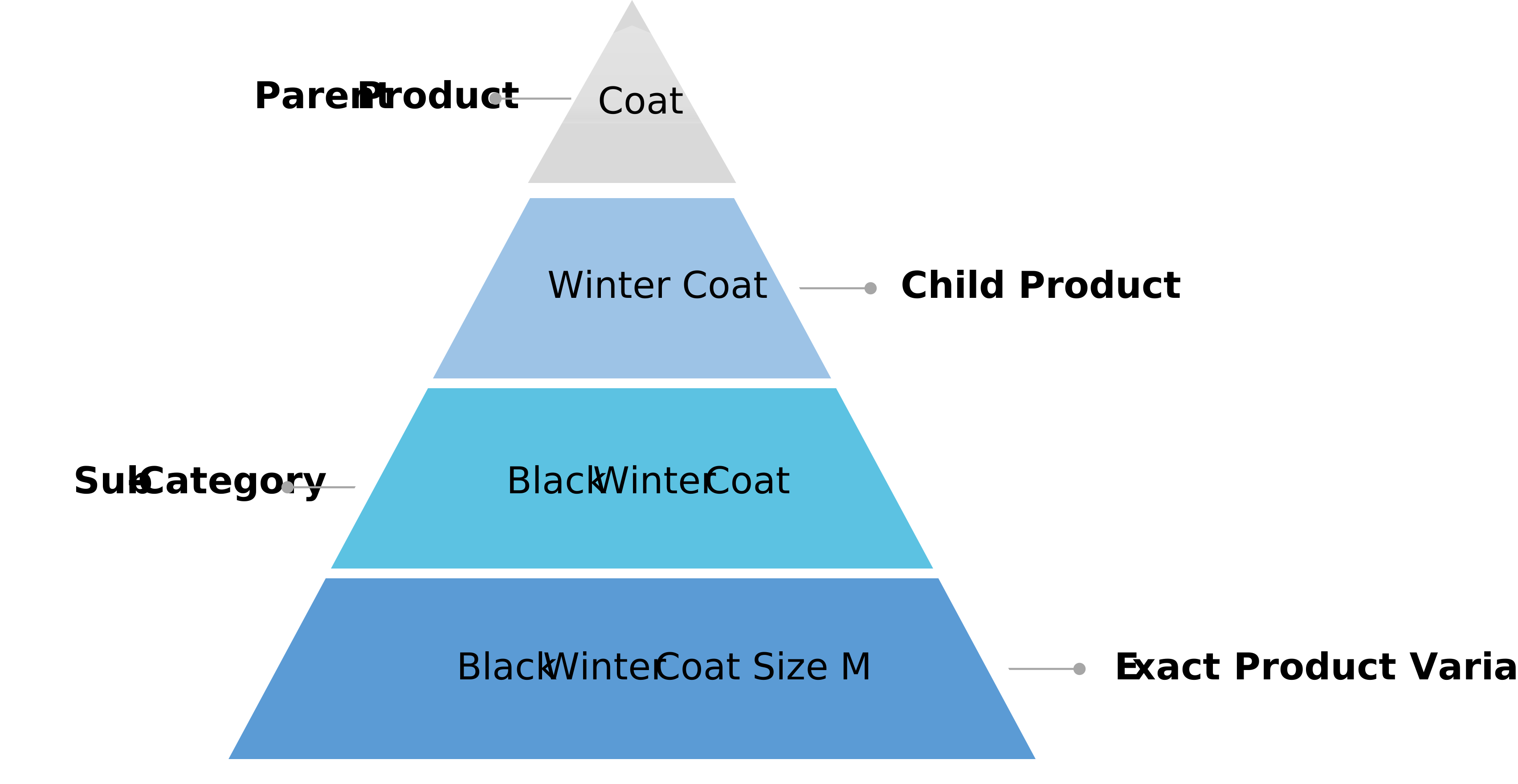
The technical backbone of a sound product category hierarchy is the parent-child relationship. A parent product holds the shared attributes. Child products inherit those attributes and add or override only what is distinct at their level.
This model works well when the rules are explicit:
- Attributes always shared across variants belong at the parent level and should be auto-inherited at the child level.
- Variant-generating attributes, like color, size, or voltage, are defined at the child level.
- Attributes that are sometimes shared and sometimes unique, like packaging dimensions, need a clear policy for which level owns them.
In projects we implemented for manufacturers of industrial equipment and electrical components, the largest data quality problems traced back to the same root cause: no one had documented which level owned which attribute. Teams updated attributes at the wrong level, inheritance was overridden inconsistently, and variant data diverged from the parent over time. In one case, a manufacturer of automotive components was spending roughly three hours per product release correcting attribute conflicts that should have been impossible by design. A written attribute ownership map, introduced before the next release cycle, brought that correction work to near zero within two months.
That document is part of your data governance policy. It does not need to be complex. It needs to exist and be maintained.
Separate Classifying Attributes from Variant-Generating Attributes
Not every attribute creates a variant. Size creates a variant. A product serial number does not. Mixing these two types at the same hierarchy level produces bloated variant trees and unnecessary SKU proliferation.
The practical rule: an attribute generates a variant only when a buyer would need to choose between two products because of it. Color, size, material, and voltage meet that threshold. Weight tolerance, certification body, and country of manufacture typically do not.
Keeping these attribute types separate also improves downstream processes. Variant-generating attributes drive configurator logic and channel listings. Classifying attributes drive search filters, technical documentation, and compliance management. They serve different audiences and belong in different attribute groups within the catalog hierarchy.
SKU proliferation from mixing these types is a real cost. Each additional SKU requires its own record, its own inventory line, and its own maintenance burden. Manufacturers with configurable products, like industrial safety equipment or building materials with dozens of finish and certification combinations, manage SKU counts by being disciplined about which attributes are truly variant-generating and which are just descriptive.
Build Product Taxonomy and Catalog Hierarchy as Separate Layers
Taxonomy and hierarchy are often treated as the same thing. They are related but distinct.
Taxonomy is classification: the rules that define what a product is. It determines which attributes a product should have based on its type. Hierarchy is structure: the parent-child tree that organizes relationships between products and controls how product data flows between records.
A product can belong to a taxonomy class, such as "Hand-Held Power Tool" in an ETIM classification, without that taxonomy driving the catalog hierarchy used for day-to-day management. In practice, the taxonomy determines the attribute template. The hierarchy determines how data is organized and inherited.
To make this concrete: suppose ETIM releases an updated classification for power tools that renames an attribute group and adds two new mandatory fields. If your taxonomy and hierarchy are the same layer, that update requires touching your catalog structure. If they are separate, you update the taxonomy template, the new attributes appear on the right products, and your parent-child hierarchy stays intact. The two changes do not interfere with each other.
Keeping them separate means you can also reclassify a product for one sales channel without restructuring your entire catalog hierarchy. Your internal product structure stays stable when external classification standards change, which they do on a regular basis in regulated industries like electrical engineering, automotive components, and construction materials.
Manage Product Bundles as Hierarchical Entities
Bundles add a layer of complexity that flat catalog structures cannot handle. A bundle is a product composed of other products, each with its own attributes, pricing, and stock status. It needs to exist as a sellable unit while its components remain individually manageable.
The best practice is to model bundles explicitly in the hierarchy: a bundle parent record with component products linked as children, each retaining their own attribute sets. This approach lets you update the price or availability of a component once and have that change reflected accurately in the bundle record.
Bundles built by copying attributes manually into a single flat record fail in predictable ways: components get updated, the bundle does not, and buyers or sales teams end up working with stale data. For manufacturers selling spare parts kits, accessory bundles, or configured machine packages, this is not a hypothetical. It is a daily operational problem in catalogs that lack a proper hierarchical structure for bundles.
Plan for Multi-Channel Output from the Start
A product catalog structure built for one channel creates problems when the same catalog needs to feed an e-commerce storefront, a marketplace, an ERP, or a print catalog. Different channels require different attribute sets, different image specifications, and sometimes different category structures.
The best practice is to build the master hierarchy in a channel-neutral way, then map it to channel-specific requirements as a separate layer. The master hierarchy holds all product data at full depth. Channel mappings define which attributes and levels get exported to which destination, and in what format.
This avoids the common failure mode of building separate product records for each channel. That approach produces duplication and turns any single product update into a multi-system exercise. A single source of truth in the master hierarchy, with channel-specific views layered on top, is the architecture that scales.
Keep Hierarchy Updates Automated Where Possible
Dynamic hierarchy updates are among the most underused capabilities in modern PIM systems. When a parent record changes, those changes should propagate automatically to child records without manual intervention.
In catalogs with thousands of SKUs, manual propagation is not a process. It is a source of error. The practical standard: any attribute defined at a parent level should require no action at the child level unless a deliberate override has been set.
When a manufacturer of building materials updates a fire-resistance rating at the product family level, that change should immediately appear on every variant in the family: every dimension, finish, and certification SKU. If it does not, the catalog is a liability in regulated sales channels.
That kind of propagation requires a PIM that treats parent-child inheritance as a first-class feature, not an optional configuration. AtroPIM handles this through its parent-child product structure and the Advanced Classification module, which controls attribute inheritance across all hierarchy levels and allows overrides to be set explicitly at any level without breaking the parent relationship. Product bundles are managed natively, with each component retaining its own attributes while the bundle record reflects the composed product. AtroPIM is built on the AtroCore platform, which gives it a data model flexible enough to handle catalog structures well beyond what standard PIM systems support. Full details on capabilities and deployment options are on the AtroPIM features page.
Document the Hierarchy and Version-Control Changes
A well-designed product catalog structure only stays well-designed if the logic behind it is documented. Without documentation, the rules exist only in the heads of the people who built it. When those people change roles, the rules change too, informally and inconsistently.
Document at minimum: the defined hierarchy levels and what each represents. Add the attribute ownership policy: which level owns which attribute. Record the naming conventions for categories, families, models, and SKUs. And define the criteria for when an attribute is variant-generating versus classifying.
Use version control for that documentation. When the structure changes, a record of what changed and why is essential for downstream processes: system migrations, year-over-year reporting comparisons, and integration mappings that reference specific hierarchy levels.
Our customers who maintain this kind of documentation handle system migrations significantly faster than those who do not. In one PIM migration project for a building materials manufacturer, the hierarchy documentation cut the attribute remapping phase from an estimated four weeks to under one week. The catalog logic was already in writing. The migration team did not have to reconstruct it from the data.
Validate Hierarchy Integrity Regularly
Even a well-designed product hierarchy degrades over time. Products are added under the wrong parent. Overrides accumulate without documentation. Taxonomy classes drift out of sync with the actual attribute sets in use.
A regular hierarchy audit, quarterly for most catalogs, monthly for high-velocity ones, should cover three areas:
- Orphaned records: products with no parent or outside the defined catalog structure.
- Override accumulation: child-level attributes overriding the parent value without a documented reason.
- Depth consistency: whether the number of levels in use matches the defined standard, and whether exceptions are justified.
Our customers typically discover the most significant data quality issues not through product audits but through hierarchy audits. Structural inconsistencies surface faster than individual attribute errors, and they are usually the upstream cause of those attribute problems.
Choose a PIM That Matches Your Hierarchy Requirements
Not every PIM handles complex product hierarchies well. Some systems support parent-child relationships only at one level. Others do not allow attribute inheritance to be configured at granular levels. A few require workarounds, like duplicating product families, to handle variants that share most but not all parent attributes.
The features that matter most for complex catalog structures are multi-level hierarchy support, configurable attribute inheritance with explicit override controls, native bundle management, and integration with ERP and e-commerce platforms that can receive structured hierarchical data rather than flat exports.
Systems worth evaluating include Akeneo, which uses product models and families for variant management, Stibo Systems, which handles complex hierarchies in retail and manufacturing contexts, and Informatica PIM, which is capable at enterprise scale but carries significant complexity and cost.
AtroPIM is an open-source option that supports multi-level hierarchies, parent-child relationships with configurable inheritance, product bundles, and a modular architecture that lets you add functionality without paying for what you do not need. It runs on-premise or as SaaS, which matters for manufacturers with data residency or integration requirements.
The right choice depends on catalog depth, variant complexity, integration requirements, and budget. But no system compensates for a hierarchy design that was not planned before implementation. Document the structure first. Then select the tool that fits it.