


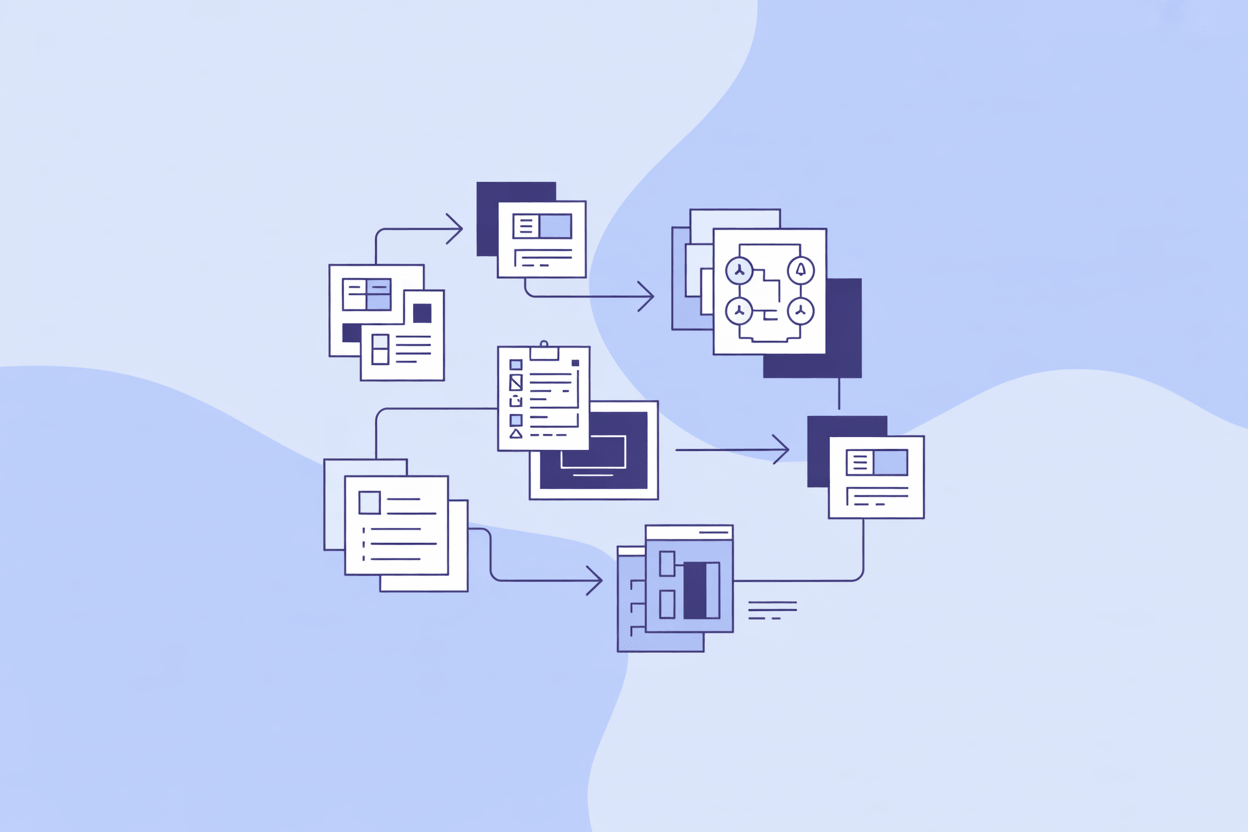
Product information management (PIM) is a set of processes and tools used to collect, enrich, and distribute product data across sales and marketing channels. Most companies understand the concept. Fewer have a clear picture of how the process actually runs: where data enters, how it gets structured, who owns each step, and what happens when something breaks.
What the PIM Process Is Actually Doing
At the core, a PIM process creates a single source of truth for product data. Product data originates in many places: supplier spreadsheets, ERP systems, CAD files, packaging documents, lab test reports. It needs to end up in many other places: e-commerce platforms, print catalogs, distributor portals, retailer feeds, marketplace listings. The PIM process is what connects those two ends and keeps the data consistent across all of them.
Without a defined process, companies end up with data scattered across email threads, shared drives, and disconnected systems. Teams manually reconcile versions. Errors reach customers. Product launches get delayed.
The process itself has six recognizable stages, though the boundaries between them are often blurry in practice.
Stage 1: Data Collection
Product data comes in from multiple sources simultaneously. Suppliers send specification sheets in different formats. Internal engineering teams produce technical drawings. Marketing writes copy that never makes it into a central system. Procurement maintains its own spreadsheet of supplier codes.
In a mature PIM process, collection is systematized. Suppliers submit data through a structured onboarding portal. Internal teams enter data directly into the PIM. Imports from ERP, MDM (master data management), or PLM systems happen automatically via API or scheduled file transfer. Digital assets like images, videos, and documents flow in from a DAM system or are uploaded directly.
In practice, most mid-size manufacturers start with a messier version of this. Data arrives in whatever format the supplier prefers, and someone manually maps it to the internal data model. That manual step is where errors accumulate fastest.
Stage 2: Data Modeling and Classification
Before data can be stored usefully, someone has to decide how to organize it. That means defining product categories, attribute sets, and classification hierarchies.
A manufacturer of industrial valves needs different attributes than a distributor of safety equipment. Even within one company, a pressure valve and a gate valve share some attributes but not all. The data model has to reflect that without forcing every product into the same template.
This is where classification standards matter. Many industries have established standards: ECLASS, UNSPSC, ETIM for electrical and HVAC components. These define attribute structures for product categories and make data exchange with trading partners more straightforward.
In projects we implemented for manufacturers with 20,000+ SKUs, the classification stage consistently takes longer than expected. It is almost never purely a technical task. It requires decisions from product management, sales, and sometimes legal: which attributes are required, which are optional, how to handle variants, what taxonomy depth makes sense for the catalog.
Stage 3: Data Entry and Enrichment
Once the structure exists, products get populated: technical specifications, marketing descriptions, images, documents, dimensional data, regulatory certifications, localizations, and channel-specific content.
Product data enrichment is the stage where most of the manual labor concentrates. Attribute values come from different sources and need to be validated. Images need to meet technical requirements. Product descriptions need to be adapted for each target market and language. Regulatory fields need to be filled accurately, especially in industries like chemicals, medical devices, or electrical equipment.
The stakes of getting this right are direct. According to Salsify's 2024 Consumer Research, 45% of shoppers have returned items because of incorrect or inaccurate product details. For manufacturers selling through distributor networks and retail channels, that number reflects both lost margin and damaged relationships.
Product data quality at this stage directly determines what customers see. A missing unit of measure, a wrong image, or an untranslated field creates problems downstream that are expensive to trace back.
A well-configured PIM system enforces completeness rules here: mandatory fields, validation patterns, data completeness scores per product. It also supports workflow routing, so a product record moves from data entry to review to approval without leaving the system. That visibility is something spreadsheet-based processes cannot replicate, and it makes it possible to track publish-readiness across thousands of SKUs at once.
Stage 4: Review and Approval
Most companies with structured PIM processes include at least one review stage before product data is published. In regulated industries, that review can be multi-step: technical review, legal review, marketing review, channel-specific review.
The approval workflow defines who is responsible for which attributes. A product manager approves technical specs. A copywriter approves descriptions. A compliance officer approves regulatory fields. In a PIM system, those roles are assigned explicitly, and the system tracks approval status per product, per channel, per market.
Without workflow tooling, review happens via email. Files get exchanged. Someone approves an outdated version, and tracing what changed becomes nearly impossible at scale.
Stage 5: Publication and Syndication
Approved product data gets pushed to channels. In practice, that means a different output format for each destination: a specific feed format for a marketplace, a PDF product sheet for a distributor, a localized content set for a regional website, a structured data file for an ERP integration, a syndication feed for a retailer portal.
This is where omnichannel distribution becomes a real technical challenge. A product sold through a consumer retail portal needs a marketing-oriented description and lifestyle images. The same product sold to an industrial distributor needs detailed specifications and dimensional drawings. The core product record is the same; the published output differs per channel.
AtroPIM handles this through configurable channel templates and publication rules. Each channel gets its own attribute mapping, its own required fields, and its own completeness thresholds. Products that meet the channel requirements get published; those that don't get flagged for completion. The platform also supports native PDF generation for product sheets and full catalog exports, which matters for manufacturers who still rely on print and PDF alongside digital channels.
Stage 6: Maintenance and Governance
Product data is not static. Prices change. Certifications expire. Suppliers discontinue components. Regulations update. New markets require new translations. The product lifecycle keeps moving, and the data has to keep up with it.
A PIM process without a maintenance phase degrades over time. Data that was accurate at launch becomes stale. The longer a company waits to address it, the harder remediation becomes.
Data governance covers the policies and ownership rules that keep data accurate after publication. The questions that need clear answers: which team owns which attributes, who approves changes to published records, how supplier updates are reviewed before they overwrite existing data, and what triggers a re-review.
Our customers typically face this challenge when scaling: a process that worked for 5,000 SKUs starts breaking at 50,000 because the informal ownership conventions no longer hold. At that scale, documented governance and system-enforced ownership rules become necessary, not optional.
Where the Process Breaks Down
The failure points in a PIM process are predictable.
Data collection breaks when suppliers submit in inconsistent formats and there is no onboarding structure to enforce standards. Enrichment breaks when ownership is unclear and products sit in limbo between teams. Syndication breaks when channel requirements are not documented and attribute mapping is done manually each time.
The subtler failure is governance drift: the process was designed for one catalog state, and the catalog changed. Categories grew. New channels were added. The original data model no longer fits, but nobody has the mandate to update it. Data quality scores drop. Time to market stretches. The PIM system gets blamed, but the problem is the process.
What companies often discover is that their product data management problem is partly technical and partly organizational. The technology is relatively easy to configure. The harder work is aligning teams on ownership, defining clear data standards, and keeping those standards enforced as the business changes.
Why the Process Matters More Than the Software
A PIM system is a tool for executing the process. It enforces rules, routes workflows, automates syndication, and centralizes product data. But the system can only do what the process design tells it to do.
Companies that implement PIM software without first defining the process end up with an expensive database of inconsistent data. The software does not fix unclear ownership, missing validation rules, or a data model that does not match the catalog structure.
The best PIM implementations start with a process audit: where does data come from, who handles it, where does it go, and what breaks today.
AtroPIM, built on the AtroCore platform, supports the full product information management process: configurable data models, omnichannel syndication workflows, and governed distribution across complex catalogs. It runs on-premise or as SaaS, is available as open-source software, and does not lock configuration into a vendor-defined data model.
The companies with the cleanest product data are not the ones with the most sophisticated tools. They are the ones where data ownership is clear and the process is consistently followed.