


ETIM is the most widely adopted product classification standard for technical goods in the electrical and electronics industry. If you're a wholesaler or distributor handling technical goods from multiple suppliers, you've likely run into the core problem it solves: every manufacturer describes their products differently. Different formats, different attribute names, different units of measurement. Getting that data into your system without errors takes significant manual effort.
ETIM classification gives every product a shared structure. One class, one set of defined features, one set of accepted values. Regardless of where the data comes from.
What Is ETIM?
ETIM stands for Electro-Technical Information Model, though it's also known as European Technical Information Model. It's a standardized classification system for technical goods, primarily in the electrical and electronic industries.
ETIM classification assigns every product a defined class, a fixed set of technical features, and accepted values for each feature. The result is product data that means the same thing across manufacturers, languages, and systems.
The model is maintained by ETIM International, the organization that governs its development and handles membership. It's represented locally in over 20 countries, with adoption by major manufacturers including General Electric, Philips, and Schneider Electric.
ETIM covers more than just electrical goods. Current sectors using the ETIM classification model include:
- Electrotechnical products
- HVAC and plumbing
- Building materials
- Shipbuilding
- Tools, hardware, and site supplies
Why ETIM Classification Exists
The alternative to ETIM is unstructured data. Manufacturers document products in their own way. A wholesaler receiving data from 50 suppliers gets 50 different structures. Features are named inconsistently, units differ, values have no fixed format.
The manual work to normalize that data is slow, error-prone, and scales badly as catalog sizes grow. In the tech and electrical sectors, where product complexity is high and catalogs run into the tens of thousands of SKUs, this is an operational problem worth solving.
ETIM classification solves it by giving every participant in the supply chain a shared vocabulary. Manufacturers map their products to ETIM classes. Wholesalers and distributors receive data that already conforms to a known structure. The need for manual interpretation drops significantly.
It also supports multilingual product data, which matters for companies operating across country borders. The same ETIM class and feature set works in German, French, Dutch, or English because the model itself is language-neutral. Values and features have translations, but the underlying structure stays consistent.
How ETIM Classification Works
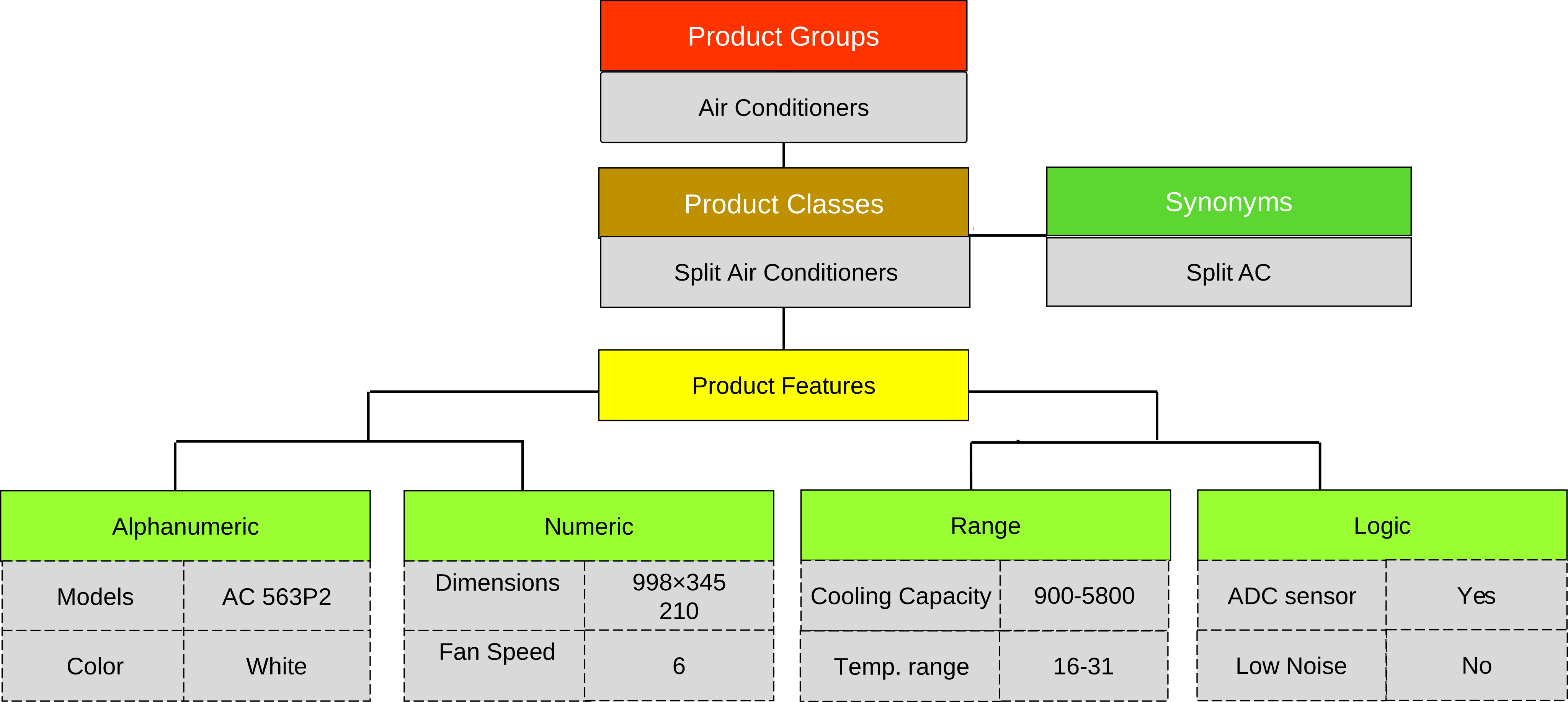
The ETIM model is built around a hierarchy of entities. Each product gets classified into a class, and that class carries a defined set of features.
Product Groups
Product groups are the broadest level. They collect related product classes under a single heading. "Cables" and "Switches" might sit in the same group, for instance.
Product Classes
Classes are the core unit of ETIM classification. Each class represents a type of product and has a unique identifier. Every product is assigned to exactly one class. That class sits within one product group.
Classes also have synonyms, which are alternate names or keywords used to help locate the right class during search. Synonyms don't have their own identifier codes.
Features
Features describe the technical attributes of a product class. ETIM defines four feature types:
- Alphanumeric features (like color or material) link to a predefined list of accepted values
- Logical features accept only "Yes" or "No"
- Numeric features take a number, sometimes paired with a unit
- Range features define two values marking the ends of a range (e.g., 50 to 60 Hz), also sometimes with a unit
Values and Units
Alphanumeric features each have a fixed list of accepted values. This prevents variation in how the same characteristic is expressed. Units of measurement attach to numeric and range features and specify exactly which unit the entered value must use.
A practical example: class EC000001 is a Miniature Circuit Breaker. Its features include rated current (numeric, in amperes), breaking capacity (numeric, in kiloamperes), number of poles (numeric), and tripping characteristic (alphanumeric, with values like B, C, or D). Every manufacturer selling a miniature circuit breaker maps their product to this same class, using the same feature codes and units. A wholesaler importing that data from ten different manufacturers gets ten files with identical structure.
ETIM Standard Versions and Releases
ETIM releases updated versions on a regular cycle as new product types are added and existing classifications are refined. ETIM 10.0, the current version, was released in December 2024 and added 119 new classes. Organizations working with the ETIM standard need to track which version their data conforms to, especially when exchanging data with partners who may be on a different release. Mapping tables between versions exist to help manage the transition.
In February 2024, ETIM International also released ETIM xChange, a new JSON-based exchange format designed as a modern alternative to BMEcat for international data exchange. It supports multilingual catalogs, multiple classification standards in a single file, and sustainability data fields. For organizations starting fresh, it's worth evaluating alongside BMEcat.
BMEcat and ETIM
ETIM defines the classification structure. BMEcat handles data transport. The two are often used together in practice.
BMEcat is an XML-based format for exchanging product catalog data. It can carry ETIM-classified product information between systems. A manufacturer exports a BMEcat file with ETIM-structured attributes. A wholesaler imports that file directly into their ERP or PIM system. The ETIM classification ensures the data fields map correctly on both ends.
Which Software Supports ETIM Classification?
ERP Systems
ERP systems used in the electrical industry can work with ETIM through dedicated modules or integrations. SAP, Oracle, and Microsoft Dynamics all have solutions or third-party extensions that support ETIM classification workflows.
PIM Systems
Product Information Management (PIM) systems are a natural fit for ETIM. They handle large product catalogs with complex attribute structures natively, which is exactly what ETIM classification requires at scale.
AtroPIM offers a dedicated ETIM module for the electrical industry. It handles class mapping, attribute management, and compliance with the ETIM standard directly within the PIM. Akeneo, Pimcore, and inRiver also support ETIM-based data management.
In projects we've implemented for electrical wholesalers, the lack of a PIM with ETIM support was consistently the point where data quality broke down. Manufacturers delivered data in ETIM format, but without a system that could interpret and store those classes and features natively, teams were manually converting attributes. A PIM with ETIM support eliminated that step.
MDM Systems
Master Data Management systems like Stibo Systems STEP can handle ETIM classification as part of broader enterprise data governance. This is more relevant for large organizations managing product data across multiple business units or systems.
E-commerce Platforms
Magento and WooCommerce can be extended to support ETIM. For companies selling electrical or technical goods online, this means product listings can reflect structured ETIM attributes directly in the storefront.
Custom Solutions
Some companies build or extend their own systems to handle ETIM. This is common when existing commercial tools don't fit the organization's workflow or when deep integration with legacy systems is required.
ETIM Membership
ETIM is an open standard. Anyone can use it for free. But change requests, technical support, and participation in developing the model are restricted to members.
ETIM International offers several membership types. National organizations, country sector members, and multi-country members can apply for full membership. Manufacturers, wholesalers, buying groups, and contractors can apply for Global Industry Membership.
You can apply through the ETIM International members page or via their contact form. If your country has no existing ETIM organization, you can establish one and apply to join at the international level.
What ETIM Classification Delivers in Practice
The benefits are mostly operational. Better data quality means fewer errors in product listings, fewer returns caused by incorrect specifications, and less manual correction work. Consistent classification also makes it easier to compare products within a class, which matters for customers and internal teams doing procurement.
Interoperability is the other big one. When suppliers, wholesalers, and retailers all use ETIM, data moves between systems without translation work. That reduces friction in the supply chain and lowers the cost of onboarding new suppliers.
For companies operating internationally, ETIM's multilingual support removes one more barrier to exchanging product data across borders.
ETIM Alternatives
ETIM is built for electrical and technical goods. If your industry is different, other classification standards may be more relevant.
eCl@ss is the most comparable alternative. It covers a wide range of product types and aims to standardize digital product catalogs broadly. It's common in German-speaking markets and widely used in manufacturing.
UNSPSC (United Nations Standard Products and Services Code) is used globally, especially in the United States, and is overseen by GS1. It's designed for e-commerce across many product categories, though it's less detailed at the attribute level than ETIM.
NIGP (National Institute of Governmental Purchasing) is a detailed standard used primarily for public procurement in the USA. Its specificity makes it less adaptable outside that context.
None of these are suitable replacements for ETIM in the electrical industry specifically. They address different levels of the supply chain or serve different purposes entirely.
The ETIM International website is the official reference for class definitions, release downloads, and membership. For PIM-based implementation, the AtroPIM ETIM module covers class mapping and attribute setup specific to the ETIM standard.