


Key Takeaways
- ETIM is a product classification standard for electrical, HVAC, and installation products. It defines classes and features so manufacturers, distributors, and software systems share a common language.
- BMEcat is an XML-based catalogue exchange format from the BME in Germany. It transfers product data but was never designed for ETIM, and is now considered a legacy format.
- ETIM xChange is the modern, JSON-based successor to BMEcat, built specifically for ETIM data. It maps directly to ETIM classes, features, and values, and supports API-based workflows.
- Current version: v2.0 (November 2025), which adds environmental data fields, packaging material data, and MDX media type codes.
- ETIM xChange is used by manufacturers, distributors, and software vendors to exchange structured technical product data efficiently across the B2B supply chain.
Manufacturers in the electrical and HVAC supply chain have been exchanging technical product data via BMEcat for decades. The format works, but it was never built for ETIM, and that mismatch accumulates into real cost: manual cleanup, mismatched field names, rejected imports. ETIM xChange is the industry's answer to that. It is the first product master data exchange standard fully owned and governed by ETIM International, built from the ground up to carry ETIM-classified product data cleanly between manufacturers, wholesalers, and distributors.
ETIM, BMEcat, and ETIM xChange: The Three Building Blocks
Three terms get used constantly in this space, sometimes interchangeably, even though they mean different things.
ETIM
ETIM (European Technical Information Model) is a product classification standard maintained by ETIM International, a non-profit organisation with national member bodies across Europe and beyond. It defines a common language for describing technical products in the electrical, HVAC, and installation industries through a structured library of classes (product types) and features (attributes), each with defined value types and units.
A circuit breaker isn't described slightly differently by every supplier. In ETIM, it has a fixed class, fixed features, and fixed allowed values. That consistency is what makes automated product data exchange possible across the B2B wholesale distribution chain.
BMEcat
BMEcat is an XML-based file format for exchanging product catalogues electronically between trading partners. Developed by the BME (Bundesverband Materialwirtschaft, Einkauf und Logistik) in Germany, it became widely adopted in technical trade as a standard way to send product data from manufacturers to buyers and distributors.
BMEcat is not a classification system; it is a container. It defines how a catalogue file should be structured: what fields to include, how to organise them, how to reference images and documents. Over time it was extended to carry ETIM classification data, but that was more a workaround than a clean solution. The format was never designed with the ETIM model in mind, and the mismatch created friction throughout the supply chain. BMEcat is now considered a legacy format, gradually being replaced by ETIM xChange.
ETIM xChange
ETIM xChange is the official successor to BMEcat: a modern, JSON-based catalogue exchange format designed from the ground up to work with ETIM classification. Developed and maintained by ETIM International, it is the recommended standard for exchanging ETIM-classified product data between manufacturers, distributors, and software platforms.
The shift from BMEcat matters on two levels. JSON is more developer-friendly than XML and better suited to API-based integrations and ERP connections. And ETIM support is built into the structure from the start, not bolted on. The xChange file maps directly to the ETIM data model: classes, features, values, and release versions are all first-class citizens in the format.
Quick Overview: ETIM vs BMEcat vs ETIM xChange
| ETIM | BMEcat | ETIM xChange | |
|---|---|---|---|
| What it is | A product classification standard | A catalogue file exchange format | A product master data exchange format |
| Purpose | Defines how technical products are described and categorised | Transfers product catalogues between trading partners | Transfers ETIM-classified product catalogues between trading partners |
| Developed by | ETIM International | BME (Germany) | ETIM International |
| Status | Active, regularly updated | Legacy, being phased out | Active, the recommended standard |
| ETIM support | It is ETIM | Bolted on, not native | Built in from the start |
| File format | Not a file format | XML | JSON |
| Who uses it | Manufacturers, distributors, software vendors | Manufacturers, distributors (historically) | Manufacturers, distributors, wholesalers, software vendors |
ETIM xChange Version History
ETIM xChange version 2.0 is the current official release, published on 27 November 2025 by ETIM International. The version history is concise:
- Version 1.0 (19 February 2024): The inaugural release. The first product master data exchange standard fully owned and governed by ETIM International, built in JSON and designed for global use.
- Version 1.1: A patch release that fixed a bug in the JSON schema related to imperial and local-standard feature codes, and adjusted the field length for the customs commodity code. Fully backwards-compatible with 1.0.
- Version 2.0 (27 November 2025): A major update introducing extended environmental data fields (LCA/EPD) for sustainability reporting, new packaging material data elements to meet EU packaging regulation (PPWR) requirements, and reintroduced MD codes as a closed list of MDX codes for more precise media type specification.
If you are starting fresh today, target version 2.0. If you are already working with 1.0 or 1.1, upgrading is the clear direction of travel.
Who Uses ETIM xChange?
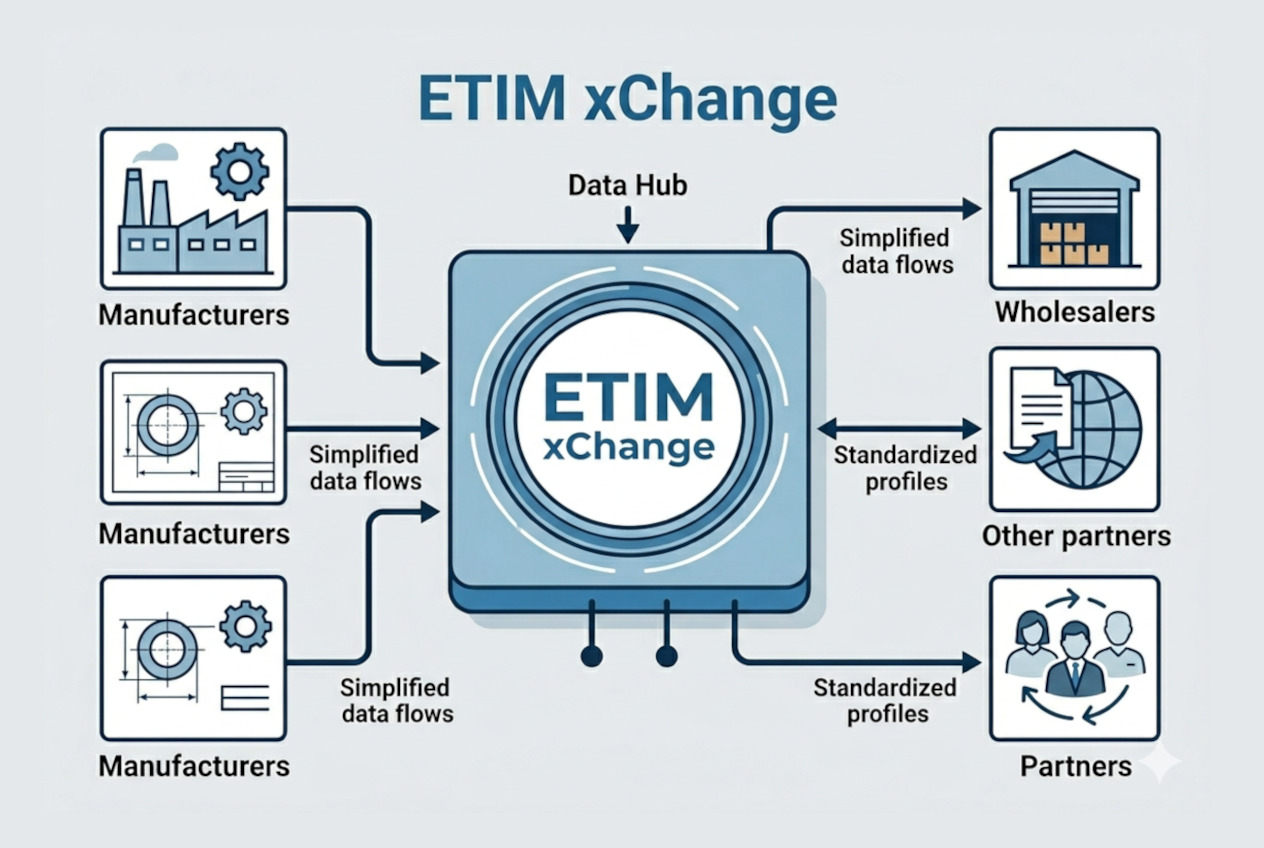
Manufacturers use ETIM xChange to send structured technical product data to their distribution partners. Instead of maintaining separate product catalogue exports in different formats for every customer, they produce one xChange file that any compatible system can consume.
Wholesalers and distributors use it to receive that data and feed it directly into their ERP systems, e-commerce platforms, or PIM tools without heavy manual cleaning and reformatting. For wholesale distribution businesses handling thousands of product lines from multiple suppliers, this removes a substantial operational burden.
Software and ERP vendors build ETIM xChange import and export functionality into their platforms so their customers do not have to handle things manually. Data pools are also part of the picture: these are intermediaries that aggregate and distribute product master data across the supply chain, offering managed ETIM xChange exchange services for manufacturers who prefer not to connect directly with every distributor.
How ETIM xChange Works
A manufacturer packages their technical product data in the xChange format and hands it to a distributor, who imports it into their system. Both sides work from the same ETIM-based structure, so there is no custom field mapping to negotiate and no ambiguity about data types or units.
A concrete example: a manufacturer of circuit breakers assigns each product to the ETIM class EC000049. That class comes with a defined set of features: rated current, number of poles, breaking capacity. The manufacturer fills in those values according to the ETIM model, packages the xChange file, and sends it. The distributor's ERP or PIM receives it, recognises the ETIM structure, and imports the data directly into the right fields without manual intervention.
Because xChange is JSON-based, it suits direct API exchange as well as file transfers. Larger distributors and platforms increasingly expect real-time, automated product data workflows, and ETIM xChange is built to support that alongside traditional file-based exchange.
ETIM xChange was designed for a supply chain that is partly still on file transfers and partly moving to API workflows. It handles both, which means adoption can be gradual rather than requiring a hard cutover.
ETIM xChange Key Concepts
ETIM Classes and Features
Every product in an ETIM xChange file is assigned to an ETIM class with a fixed set of features and defined value types. You cannot add proprietary fields outside the ETIM model. The structure is agreed upon and consistent across the whole supply chain, which is what enables automated import at the receiving end.
ETIM Release Versions
ETIM International updates the classification model periodically: ETIM 9, ETIM 10, and so on. Each release may add new classes, revise features, or deprecate old ones. When exchanging ETIM xChange data, always confirm which ETIM release version your trading partner expects. Mismatches between sender and receiver are one of the most common causes of import failures, and the same applies to the xChange format version itself (v1.x vs v2.0).
xChange File Structure
An ETIM xChange file contains a header (supplier info, date, ETIM release version) followed by the product records. A key structural difference from BMEcat is the clean separation between Products (the base item and its technical properties), Trade Items (buyable configurations), and Packaging Units. This separation reduces redundancy and makes the data cleaner for downstream ERP and PIM integration.
JSON Schema and Validation
ETIM xChange files are validated against a published JSON schema before being sent, catching errors early: wrong data types, missing required fields, out-of-range values for ETIM features. Schema validation is standardised and tooled from the start, which is a concrete improvement over BMEcat. Official validation tooling is provided by ETIM International.
Membership and Certification
Official validation and certification are tied to ETIM membership. Companies that want to formally certify their product data as ETIM-compliant are expected to be members of the ETIM organisation, either directly or through their national body. Membership gives access to the official validation tools, the full ETIM classification database, and the certification process. For any serious commercial deployment, membership is the expected baseline that trading partners will increasingly require. If you are exploring the standard, you can get started without it, but plan for it early.
Working with ETIM xChange in Practice
In projects we have implemented with manufacturers in the electrical and building materials sectors, the most common starting point is not a tooling problem. It is a data quality problem. Companies come to us after realising their internal technical product data is inconsistent or incomplete, and that no exchange format will fix that upstream. Before any ETIM xChange file can be generated correctly, the source data needs to be clean, classified according to the ETIM model, and structured consistently.
The second most common issue is classification accuracy. Assigning a product to the wrong ETIM class means the feature set does not match, and the resulting data is wrong or incomplete at the receiving end. Taking time upfront to map products correctly, using the ETIM webshop to browse classes and features for the relevant ETIM release version, pays off in reduced rejection rates and fewer manual corrections downstream. This is particularly true for manufacturers supplying large wholesale distributors, where automated import pipelines have no tolerance for classification errors.
Good ETIM xChange output is a consequence of good internal data management. The format itself is not the hard part.
What helps in both cases is a PIM system that handles ETIM classification at the product level and generates valid ETIM xChange exports as part of a managed workflow, rather than treating the product catalogue export as a one-off manual task. AtroPIM does this natively. It supports ETIM classification, generates valid xChange files, and lets manufacturers manage multiple ETIM release versions within a single system, which matters when different wholesale distribution partners are on different ETIM releases.
Product data changes constantly. New products, updated specs, new ETIM releases: ETIM xChange is not a project with an end date. Build it into your regular product data workflow from the start.
Getting Started with ETIM xChange
- Classify your products in ETIM. Your products need to be classified against the ETIM model before any xChange export is possible. The ETIM webshop lets you browse classes, features, and allowed values for each release version.
- Join ETIM. For commercial use with official validation and certification, joining ETIM directly or via your national body gives access to the tools, the full classification database, and the formal recognition trading partners expect.
- Choose your tooling. Most manufacturers use a PIM system or dedicated data pool that supports ETIM xChange export. Confirm with your software vendor which ETIM release versions are covered and whether JSON schema validation is built into the workflow.
- Confirm the target ETIM release version with your trading partner. Check which ETIM release and xChange format version your partner's ERP or PIM expects, then make sure your export settings match.
- Validate before you send. Run your xChange file through the ETIM validation tool first. Catching schema errors early avoids rejected imports and rework on both sides.
- Start with one product family. Get it right, validate it, share it, and get feedback. Build from there rather than attempting a full product catalogue export at once.
Tools and Resources
ETIM International
etim-international.com is the central hub for everything ETIM: the classification database, ETIM xChange documentation, release downloads, the JSON schema, and membership information.
ETIM xChange Validation Tool
An official online tool from ETIM International that validates your xChange file against the JSON schema and the referenced ETIM release version. The first checkpoint before sending any file to a trading partner.
PIM Systems with ETIM xChange Support
A capable PIM handles the heavy lifting of generating valid ETIM xChange catalogues so you are not working with raw JSON manually. AtroPIM is an open-source PIM with native ETIM classification support and xChange export built in, designed for manufacturers who need configurability and control over their technical product data. When evaluating any PIM for ETIM xChange, confirm which ETIM release versions it supports, whether JSON schema validation is part of the workflow, and whether it can handle multiple trading partner configurations simultaneously.
ETIM National Organisations
Most countries with active ETIM adoption have a national body (ETIM UK, ETIM Germany, ETIM Netherlands, and others). They offer support, training, and guidance on ETIM classification and xChange adoption, and are the first point of contact for membership.
Data Pools and Managed Service Providers
Companies like DDS and ChannelEngine offer managed product master data exchange services around ETIM xChange for manufacturers and distributors who prefer not to handle the technical integration in-house.