


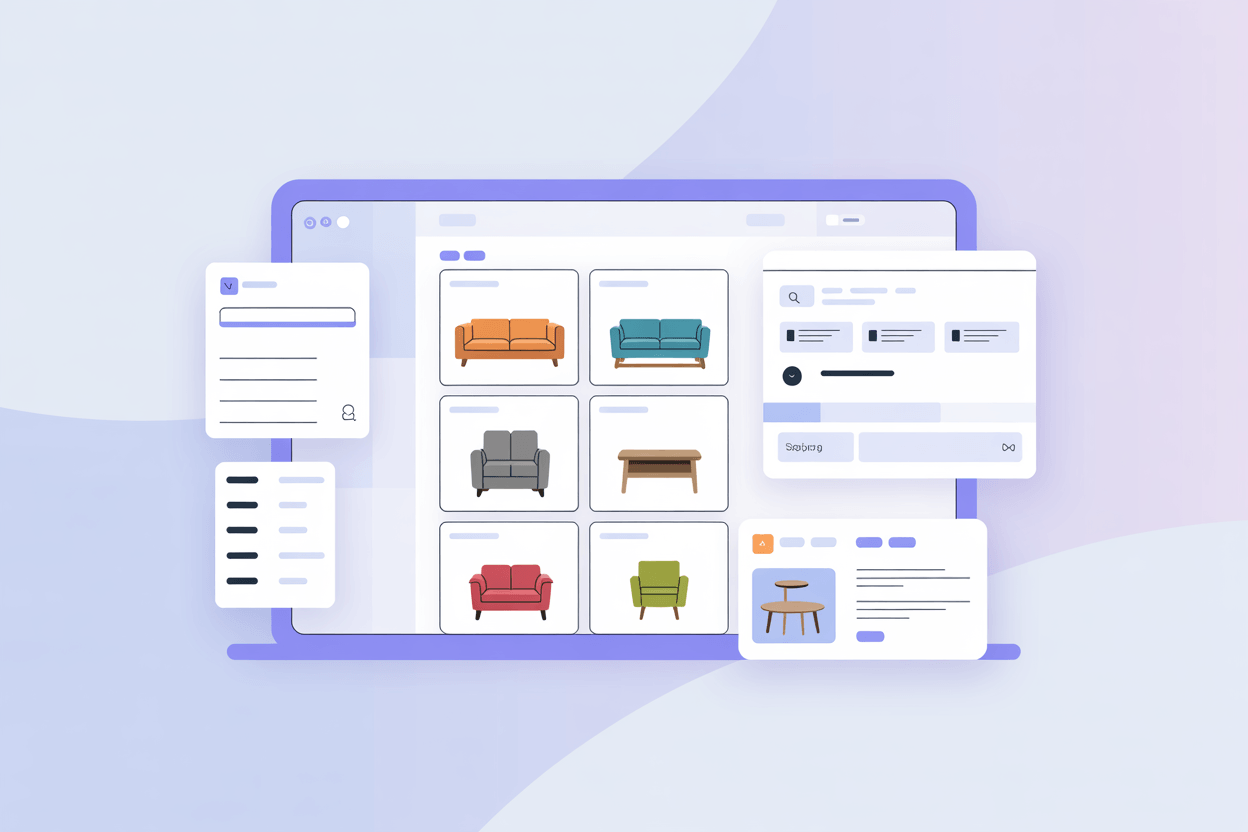
Most furniture brands hit the same wall at a similar point in their growth. The catalog is large enough that spreadsheets are breaking down, but the product data is complex enough that a generic PIM just moves the mess into a different system. Variants multiply, supplier formats don't align, channels want different data, and the team spends more time reconciling records than actually publishing.
Choosing the right PIM for furniture solves this, but only if the system is built to handle what furniture data actually looks like. This guide covers what to prioritize, what to scrutinize, and how to narrow the field before you commit.
One caveat first: if you're a smaller furniture brand managing fewer than a few hundred SKUs across one or two channels, a dedicated PIM may be more than you need. Many e-commerce platforms handle that range well natively.
PIM for furniture earns its cost when variant complexity, channel volume, or supplier data volume starts to overwhelm simpler tooling. If you're past that threshold, read on.
Why Furniture Product Data Is Different
A single sofa can have dozens of combinations: fabric type, color, leg finish, configuration, and size. Each combination may need its own image, its own set of dimensions, and its own availability status. Multiply that across a catalog of hundreds or thousands of SKUs and you have a product information management problem that scales fast.
Beyond variants, furniture manufacturers and brands deal with:
- Technical specs that vary by product type. Upholstered pieces, case goods, and outdoor furniture each have completely different attribute sets. A single flat schema doesn't work.
- Heavy media requirements. High-resolution imagery, 360-degree views, room scenes, swatch libraries, and increasingly 3D/AR files all need to be linked to the right product and variant.
- Channel-specific data demands. Retailers, interior designers, online marketplaces, and export markets want different formats, different levels of detail, and different naming conventions.
- Frequent sourcing-driven updates. Material changes, new certifications, and regulatory compliance requirements mean product records are never truly finished.
A general-purpose PIM can technically store all of this. But whether it lets you manage furniture product data efficiently, without a data team working around the system's limitations, is a different question.
What To Look For In A Furniture PIM
These are the five capabilities that separate furniture-ready systems from systems that almost work.
Flexible Data Modeling
Furniture products don't fit a flat attribute structure. A dining table needs different fields than a modular shelving system or an upholstered bed frame. A good PIM for furniture supports product families and attribute inheritance, letting you define attribute sets per category and reuse shared attributes across them. Without this, you end up maintaining parallel records manually or forcing unrelated products into the same schema, both of which create long-term debt.
Variant Management Built For Scale
Some PIMs handle variants by creating fully separate product records. Others use a parent-child structure where shared data lives at the parent level and only the differentiating attributes sit at the variant level. For furniture, parent-child is almost always the right choice. When a supplier changes a fabric name, you update it once. When dimensions change on a size variant, only that record changes. The alternative, updating the same field across 40 or 60 variant records, is how data quality breaks down over time.
Media Asset Handling That Matches Furniture Complexity
Furniture PIM systems need to go well beyond basic image attachment. You need to link specific images to specific variants, manage image sequences, control which assets appear in which channels, and handle multiple file types. Some furniture brands now distribute .glb or .usdz files for 3D and AR alongside standard imagery: the PIM needs to treat those as first-class assets, not file attachments bolted onto a product record. Look for either a built-in DAM module or a proven, documented integration with your existing DAM.
Channel-Specific Output
A trade catalog for interior designers looks nothing like a marketplace data feed or a product page on your own website. A PIM for furniture brands needs to support multiple output templates and channel-specific data completeness rules, without requiring duplicate product records per channel. The best systems let you define what "complete" means per channel and flag gaps before export, so teams know what's missing rather than finding out after a feed fails validation.
Import and Supplier Data Handling
Most furniture companies don't enter product data from scratch. Data arrives from suppliers, factories, and sourcing partners in inconsistent formats, with inconsistent naming, and at irregular intervals. A furniture PIM with strong import tooling: field mapping, validation on import, and transformation rules, eliminates most of the manual cleaning work that otherwise falls to someone's spreadsheet skills. This capability is underrated in demos and overrepresented in real operational costs.
The Variant Problem In Practice
In projects implemented for furniture manufacturers, variant complexity was consistently the biggest pain point, not integrations, not media volume, but variant architecture.
For example, the furniture brand was managing roughly 600 active SKUs, but their ERP showed over 4,000 individual records because every finish-and-size combination had been created as a standalone product. Their team spent weeks before each season reconciling data just to publish an updated catalog. Changes to a finish name required finding and updating dozens of records by hand.
After moving to a PIM for furniture with proper parent-child variant structure and attribute inheritance, they reduced the number of records to manage by around 80% and cut catalog preparation time from weeks to days. The furniture product data became something they could maintain with their existing team, without a dedicated data entry operation running in parallel.
Furniture PIM architecture around variants has a direct, measurable operational cost. Get it wrong, and the overhead compounds with every new product line you add.
This isn't an edge case. Most furniture brands that have been managing products for more than a few years have accumulated structural debt in how variants were originally set up. Choosing a PIM that enforces the right architecture from the start — or supports migration to it — is worth prioritizing early.
Integration Requirements For Furniture PIM
For furniture brands and manufacturers, the integrations that matter most are typically:
- ERP for stock levels, pricing, and supplier records
- E-commerce platforms — Shopify, Magento, or custom builds
- Retailer portals and marketplace feeds — Amazon, Wayfair, and similar
- Print and digital catalog tools
- 3D visualization and AR platforms if you're deploying product visualization
The furniture PIM you choose should support both push and pull integrations and expose a well-documented API. Some vendors offer pre-built connectors for common platforms; others rely on middleware. The important question isn't how many connectors a vendor lists: it's whether those connectors cover your actual stack and how much customization they require to get working.
A PIM with 50 connectors listed on its website, but none that match your actual stack, is not better than a PIM with 10 connectors that fit.
Deployment: SaaS, On-Premise, Or Open Source
Most modern furniture PIM solutions are cloud-based SaaS, and for most brands, that's the right default. Lower maintenance overhead, predictable pricing, and faster implementation are real advantages when you're not running a large IT team.
That said, a few scenarios push toward self-hosted or open-source deployment:
- Data residency requirements — relevant for furniture brands operating in EU markets with strict data localization rules
- Deep data model customization — SaaS platforms limit how far you can extend the underlying schema; on-premise or open-source removes that ceiling
- Legacy ERP integration — older ERP systems sometimes connect more reliably with on-premise middleware
Open-source PIM options (Akeneo Community Edition, Pimcore, and AtroPIM) are the most commonly deployed, giving full control over the data model and hosting without vendor lock-in. The trade-off is that implementation and ongoing maintenance require more internal or partner resources. They're not a cheaper option so much as a different cost structure: lower licensing, higher implementation investment.
The deployment decision comes down to whether your requirements fit within the constraints of SaaS, or whether you need flexibility that only open-source or on-premise can provide. Map your customization needs and data residency requirements before evaluating vendors, not after.
What To Scrutinize In Vendor Demos
Vendors will demo their best-case scenarios with clean sample data and pre-configured workflows. These are the areas where the real gaps show up:
Import flexibility.
Ask specifically how the system handles a non-standard supplier spreadsheet. Request a live demo with a messy, real-format file — not a clean sample. This single test reveals more about the system than an hour of feature walkthroughs.
Performance at scale.
A furniture PIM setup with 500 products and 10 users performs very differently from one with 50,000 products, 200,000 image assets, and 30 concurrent users. Ask for references from furniture brands at your SKU and user volume.
Total cost of ownership.
Licensing is only part of the cost. Factor in implementation, data migration, connector customization, and ongoing support tiers. Some "affordable" SaaS furniture PIM options become significantly more expensive at the contract renewal stage once you've added integrations and upgraded support levels.
Migration support.
Getting from spreadsheets or a legacy system into a new PIM is consistently the hardest part of these projects. Ask specifically what's included in implementation, who does the migration work, and what the timeline looks like with real data volume. References from completed migrations are more useful than references from new deployments.
How To Build A Shortlist
Before evaluating vendors, answer these questions about your own situation. The answers determine which systems are worth your time.
- How many SKUs and variants do you manage? This sets your baseline for performance requirements and eliminates systems that don't scale to your volume.
- How many channels do you publish to, and in what formats? This defines your output requirements and tells you how important multi-channel workflow features are.
- Who maintains product data, and what's their technical level? A system requiring technical users to manage daily workflows is a mismatch for a team of merchandisers.
- What systems does the furniture PIM need to connect to? List them before you talk to vendors. Your ERP is non-negotiable; know the others, too.
- What's your total budget, including implementation? Licensing costs are published. Implementation costs rarely are, therefore you should ask for estimates early.
With those questions answered, you can filter vendor shortlists quickly. Most furniture brands land on three to five systems worth evaluating in depth. For each one, run a proof-of-concept with real product data from your own catalog: import a real supplier file, build a product family with variants, and generate a channel export. What breaks in that process tells you more than any demo. Then ask for a reference call with a furniture brand of comparable size that went live at least twelve months ago, which is long enough for the initial implementation polish to have worn off.
The right PIM for furniture handles complex variant structures cleanly, manages media to the depth furniture requires, connects to every channel in your stack, and stays manageable for the team doing the daily work. Systems that check all four of those boxes without requiring a dedicated data operations function are rare, but they exist, and the evaluation process above will surface them.