


Most product data problems don't start as data problems. They start as a second sales channel, a third market, or a fourth person editing the same spreadsheet.
If you sell products through more than one channel (online store, marketplace, print catalog, retailer portals), you already know the pain. Product descriptions live in spreadsheets. Images are scattered across shared drives. Someone updates a spec in the ERP but forgets the website. By the time a customer reads the wrong weight on Amazon, the damage is done.
A PIM platform (or PIM system, as it's also called) solves this. But understanding what it actually does, and when it makes sense to implement one, saves you from buying software you don't need yet, or from underestimating what you do need. Wrong product data drives returns and erodes trust. Fixing it after the fact costs more than preventing it.
What a PIM Platform Is
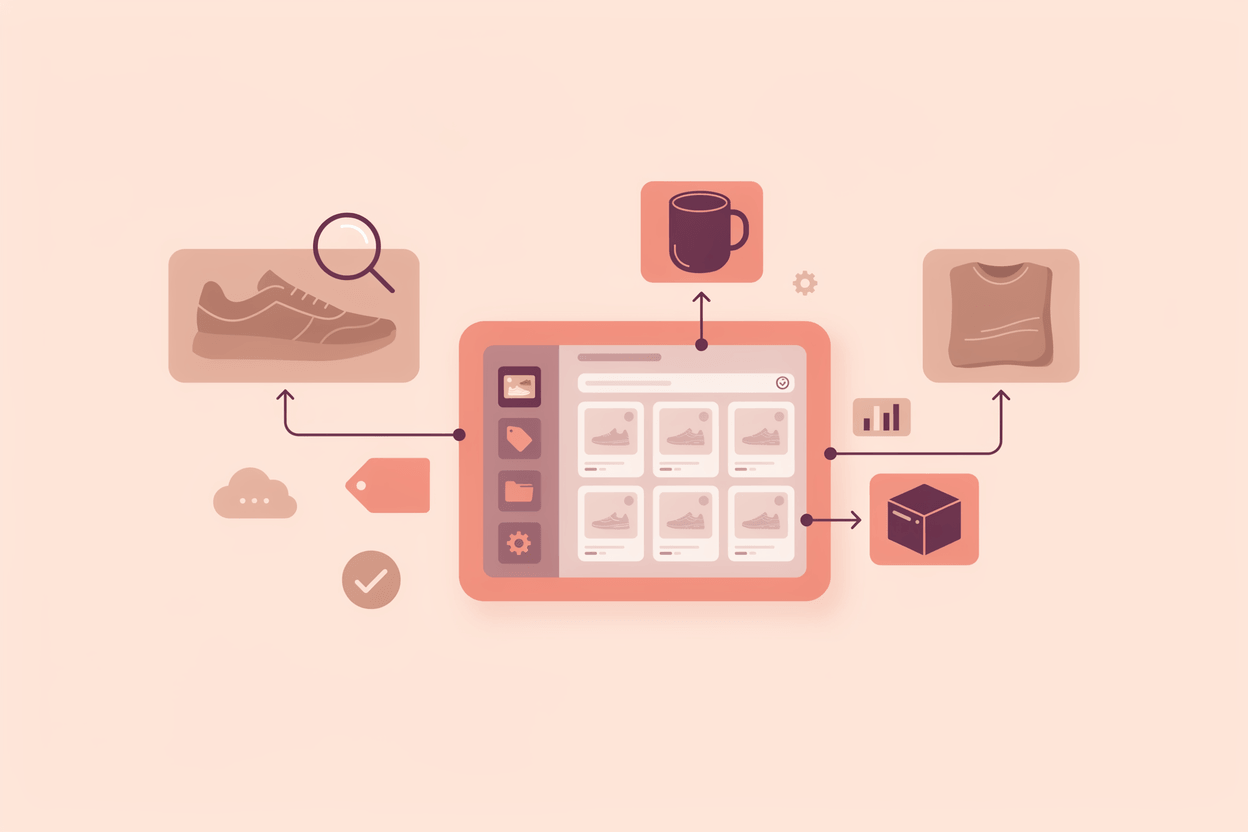
PIM stands for Product Information Management. A PIM platform is software that centralizes all product data in one place, structures it, and distributes it wherever it needs to go. At its core, it's a catalog management system, but one designed around the complexity of modern product catalogs rather than a simple list of SKUs.
That single-sentence definition undersells what's involved. "Product data" covers far more than a product name and a price. It includes:
- Technical specifications (dimensions, materials, certifications, compatibility)
- Marketing copy (descriptions, USPs, feature lists, tone-of-voice variations per channel)
- Digital assets (images, videos, PDFs, 3D files)
- Product taxonomy and classification (categories, attributes, hierarchies)
- Product variants and SKU-level data (sizes, colors, configurations)
- Localization and translation (region-specific descriptions, multilingual content, currency adaptations)
- Regulatory and compliance data (safety data sheets, REACH declarations, energy labels)
Most businesses manage this data across a combination of ERPs, spreadsheets, shared drives, and email threads. A PIM replaces that patchwork with one structured environment where product data is owned, governed, and enriched before it goes anywhere.
How a PIM Platform Works
The basic workflow has three stages.
First, the PIM collects. Product data comes in from multiple sources: ERP systems, supplier data feeds, manual entry, imports. It pulls everything together into a single record per product, enforces required fields, and structures relationships between products: variants, accessories, bundles.
Then it enriches. Teams fill in marketing descriptions, upload images, assign categories, translate content, add regulatory data, and run quality checks. This data enrichment step is where incomplete supplier records become publish-ready product content. A well-configured PIM enforces completeness rules: a product can't be published until it has a description, at least three images, and a valid EAN code, for example.
Collaboration mechanics run in parallel. Workflow automation handles routing: tasks move to the right team member automatically rather than sitting in someone's inbox. Role-based access controls who can edit what, and version history means every change is logged and reversible. This is where the PIM acts as a single source of truth for product data quality.
Then it distributes. The enriched data goes out to every channel: e-commerce platforms, marketplaces, print catalogs, retailer portals, apps. Each channel gets the right format, the right language, and the right set of attributes. Update a spec once in the PIM, and it propagates everywhere automatically, which is where time to market starts to compress for teams managing large catalogs across an omnichannel setup. Consistent, accurate product data at every touchpoint is also what drives a better product experience for the end customer.
What makes this different from just using an ERP or a spreadsheet is the data model. A PIM is built around flexible product attributes. You can define that a "power tool" product needs voltage, RPM, and cable length fields, while a "textile" product needs material composition, wash instructions, and color codes. An ERP's product record is too rigid for this. A spreadsheet breaks down fast as the catalog grows.
PIM vs. Related Systems
A DAM (Digital Asset Management system) manages files: images, videos, documents. A PIM manages product data. Many PIM platforms include basic DAM functionality, and some integrate tightly with dedicated DAM tools. They're complementary, not competing.
An ERP stores transactional product data: SKUs, prices, stock levels, supplier records. It's authoritative for operations. A PIM takes that data as input and adds the layer of structured, channel-ready content the ERP was never designed for.
An MDM (Master Data Management) platform is broader. It manages master data across multiple domains: products, customers, suppliers, employees, assets. A PIM is effectively a domain-specific MDM for product data. In practice, the line blurs when a manufacturer needs to manage supplier master data and product data in the same system, or when product data governance requirements grow complex enough to need MDM-level controls. Some platforms built on flexible data modeling architectures handle both, which matters for companies that want one system rather than two.
When You Actually Need a PIM Platform
Not every business needs a PIM. Small catalogs with a single sales channel and a stable product range can be managed with simpler tools.
The clearest signal is catalog growth. Once you're managing thousands of SKUs, maintaining product data in spreadsheets becomes a full-time job with a high error rate. A PIM enforces structure and cuts manual effort.
The second signal is multichannel publishing. Each channel has different requirements: Amazon needs specific attribute fields, your own webshop uses a different taxonomy, your German market needs localized descriptions. Managing these variants manually doesn't scale past a certain point, and that point arrives faster than most teams expect.
Product data quality problems are a third signal, and often the most visible one. Product returns driven by inaccurate specs, customer complaints about wrong dimensions, internal confusion about which version of a description is current: these are PIM problems. So is the situation where nobody can tell you which product data record is authoritative. Poor product data directly degrades the customer experience at the point of purchase.
Team size matters too. Without a PIM, collaboration on product content is chaotic: no clear ownership, no versioning, no audit trail. A PIM gives content, translation, and legal teams a shared workflow without the email threads.
The fifth trigger is regulatory exposure. The EU's Digital Product Passport and PPWR packaging regulations require structured, auditable product data tied to specific product identifiers. Unlike the other triggers, this one has a hard deadline attached. Manufacturers selling into European markets who don't have a PIM-ready data infrastructure will face a compliance problem, not an efficiency problem.
In projects we've implemented for mid-sized manufacturers, the typical trigger is a combination of the first two: a catalog that grew beyond what the team could manage in Excel, combined with a new marketplace or retail channel that demanded structured attribute data they couldn't produce quickly enough. After PIM implementation, the teams that struggled to publish product updates across three channels in two weeks were doing the same work in two days.
What to Look for When Choosing One
The market has a wide range of options, from SaaS tools built for small e-commerce teams to enterprise platforms with custom deployment models.
A few things worth checking:
Data model flexibility.
The question is whether you can define your own attributes, entity types, and relationships, or whether you're locked into a fixed product structure. For complex catalogs with many variants, technical specs, or regulatory fields, a rigid data model becomes a bottleneck fast.
Channel management.
The platform needs to handle different requirements per channel: attribute mapping to channel-specific fields, and data completeness rules that prevent products from going live with missing fields.
Integration capability.
ERP integration is usually the first connector teams need, but it's rarely the last. A PIM that can't connect cleanly to your ERP and your e-commerce platform creates more problems than it solves. Look for native connectors or a well-documented REST API.
Deployment model.
SaaS PIM platforms are quick to start and require no infrastructure. On-premise or self-hosted options give more control over data and customization. For companies with strict data governance requirements or complex enterprise environments, the deployment model matters.
Total cost of ownership.
Some platforms charge per user, which creates friction as the team grows. Others price by module or data volume. Understand the full cost once you're running at volume, beyond the entry price.
Those criteria narrow the field considerably. For teams that need data model flexibility, strong integration capability, and control over deployment without paying per user, AtroPIM is worth evaluating. It's an open-source PIM system, GPLv3 licensed, built on a fully configurable EAV (Entity-Attribute-Value) data model, which means the product structure maps to your catalog rather than the other way around. It supports on-premise and SaaS deployment, includes a built-in DAM, native PDF catalog generation, and bidirectional ERP integration and e-commerce connectivity via REST API. Manufacturers with deep technical attribute sets and multi-market distribution use it specifically because the data model doesn't impose limits. The base version is free; paid modules add channel syndication, advanced workflow, and compliance features.
The Real Test
A PIM platform is infrastructure. It doesn't automatically improve your product data. Someone still has to define the data model, set the completeness rules, onboard the catalog, and train the team.
The platforms that deliver ROI are the ones chosen to match a specific data problem, implemented with clear ownership, and connected to the channels that matter. If you can describe your product data problem concretely (too many channels, too many errors, too slow to launch new products), you probably need a PIM. If the problem is more vague, start with better processes first and revisit in six months.