


Key Takeaways
- A PIM data model defines the entities, attributes, and relationships in your product domain. It is a design decision, not a database detail.
- Core entities (product, variant, classification, category, asset, channel, locale) must be kept distinct. Collapsing them into one record creates structural debt that compounds with every new product type or channel.
- Attribute scope (global, locale-specific, channel-specific) is the highest-stakes modeling decision. Getting it wrong breaks publishing logic across every downstream integration.
- Model drift is a common failure mode: attributes added outside classifications, completeness rules not updated, documentation left to go stale. A named model owner prevents it.
- Structural problems in the data model affect every product record, every export, and every integration. Fixing them in production costs multiples of what they cost to get right at the start.
A product information management data model is the structural foundation your product information is built on. Before you configure workflows, import pipelines, or publishing rules, it determines what entities exist, how they relate, and which attributes belong where. Get it right early and everything downstream is easier. Get it wrong, and the cost compounds with every new product type, channel, or market you add.
What a Product Information Management Data Model Actually Is
A data model is the conceptual layer above the database schema. The schema is the technical implementation. The model is the design that drives it.
In a PIM context, the product information management data model describes every entity in your product domain, the attributes that describe those entities, and the relationships between them. It determines whether a color is a field on the product record or a dimension that creates distinct variants. It decides whether a technical specification belongs to the product itself or to its classification, and whether a price is a core product attribute or a separate linked entity.
In practice, those decisions determine whether your catalog stays maintainable as it grows or becomes an expensive mess to restructure.
The absence of an explicit data model was almost always the root cause of product data quality problems in projects we were brought in to fix. Teams add attributes wherever they fit, identifiers get duplicated, and channel-specific data bleeds into core records.
Core Entities in a Product Information Management Data Model
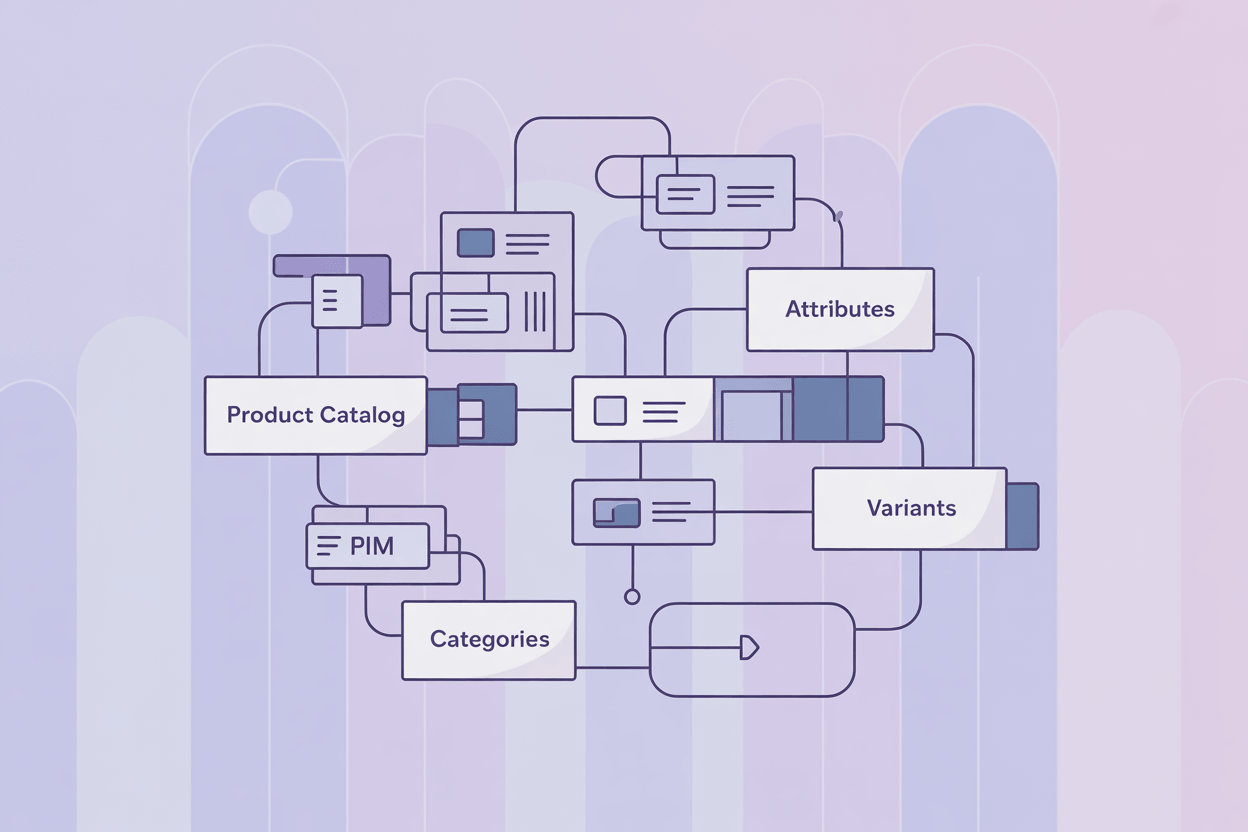
A well-designed PIM data model treats the following as distinct entities, not collapsed into a single product record. Each one represents a separate domain of master data with its own lifecycle and ownership.
Product. The base unit. Contains identifiers (internal ID, SKU, GTIN/EAN, MPN), core descriptive fields, and global attributes shared across all channels and locales. This record is the master reference. It does not carry locale overrides or channel-specific content directly.
Product variant. A separate entity linked to the parent product via a parent-child relationship. Each variant gets its own SKU and its own inventory-trackable identity. The variant inherits shared attributes from the parent and carries only the attributes that distinguish it, such as size or color. Conflating variants with configurable options (things applied at order time, like custom engraving) is one of the most common modeling mistakes. It produces SKU explosion or breaks inventory tracking.
Classification and attribute set. The mechanism that assigns a group of attributes to a product based on what it is. An industrial pump and a safety helmet need entirely different attribute sets. Classifications let you define those sets once and assign them consistently rather than manually adding the same attributes to hundreds of records. Industry classification standards like ETIM, ECLASS, or GS1 map directly to this layer.
Category. The organizational hierarchy customers navigate through. Categories are not the same as classifications. A category defines where a product lives in the browsable tree. A classification defines what attributes apply to it. Many product data models conflate these, which makes the product taxonomy brittle.
Digital asset (DAM link). Images, videos, PDFs, technical drawings, and certificates are entities in their own right, linked to products via a relationship rather than embedded in the product record, so the same asset can be reused across multiple products and updated in one place.
Channel. The output destination: a webshop, a marketplace, a print catalog, a B2B portal. Channels carry their own attribute configurations and completeness requirements. Core product data stays in the base record. Channel-specific overrides sit in a separate linked structure so teams can adapt content per destination without touching master data.
Locale. Language and regional variants of text attributes. Locale-specific content (translations, regional descriptions, local compliance copy) lives in its own linked record, not as parallel columns on the main product record.
Attribute Scope: The Design Decision That Breaks Most Models
Attribute scope is the highest-stakes design decision in any product information management data model. Every attribute needs a defined scope before you add it to the model. There are three:
- Global. The same value applies in all channels and locales. Gross weight, material composition, GTIN.
- Locale-specific. The value varies by language or region. Product name, marketing description, compliance text.
- Channel-specific. The value applies only in a particular output channel. Short description for a marketplace listing, print-ready headline for a catalog.
Getting scope wrong breaks downstream publishing logic. A product name flagged as global will publish the same text to every market. A technical specification assigned as channel-specific may not reach the ERP integration that needs it.
Gartner research estimates that poor data quality costs organizations an average of $12.9 million annually. In product data, a significant share of that cost traces back to structurally misplaced data: correct values stored against the wrong scope, entity, or attribute definition.
Attribute types also matter. A plain text field, a numeric field with unit, a controlled vocabulary (single-select enum), a multi-select, a boolean, an asset reference: each has different validation logic and different downstream behavior in exports, marketplace feeds, and print templates. Systems like AtroPIM offer more than 20 attribute types with per-type validation, which removes most of the manual data governance burden that spreadsheet-based catalog management leaves in place.
Hierarchies and Relationships
Most complex product catalogs need multi-level hierarchies: product families at the top, product groups below, individual products and their variants at the bottom. A building materials manufacturer might structure it as Fasteners > Wood Screws > Countersunk Wood Screw 4x40mm, with each level carrying its own inherited attribute set.
Hierarchy design determines how attribute inheritance works. A child product can inherit shared attributes from a parent and override only what differs, rather than duplicating the full attribute set on every record, which keeps the model lean as the catalog grows.
Relationships between products are a separate concept. Accessories, spare parts, replacement options, upsell alternatives, and bundle components are all meaningful associations in a B2B product catalog. An electrical equipment manufacturer, for example, needs to express that a circuit breaker has compatible DIN rail adapters and that a replacement fuse series supersedes an older one. These associations are not attributes; they are typed relationships between entities.
In projects we implemented for industrial equipment manufacturers, the absence of explicit relationship modeling was consistently where the data model broke down. Teams stored associated products as comma-separated SKU strings in a text field, which worked until they needed to filter, display, or export that information in any structured way.
Where the Data Model Lives and Who Owns It
A product information management data model is not just a database diagram in a technical repository. It needs to be a readable reference document accessible to both developers and business stakeholders, describing every entity, attribute, relationship, and validation rule in plain language. That document is what keeps cross-team alignment intact as the catalog evolves and what any data governance program depends on for enforcement.
One pattern we see repeatedly: a manufacturer runs a PIM implementation, the original consultant documents the model, and eighteen months later that document is out of date. Product managers have added attributes directly at product level that should have gone through classifications. New channel configurations were created without updating completeness rules. The model has drifted from the documentation, and nobody has a reliable picture of what the system actually contains. The fix is treating the model document as a living artifact with a named owner, versioned alongside system changes.
If you are starting a PIM or MDM project, the right first step is a data model audit: map your current entities, identify where product master data is stored inconsistently, and define the target model before touching any system configuration. Importing data into a PIM without a defined model means you are migrating the same structural problems into new infrastructure.
How AtroPIM Implements the Data Model
AtroPIM is built on the AtroCore platform, which treats the product information management data model as a first-class configuration concern. Entities, fields, attribute types, relationships, and hierarchies are all configurable through the admin interface without custom development, so the data model becomes an operational artifact that business and IT teams can evolve together rather than a locked schema that requires a developer every time a new product type appears.
The system supports attributes assigned at three levels: directly to a product, via a classification, or via the parent product through inheritance. That flexibility matters when you manage catalogs where product types vary significantly. Customers coming to us from spreadsheet-based management or rigid legacy PIM systems often have a single flat attribute schema applied across the whole catalog. A safety equipment distributor handling both personal protective gear and fixed installation hardware cannot use that approach. AtroPIM handles it through classifications with product-type-specific attribute sets, each with its own required fields and completeness rules.
Channels in AtroPIM carry their own attribute configurations. A product linked to a webshop channel and a print catalog channel can have distinct required fields per destination, with completeness tracked separately per channel. That structure lets the data governance layer enforce quality requirements specific to each output, rather than applying one-size-fits-all validation rules across the whole catalog.
AtroPIM also supports custom entities beyond the standard product model. Teams managing contracts, certifications, supplier records, or special offers can create those as first-class entities in the same system, with relationships back to the product model. The built-in DAM sits within the same data model rather than in a separate system with a loosely coupled integration, so assets link directly to products, categories, and other entities as typed relationships. Both capabilities come from the AtroCore foundation, which is designed for broader data management scenarios beyond a classic PIM scope.
For organizations working with industry data standards, AtroPIM supports ETIM, BMEcat, ECLASS, and GS1 formats in its import and export feeds. Classification structures from those standards can be mapped directly into the AtroPIM data model, which reduces the manual effort of conforming catalog data to distributor or marketplace requirements.
Common Modeling Mistakes
Flattening everything into one product record is the most expensive to undo. Variants, locales, channels, and assets are collapsed into a wide table with hundreds of columns, manageable for small static catalogs but breaking the moment you need to add a new locale, publish to a new channel, or restructure your variant logic.
Using categories as classifications conflates two distinct functions. Categories change when the navigation structure changes. Classifications change when product types change. Keeping them separate means you can reorganize the storefront without touching attribute assignment logic, and vice versa.
Conflating identifiers causes reconciliation failures across every integration. Internal ID, SKU, EAN/GTIN, and MPN each have different functions and different scopes across the supply chain. A manufacturer's MPN is not the same as a distributor's SKU, and both are different from the GTIN registered in a GS1 database. A cross-system mapping table that holds all of them as distinct fields, linked to the product record, is the right approach. Storing only one identifier per product creates reconciliation problems in every ERP and marketplace integration downstream.
The Cost of Deferring the Model
The practical argument for investing in product information management data model design before system configuration is simple: a structural problem in the model affects every product record, every export, and every integration built on top of it. Fixing it later means reconfiguring the system, re-importing data, and rewriting integration mappings. It also means that every month the flawed model is in production, more decisions and processes depend on its structure, making the eventual fix harder.
Design the model before you configure the system. Most data problems in product catalogs are model problems, not data entry problems.
A pre-migration model audit typically surfaces the same issues: attributes stored at the wrong level, classification logic missing entirely, identifiers duplicated across fields, and channel-specific content sitting in global records. None of those are data entry errors. They are structural decisions made early and then worked around for years. Organizations that define explicit entity structures, attribute scopes, and relationship types before the first import consistently spend less time on rework and produce more reliable channel output. Structural decisions made at the start of a PIM project cost almost nothing to change on paper and a great deal to change in production, which makes the data model the highest-leverage point of investment in any product information management initiative.