


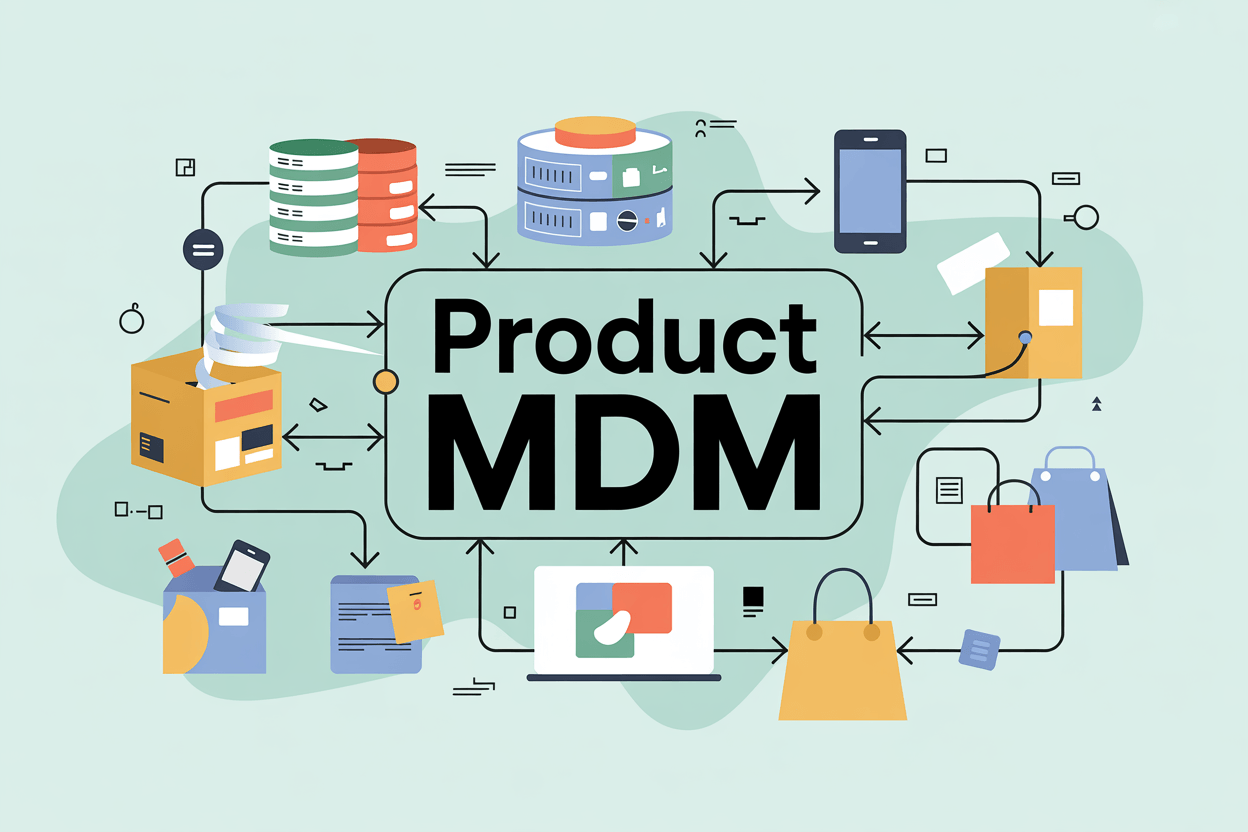
Product data rarely starts life in one place. A manufacturer might maintain specifications in an ERP, pricing in a spreadsheet, images on a shared drive, and product descriptions in a CMS. Each system holds a fragment. None of them agree. One calls the item "Blue Running Shoe, Men's." Another has "Running Shoe Blue M." A third lists it twice under different SKUs with different dimensions.
Product master data management (PMDM) is the discipline that fixes this. It creates a single authoritative record for each product and makes that record the source every connected system pulls from. Not a copy. Not a local version. The master.
What Is Product Master Data?
Product master data is the stable, core information that defines a product. It changes infrequently and every other system in the organization references it:
- Product name, description, and SKU
- Barcode or GTIN
- Category and classification
- Physical attributes: dimensions, weight, color, material
- Pricing and cost data
- Images and digital assets
- Supplier and manufacturer details
This is different from transactional data: sales orders, inventory levels, shipment records. Transactional data changes constantly and depends on master data being correct. If the master record has the wrong dimensions, every warehouse pick and every shipment label inherits that error.
Product master data also sits within a broader MDM landscape that includes customer data, supplier data, and location data. These are separate data domains, each with its own governance requirements. PMDM focuses specifically on the product domain, but in practice it rarely operates in isolation. A product record connects to supplier records, customer records, and location records. Multi-domain MDM systems manage all of these together. Single-domain implementations manage only products. Which approach fits depends on organizational complexity and integration requirements.
The goal of product master data management is to make the master record trustworthy enough that everyone stops maintaining their own local version.
Why Organizations Actually Need It
In projects we have implemented for industrial manufacturers, we frequently encounter the same pattern. A company launches a product. The ERP gets one set of attributes from the engineering team. The e-commerce platform gets a different version from marketing. The retail partner receives a third version exported from a spreadsheet that was last updated six months ago. By the time the product reaches the shelf, three systems have three different descriptions, two different weights, and at least one conflicting price. Customer returns follow. Then a manual reconciliation exercise that takes weeks.
The cost of bad product data is not theoretical. It shows up in returned shipments, failed compliance audits, and delayed product launches, all of which are measurable.
Regulated industries feel this most acutely. Under the EU's REACH regulation (EC 1907/2006), chemical manufacturers and importers are required to register substance data with the European Chemicals Agency and provide accurate safety information throughout the supply chain. An incorrect hazard classification or a missing safety data sheet is not a data quality problem at that point. It is a legal one, with potential market access consequences. Product master data management provides the governance structure to catch these errors before they reach a downstream system, a compliance audit, or a customer.
Gartner estimates that poor data quality costs organizations an average of $12.9 million per year, with product data inconsistencies among the most frequently cited drivers of operational failure in manufacturing and distribution.
For companies outside regulated industries, the business case is still concrete: fewer order errors, faster supplier onboarding, shorter time to market, and less manual rework across teams.
Three Use Cases for Product Master Data Management
Gartner describes three scenarios in which organizations actually need to manage product master data. Understanding these helps scope an implementation before selecting tools.
The buy-side scenario involves products and materials purchased from suppliers. Product data originates outside the organization, and the attributes arriving with it are often incomplete or inconsistent with internal standards. MDM is used here to validate, enrich, and reclassify incoming supplier data before it enters operational systems.
The inside scenario covers product data as it moves from system to system within the organization: from PLM or ERP into PIM, from PIM to e-commerce platforms. Each handoff is a point where data can degrade. Structured workflows and validation rules manage these transitions.
The sell-side scenario is about publishing product data to external channels: retail partners, marketplaces, distributors, and direct commerce platforms. Channel syndication, distributing the right data in the right format to each destination, is the primary concern here.
Most organizations deal with all three simultaneously. But implementations that try to solve all three at once tend to run into scope problems. Starting with the most pressing scenario first is almost always the better path.
Five Components of a Working Product Master Data Management System
Technology alone does not solve a data problem. PMDM works when technology, process, and accountability are aligned. Five components make that happen.
Data model. The data model defines what a product record looks like: which attributes are required, how products are categorized, what naming conventions apply, and how variants and bundles relate to parent records. Without a shared data model, every system invents its own structure, and the reconciliation problem returns immediately. GS1 standards provide a widely adopted framework for product identifiers and data exchange, particularly relevant for manufacturers and distributors working with retail partners.
Data quality rules. Quality rules define what a valid record looks like in practice: required fields populated, correct data types, standardized units and formats. Records that fail these checks get flagged before they reach any downstream system. Data profiling, which assesses the current state of records to identify gaps, duplicates, and inconsistencies, is typically the first step in understanding what the rules need to cover.
Master data governance. Who can create a product record? Who can modify it? Who resolves a conflict when two systems disagree? Governance assigns these responsibilities through defined roles: a data owner sets policy, data stewards handle operational oversight and exception resolution, and technical custodians manage integration and validation. Without named owners and defined processes, the PMDM system becomes another place where data accumulates and nobody is accountable for it.
System integration. The MDM system has to connect to the rest of the landscape: ERP, PLM, e-commerce platforms, supplier portals, marketplaces. The integration layer is what makes the master record useful. Changes propagate outward. Downstream systems stop maintaining their own copies.
Workflow and approvals. Most data quality problems enter a system at the point of creation, not after. Structured workflows control how a product record moves from creation through enrichment, review, and approval before publication, which enforces quality at the source rather than requiring cleanup later.
How Product Master Data Management Works in Practice
A new product enters the system. Here is what happens in a functioning PMDM environment.
First, the record is onboarded from a supplier spreadsheet, an ERP entry, or a manual submission, and tagged with its source. The system then runs duplicate detection. If the product already exists under a different name or SKU, the potential duplicate surfaces for review. Where two source records conflict on the same attribute, survivorship rules determine which value takes precedence. These rules are business decisions: the ERP may be authoritative for logistics attributes, while the PIM governs marketing descriptions. A confirmed, conflict-resolved record moves forward as the golden record, the single source of truth for that product.
At the enrichment stage, the record is validated against the data model. Missing attributes are flagged. Non-conforming values get corrected. Additional content such as descriptions, images, and translations is added by the relevant team. Then the record goes through approval: a data steward or product manager signs off before it publishes.
Once approved, the golden record distributes to the connected systems. The ERP gets the operational data it needs. The e-commerce platform gets the marketing content. Retail partners receive the data in their required formats. When anything changes, the cycle runs again.
A golden record is only as good as the governance around it. The technology is the easier part. The harder part is ensuring that every team that touches product data works from the same record and agrees on who owns it.
Product Master Data Management: Implementation Approaches
Three structural models exist for product master data management. Which one fits depends on how many source systems the organization has, how replaceable they are, and how much central control is realistic.
The centralized model is the cleanest on paper. All product data lives in one system. Every other platform consumes from it and owns nothing. Maximum consistency, but it requires significant investment and real organizational change, since teams that previously owned their own data have to give that up, which rarely happens without friction.
The consolidated model is more common in practice. Data pulls in from multiple source systems into a central hub, gets cleaned and merged into a golden record, and the source systems keep running independently. A chemical distributor we worked with had product data spread across three regional ERP instances, each maintained by a different country team. None could be decommissioned. The consolidated approach let them build a clean central record without dismantling what was already working. The source systems stayed in place; the MDM hub became the reference point everything published from.
The federated model skips the central hub entirely. Each system manages its own data, but shared standards and identifiers are agreed on across the organization, and the MDM layer coordinates conflicts. This works in large, decentralized businesses such as conglomerates and multi-brand manufacturers, where no single team has the authority to centralize everything. But it depends heavily on governance. Without it, the conflicts just move from the data layer to the process layer.
Most organizations starting for the first time use a consolidated approach, scoped to a single product category or integration point. A successful limited rollout builds the governance habits and organizational confidence that a wider implementation depends on.
Tools for Managing Product Master Data
Four categories of tools are relevant here. Understanding the difference between them saves a lot of wasted evaluation time.
Dedicated MDM platforms are built for enterprise-scale data governance. Their core capabilities are deduplication, survivorship, golden record creation, and integration with complex system landscapes. They are powerful and expensive, and they require dedicated data teams to operate effectively. Examples include Informatica MDM, Stibo STEP, SAP Master Data Governance, and IBM InfoSphere MDM.
PIM systems focus on content enrichment and channel distribution. They support marketing descriptions, digital asset management, localization, and syndication to sales channels and marketplaces. They handle product content well but are not built for multi-domain governance or complex deduplication. Examples include Akeneo, Salsify, Syndigo, and Plytix.
ERP systems manage core business operations: inventory, procurement, finance, order management. They hold product data as part of broader operational processes but are not designed for governance or content work. They serve as a primary data source and integration point rather than a PMDM solution. PLM systems occupy a similar position: authoritative for engineering and product development data, but not built for cross-channel distribution or master data governance.
Hybrid platforms combine MDM and PIM capability in a single system, which removes the need to maintain two separate tools and simplifies the architecture.
Pimcore is an open-source platform that integrates MDM, PIM, DAM, and CMS capabilities. It is built around a fully configurable, object-based data model and suits larger organizations that need a highly customized solution.
AtroPIM is an open-source, modular PIM system built on the AtroCore platform, which itself functions as a master data management and system integration layer. AtroCore provides the PMDM foundation: configurable entities, attribute management, role-based permissions, workflow automation, and a REST API covering 100% of system functionality including custom configurations. AtroPIM extends this with product-specific capabilities: multi-channel publishing, catalog management, DAM, multilingual content, and native integrations with e-commerce platforms including Magento 2, Shopware, WooCommerce, and Shopify, as well as ERP systems. The modular architecture means organizations can start with the free core and add premium modules for AI-assisted enrichment, advanced data quality management, and automated import/export feeds as their needs grow, without migrating platforms or incurring rising licensing costs. Both cloud and on-premises deployment are supported.
For mid-sized organizations that need more than a basic PIM but are not yet ready for the cost and complexity of a dedicated enterprise MDM platform, hybrid systems like AtroPIM are worth a close look.
| Capability | MDM Platforms | PIM Systems | ERP / PLM | Hybrid (AtroPIM, Pimcore) |
|---|---|---|---|---|
| Primary purpose | Data governance and golden record | Content enrichment and channel distribution | Business process and product lifecycle management | Governance and content in one system |
| Primary users | Data architects, IT, data stewards | Product managers, marketers | Engineering, finance, operations | Mixed, depends on configuration |
| Data quality and deduplication | Strong | Basic to moderate | Limited | Moderate to strong |
| Content enrichment | Limited | Strong | Minimal | Strong |
| Channel syndication | Limited | Strong | Not supported | Strong |
| Workflow and approvals | Advanced | Moderate to advanced | Moderate | Moderate to advanced |
| Integration complexity | High | Moderate | High | Moderate |
| Best for | Large enterprises with complex data ecosystems | Brands and retailers with large catalogs | Operational and product lifecycle management | Organizations wanting a unified MDM and PIM solution |
Many larger organizations run all three in combination: ERP for operations, a dedicated MDM platform for governance, and a PIM for content and distribution. Mid-sized companies more often consolidate into a hybrid platform to reduce architecture complexity and total cost.
What to Get Right Before Starting Product Master Data Management
PMDM initiatives fail more often for organizational reasons than technical ones. These are the areas worth resolving before committing to an implementation.
Executive sponsorship. PMDM spans IT, product, marketing, and operations. Without senior support, it is difficult to align stakeholders or secure budget across those teams. The initiative stalls at the first departmental conflict over data ownership.
Data ownership. Every product record needs a named owner. Not a team. A role, ideally a person. Ambiguity here produces accountability gaps that compound over time and are difficult to fix after the system is live. Research from Info-Tech Research Group finds that up to 75% of governance initiatives fail primarily because ownership is unclear.
Current data volume and structure. The number of products, data sources, and rate of change will shape scope and tool selection. Assess this before evaluating platforms, not during.
Existing system landscape. The PMDM solution will need to integrate with what is already in place. Organizations consistently underestimate the complexity and cost of integration when they skip this assessment.
Scope. Starting with one product category, one market, or one integration point reduces risk. A successful limited rollout builds the organizational confidence and data governance habits that a broader implementation depends on.
Ongoing maintenance. Product data changes continuously. PMDM is not a project with an end date. It is an operational capability. Staffing, maintenance processes, and governance structures need to be defined from the start. Data quality KPIs such as record completeness rates, duplicate counts, and validation failure rates should be defined before go-live and tracked from day one.
Common Failure Patterns
Most PMDM projects hit the same few problems. Some are avoidable with better planning. Some are just underestimated until they surface. But the pattern across failed product master data management implementations is consistent enough to be worth examining before you start.
Scope creep is the most common. Teams attempt to solve every data problem at once, the project grows unwieldy, and results take too long to materialize. Stakeholder confidence erodes before the system delivers anything useful.
Data migration is consistently underestimated. Historical data contains inconsistencies, duplicates, and gaps that are not visible until migration begins. Organizations that budget realistically for data profiling and cleansing tend to have smoother implementations. Those that do not spend the first year firefighting data quality problems in their new system.
Neglecting maintenance after go-live is the other persistent pattern. Without active stewardship processes for keeping the golden record current, the PMDM system gradually drifts from operational reality. Within eighteen months, teams start maintaining local copies again, which is where most of them started.
Our customers have come to us with exactly this situation. A mid-sized industrial equipment manufacturer went live with a new MDM setup, ran it well for the first year, then lost the two people responsible for data stewardship to a reorganization. No one replaced them formally. Eighteen months later, product managers had rebuilt their own spreadsheets on the side because the master records were no longer reliable. The system was still running. The governance around it was not.
Most MDM failures are not technical. The system works. The governance around it does not.