


Key Takeaways
- A PIM data model defines entities, attributes, relations, and validation rules. It is not the product data itself but the schema that holds it.
- Flat models work for small, homogeneous catalogs. Hierarchical and class-based models are standard for manufacturers with complex, multi-category product ranges.
- Design from the output side: start with channel requirements, not with existing ERP fields or supplier spreadsheets.
- Attribute inheritance, product class separation, and channel-specific completeness rules produce the most long-term structural value.
- Data model governance is as important as the initial design. Without it, attribute proliferation and schema inconsistency accumulate fast.
A Product Information Management (PIM) data model is the blueprint that defines how product information is organized inside a PIM system. It determines what attributes exist, how products are grouped, how data relates across entities, and what rules govern completeness and quality. Get the model right and the system works. Get it wrong and you spend years working around it.
Most PIM implementations that fail or stagnate do so because of a poorly designed data model, not because of the software itself.
What a PIM Data Model Actually Is
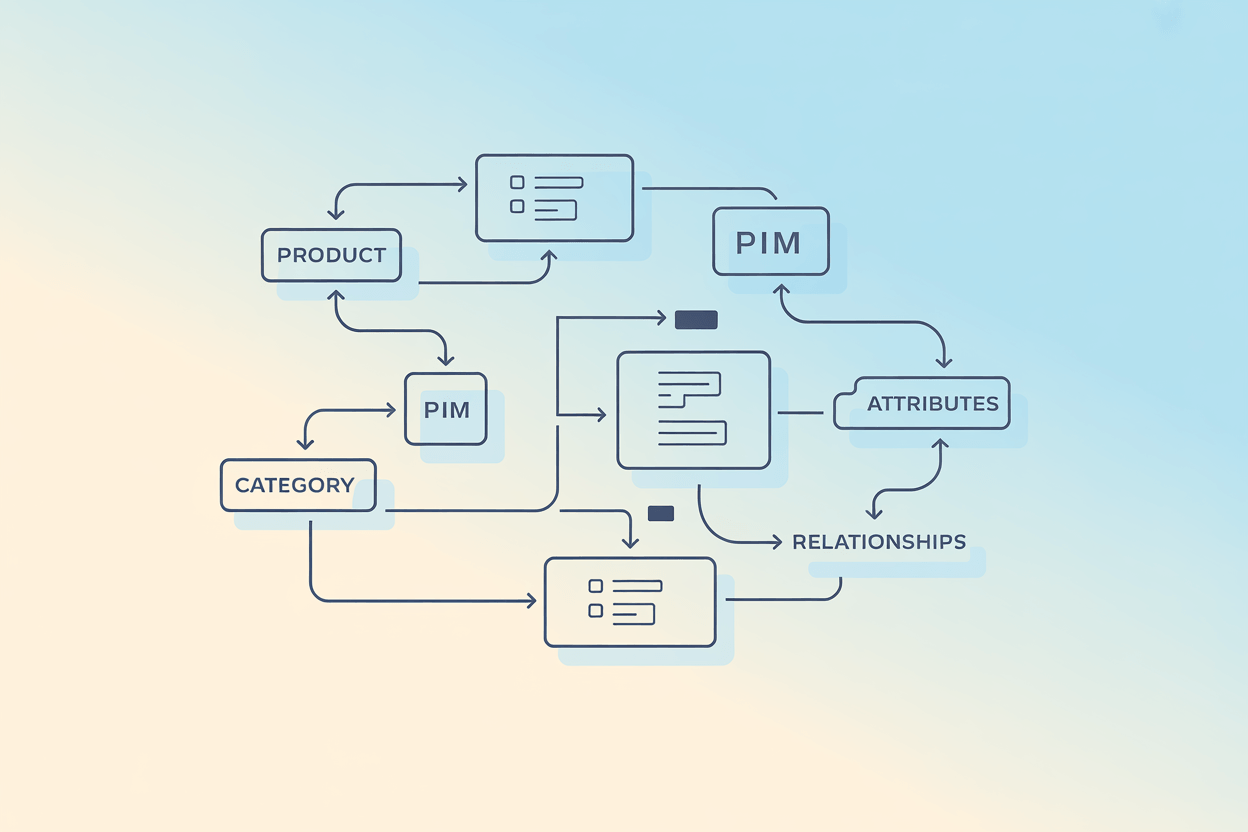
A PIM data model is a structured definition of what entities exist (products, variants, categories, assets, channels), what attributes describe each entity, how those entities relate to each other, and what values are valid, required, or conditional.
It is not the data itself. It is the schema that holds the data. A product information management system stores thousands of SKUs, but the data model defines what fields those SKUs have, which are mandatory, which are localized, and how they connect to images, documents, or related products.
In simpler systems, the data model is often flat: a product has a fixed set of fields and that is it. In mature PIM systems designed for complex catalogs, the model is significantly more layered.
PIM Data Model and Master Data
The PIM data model and master data are closely connected but not the same thing. Master data is the single source of truth for product information across the organization: the definitive, agreed-upon record for each product. The data model is the structure that makes that possible.
Without a well-designed model, master data degrades. Different teams pull product data from different sources, apply different attribute names to the same concept, and create conflicting records. The data model enforces the structure that keeps master data coherent. It defines what a product record contains, what is required before a record is considered complete, and what validation rules prevent bad data from entering the system in the first place.
This is also where PIM and MDM (master data management) intersect. An MDM system governs master data across multiple domains: customers, suppliers, materials. A PIM focuses specifically on product data, but it serves as the master data repository for that domain. The quality of the PIM data model directly determines the quality of the product master data it manages.
Core Components
Product Entities and Variants
The base entity in any PIM data model is the product. But most manufacturers and distributors deal with products that come in multiple configurations: sizes, colors, voltages, materials. These are variants, and how the data model handles them matters a lot.
A flat model treats each variant as an independent record. A hierarchical model groups variants under a parent product. Hierarchical models avoid data duplication and make attribute inheritance possible: set a value at the parent level and all variants inherit it unless overridden. In projects we implemented for industrial equipment manufacturers, this inheritance logic alone reduced data maintenance effort by roughly 60% compared to their previous flat spreadsheet-based setup.
Attributes and Attribute Groups
Attributes are the properties that describe a product: weight, voltage, material, dimensions, certifications. In a well-designed PIM data model, attributes are not hard-coded fields. They are configurable objects with their own properties: data type, unit of measure, whether the value is localized, whether it is mandatory for a given channel, and what validation rules apply.
Attribute groups organize related attributes together. For a manufacturer of electrical components, you might have groups for technical specifications, packaging data, regulatory compliance, and marketing copy. This grouping matters for editorial workflows and for data completeness tracking.
The model should also define what constitutes a complete, publishable attribute value. An attribute set as mandatory but left empty is a data quality failure. These completeness rules belong in the model, not in a manual checklist.
Product Classes and Categories
Product class defines what type of product something is and therefore what attributes apply to it. A cable and a circuit breaker are both electrical products, but they have different technical specifications. The data model needs a way to assign the right attribute set to the right product without manually configuring each one.
Categories are navigational or organizational structures, often tied to how products are presented in a catalog or e-commerce channel. These are not the same as product classes, though many teams conflate them. A product can belong to multiple categories but typically has one class.
Keeping classes and categories separate is one of the highest-value structural decisions in PIM data modeling. Categories change when the channel changes. Product classes should change only when the product range changes.
Relations Between Entities
Real product catalogs are not flat lists. Products relate to other products: accessories, spare parts, replacements, bundled items. Products relate to digital assets: images, technical drawings, certifications, safety data sheets. Products relate to channels: a product might be published to a trade portal with full technical data and to a consumer site with simplified marketing copy.
The data model needs to define these relation types explicitly, with cardinality rules. A product can have multiple images but only one primary image. A spare part can relate to many parent products. These rules live in the model, not in application code.
For manufacturers with complex after-sales requirements, typed product relations are especially important. Structuring spare part and accessory relationships correctly in the data model enables automated cross-sell logic, accurate spare parts catalogs, and downstream ERP integration without manual mapping.
Channels, Locales, and Digital Assets
A PIM data model that does not account for multichannel marketing output creates problems downstream. Channel-specific attributes allow the same product to have different descriptions, different images, and different completeness requirements depending on the destination: print catalog, e-commerce, ERP export, retailer data pool.
Locales add another dimension. A German and a French version of a product description are different values for the same attribute. The model needs to support this without duplicating the product record. For global manufacturers, this matters immediately: a single product might need localized marketing copy in eight languages while sharing the same technical specification values across all of them.
Digital assets are a separate but closely related concern. The PIM data model should define how assets attach to product records: which asset types exist (hero image, dimensional drawing, certificate, video), which are required per product class, and what metadata describes each asset. Treating digital asset management as an afterthought leads to loose file attachments with no structure, which defeats the purpose of centralized product data.
Types of PIM Data Models
Flat models
Flat models assign the same fixed set of attributes to every product. Simple to implement, difficult to maintain at scale. Works for small, homogeneous catalogs. Breaks down fast when a company sells both fasteners and electric motors.
Hierarchical models
Hierarchical models introduce product families and inheritance. Attributes defined at higher levels cascade down. Variants inherit from parents. This is the standard approach for any manufacturer with product lines and variants. It is how AtroPIM structures its data model, with configurable attribute inheritance at each level of the hierarchy.
Faceted or class-based models
Faceted or class-based models assign attribute sets based on product class. More flexible than hierarchy alone because a product's class can be changed without restructuring the entire catalog. This is particularly useful when product ranges expand into new categories or when suppliers deliver products that do not fit the existing hierarchy.
Graph-based or relational models
Graph-based models treat every entity as a node with typed relationships to other nodes. Extremely flexible, but complex to govern. Useful when product relationships are a first-class concern, such as in after-sales parts management or complex configured products.
Most enterprise PIM implementations use a combination: hierarchical for the product tree, class-based for attribute assignment, relational for cross-product connections.
Designing a PIM Data Model
Start with the output, not the input
A common mistake is to design the data model based on existing data sources: ERP fields, supplier spreadsheets, legacy databases. That produces a model that mirrors the mess you already have.
The right starting point is the output side: which attributes each channel requires, what the print catalog needs, what the B2B portal filters by, and what data the ERP needs back from the PIM. Design the target model first, then map incoming data to it.
This also affects time-to-market for new products. A model designed around output requirements means that when a new product is ready for launch, the data structure is already there. Teams know exactly which attributes to fill, which assets to attach, and which completeness thresholds to hit before publishing. A model built around input data turns every product launch into a mapping exercise.
Map your product range before writing a single attribute
Before defining attributes, map the full product range and identify natural classes. A manufacturer of safety equipment might have personal protective equipment, fall protection systems, and workplace hazard signs. These share almost no technical attributes. Each needs its own attribute set.
Our customers in building materials distribution often come with a single flat product list exported from their ERP with 40 columns applied to every product, half of which are empty for most records. The first task is always to segment the catalog into classes and design attribute sets per class. In one recent project, that process reduced 40 generic columns to six product class-specific attribute sets, each with 12 to 18 targeted fields, and cut the share of empty attribute values from over 50% to under 8%.
Decide on inheritance logic early
Inheritance is powerful but has to be explicit. Define what attributes are inherited from parent to variant, which can be overridden at variant level, and which exist only at variant level. Also decide whether categories inherit attributes from parent categories or not.
Changing inheritance logic after implementation is expensive. A common wrong decision is setting product descriptions as inheritable, then discovering that half the variants need distinct descriptions for regulatory or technical reasons. Unwinding that means touching every affected record individually. Getting it on paper before go-live costs a few hours. Fixing it afterward costs weeks.
Plan for completeness scoring
A good data model supports completeness rules: which attributes are mandatory for a product to be published to a given channel. These rules are part of the model, not a reporting layer on top of it. Define them per channel, not globally. A product ready for the internal ERP sync has different completeness requirements than a product ready for a public e-commerce site.
AtroPIM handles this natively through configurable completeness rules tied to channels and product classes, which lets teams track readiness and identify gaps without manual checklists or external reporting tools.
Account for supplier data onboarding
Manufacturers and distributors rarely produce all their own product data. Supplier feeds, component data sheets, and manufacturer specifications all flow in. The data model needs to account for this from the start.
That means defining mapping rules: how an incoming supplier field maps to a PIM attribute, what transformations apply, and what happens when the incoming value fails validation. The cleaner the model, the less manual intervention the onboarding process requires. Systems that treat supplier data as a special case rather than a first-class input end up with persistent enrichment backlogs.
Account for external classification standards
If you sell through distribution channels or data pools, your data model needs to accommodate external classification standards: ETIM, UNSPSC, GS1, eCl@ss. These impose specific attribute requirements. Design your model so that class-based attribute sets can map to these standards without restructuring the entire catalog.
Regulatory requirements add another layer. Products in electrical, chemical, construction, or food industries often need to carry compliance data: safety certifications, material declarations, substance restrictions. Regulations like the EU Digital Product Passport are making structured compliance data a hard requirement for market access, not just a best practice. The data model needs dedicated attribute sets for this, kept separate from commercial or marketing attributes.
Common Design Mistakes
Trying to put everything in one model upfront is the most common failure pattern. Data models need to start with the most critical product classes and expand. A model that tries to cover 200 product categories from day one usually collapses under its own weight before go-live.
Mixing navigational categories with product classes creates long-term confusion. Categories change when the website changes. Product classes should change only when the product range changes. Keep them separate from the start.
Ignoring governance is another recurring issue. A data model without clear rules about who can add attributes, change validation rules, or modify class assignments becomes inconsistent fast. Attribute proliferation, where teams add new fields without retiring old ones, is the most visible symptom. It produces attribute lists with 300 entries where fewer than 80 are actively used, and no one is sure which to delete.
Designing for the ERP rather than for the customer is a structural mistake that is hard to fix later. ERP data models are optimized for transactions, not for product experiences. A PIM data model that inherits ERP field structure usually ends up with technical identifiers where marketing descriptions should be, and operational flags where product attributes should go.
The Model Is a Living Document
A PIM data model is not a one-time design artifact. Products change, channels multiply, standards evolve. The model needs a governance process: a review cycle, an owner, and a change log.
Systems that make model changes expensive (rigid schemas, code-based attribute definitions) accumulate technical debt. Systems that make model changes easy without governance accumulate data debt. The right setup is configurable enough to evolve and governed enough to stay coherent.
AtroPIM is built on the AtroCore platform, which means the entire data model is configurable through the UI: new entity types, new attribute sets, new relation types, new completeness rules. No code changes required. That makes the governance question more important, not less. When anyone can change the model, the process for deciding when and how to change it becomes the critical control point.