


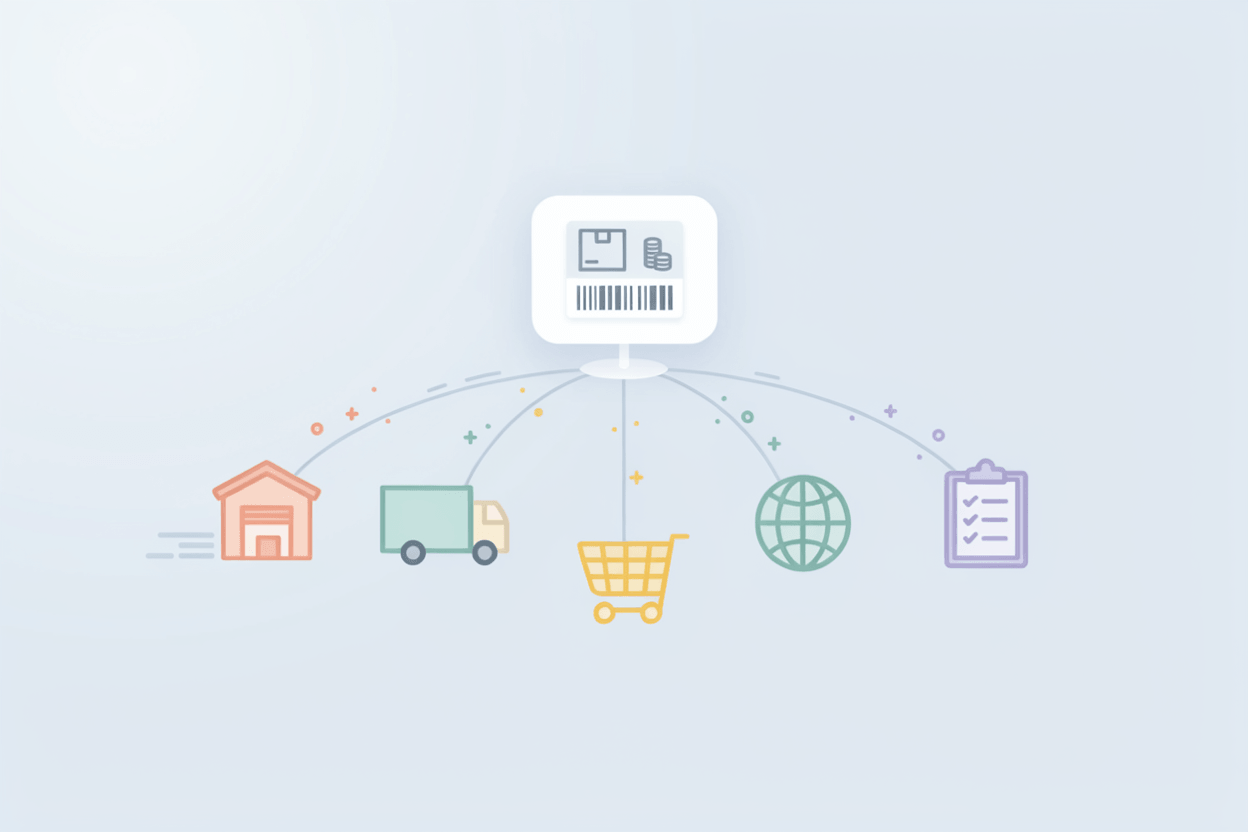
Distributors occupy a difficult position. They own thousands of SKUs but authored almost none of the data behind them. Every attribute, spec sheet, and image arrives from an external source, in whatever format the supplier provides. The catalog is your product, yet you don't control its raw material.
That gap produces most product data problems. Gartner puts the average annual cost of poor data quality at $12.9 million per organization, and distributors carry more of that weight than most because their data is supplier-driven and spread across channels.
Product information management for distribution serves one core purpose: making inconsistent supplier data reliable enough to sell from.
Why Product Data Breaks Down In Distribution
Since distributors receive their data from hundreds of manufacturers, they inherit every supplier's quirks at once: different attribute names, units, formats, and update schedules. One sends clean XML, the next a PDF you have to retype, a third leaves half the fields blank.
It hits distributors harder than manufacturers because a manufacturer authors data for its own products and owns the source. A distributor just aggregates thousands of SKUs across many brands, so there's more volume, more variety, and almost no way to fix errors at the origin. You catch them downstream instead, again and again, as new feeds arrive.
Buyers notice the inconsistency more than you'd think.
In a Gartner survey, 69% of B2B buyers reported inconsistencies between the information on a company's website and what its sellers told them.
The same research found that 61% of B2B buyers prefer a rep-free buying experience. So the data has to answer for itself. If a spec is wrong on the product page, no salesperson is standing there to smooth it over. The page is the sale.
AtroCore customers from the distribution industry often turn to us with catalogs stitched together from dozens of manufacturer spreadsheets, an ERP that only holds prices and stock, and a webshop full of half-filled fields. The data exists, but it is scattered and contradictory. Managing it well means fixing each stage of the flow, rather than simply cleaning the mess at the end.
Stage 1: Collecting Supplier Data
This is the stage that decides how hard every later stage will be. Get it wrong, and you spend the rest of the year cleaning up.
Supplier data rarely arrives ready to use. In projects we implemented, a single distributor was receiving product information as:
- Excel files with different column orders from every manufacturer
- PDF spec sheets that needed manual retyping
- BMEcat and other XML feeds from the larger, more organized suppliers
- Images named
IMG_4471.jpgwith no link to any SKU - Emails with attributes buried in the body text
The instinct is to accept whatever comes and reformat it later, but this instinct is expensive. The better move is to push structure back toward the source.
Give suppliers a template or an onboarding portal so their data lands in a predictable shape. You won't get every manufacturer to comply, and that's fine. Even partial standardization at intake removes a huge amount of downstream work. For the suppliers who won't change, build repeatable import mappings so their odd formats convert the same way every time, without someone reinventing the mapping each month.
One practical rule: capture the source and date of every import. When a spec is wrong three months later, you want to know which feed it came from and whether a newer version exists.
Stage 2: Modeling And Standardizing The Data
Once data is in, it has to fit a structure you defined, not the structure each supplier happened to use.
This means a product model that's yours. Your categories, your attribute names, your units. A manufacturer might call it "Leistung" in kilowatts while another sends "power rating" in watts. Both describe the same thing. Your model needs one attribute, one unit, and a rule for converting the rest.
Two things matter most here.
First, the taxonomy. Distributors often inherit category trees from their biggest supplier and regret it later when a second supplier's products don't fit. Build the tree around how your customers search and filter, then map supplier categories into it.
Second, attribute governance. Decide which attributes are mandatory per category and which are optional. A cable needs length and gauge. A pump needs flow rate and head. Without this, "complete" means nothing, and you can't measure quality.
A distributor's product model is the one thing suppliers don't get to define. It's the layer where thousands of inconsistent inputs finally agree on what a product is.
Modeling is unglamorous, and it pays off for years. It's also where a flexible PIM system earns its keep, because distributor catalogs rarely fit rigid, predefined schemas. This is a large part of why we built AtroPIM around a fully configurable data model rather than fixed product types.
Stage 3: Enriching Product Content
Enrichment is where raw specs turn into something a buyer can actually use to decide.
Suppliers give you the bare minimum. A part number, a few dimensions, maybe a line of marketing copy written for a different market. That's a starting point, not a product page. Enrichment adds the descriptions, application notes, compatibility details, and media that make the product findable and comparable.
The practical challenge is scale. Enriching 200 products by hand is fine. Enriching 50,000 is a workflow problem, not a writing problem. So treat it like one. Route products to the right people, track what's done, and prioritize by what sells. Your top 20% of SKUs deserve rich content first. The long tail can wait for a lighter pass.
Digital assets need the same discipline as text. Images, datasheets, certificates, and manuals should be linked to products, versioned, and reusable across channels. In practice, this is where a PIM and a DAM start to overlap, and keeping them connected saves the recurring mess of "which image is the current one."
Watch for the trap of enriching data you'll throw away. If a supplier is about to send a full feed next quarter, don't spend three weeks hand-keying their catalog now.
Stage 4: Validating And Governing Quality
Enrichment adds content. Validation decides whether that content is allowed out the door.
This is the stage most distributors skip, then wonder why bad data keeps reaching the webshop. The fix is to make quality a rule the system enforces, not a habit you hope people keep.
Set completeness and correctness checks that run automatically:
- Required attributes filled per category, so nothing publishes half-empty
- Values inside sensible ranges, to catch a "2000 kg" laptop before a customer does
- Consistent units and formats across every product
- Every sellable product carrying at least one image and a description
- Duplicate detection, because the same item arrives from two suppliers under two codes
The point of these checks is to catch errors at the moment data enters or changes, not during an annual cleanup. Cleaning data downstream is more expensive than stopping bad data at the gate, and it's a job that never ends because the data keeps decaying.
Governance is the human side of the same idea. Who can edit what, who approves before publishing, and what state a product is in. A simple workflow of draft, review, approved, published prevents unfinished or unverified data from leaking to customers. It sounds bureaucratic. In a catalog with thousands of moving parts and several people touching them, it's the difference between control and chaos.
Stage 5: Syndicating To Channels
All the work above exists to serve this stage. If the data can't reach your channels cleanly, none of it counts.
Distributors publish to more places than they used to. A webshop, marketplaces, an ERP, print catalogs, punchout systems for B2B procurement, and data feeds to partners further down the chain. Each one wants the data in its own format, with its own required fields.
The mistake is maintaining separate versions per channel. That's how the 69% inconsistency problem happens. One product ends up described three ways because three teams edited three exports. Manage the data once in a central source, then transform it per channel on the way out. Change a spec once, and every channel reflects it.
Channel requirements also differ in substance, not just format. A marketplace may demand its own category codes and specific attributes. A print catalog needs tight, compact copy. A procurement punchout needs standardized classification like ETIM or UNSPSC. Map these requirements into your syndication step so each channel gets what it needs without anyone hand-editing exports.
For distributors who also feed data back to trading partners, this stage doubles as a product. Clean, well-structured feeds make you easier to do business with, and that's a real competitive edge in a market where buyers compare options in minutes.
Stage 6: Maintaining Data Over Time
A catalog is never finished. Prices move, specs get revised, products get discontinued, and new suppliers arrive. Data that was perfect in January is stale by summer if nobody maintains it.
Maintenance is mostly about change management. When a manufacturer updates a datasheet, you need to know, and the update needs to flow through the same validation and syndication path as the original. Re-importing a supplier feed shouldn't silently overwrite the enrichment your team added. It should update the supplier-owned fields and leave your work intact. Getting this separation right, supplier data versus your data, is one of the quieter marks of a mature setup.
Keep a history of changes. When a customer disputes a spec, or a return spikes on one product, you want to trace what changed and when. Versioning turns "we think someone edited it" into an answer.
Also plan for retirement. Discontinued products shouldn't just vanish. They often need to stay visible with a clear status, linked to a replacement, so buyers and search engines aren't left on dead pages.
A Few Habits That Separate Clean Catalogs From Messy Ones
The distributors with the best data aren't the ones with the fanciest tools. They're the ones who treat product information as a process with owners, not a task someone does when there's time.
Fix problems at the source instead of the surface. Define your own model instead of inheriting a supplier's. Automate the checks so quality doesn't depend on anyone's mood on a Tuesday. Publish from one place so every channel tells the same story.
None of these stages is hard on its own. The difficulty is that they connect, and a weak stage drags down the ones after it. Manage the flow end to end, and the catalog stops being a liability you patch and starts being an asset you sell from.