


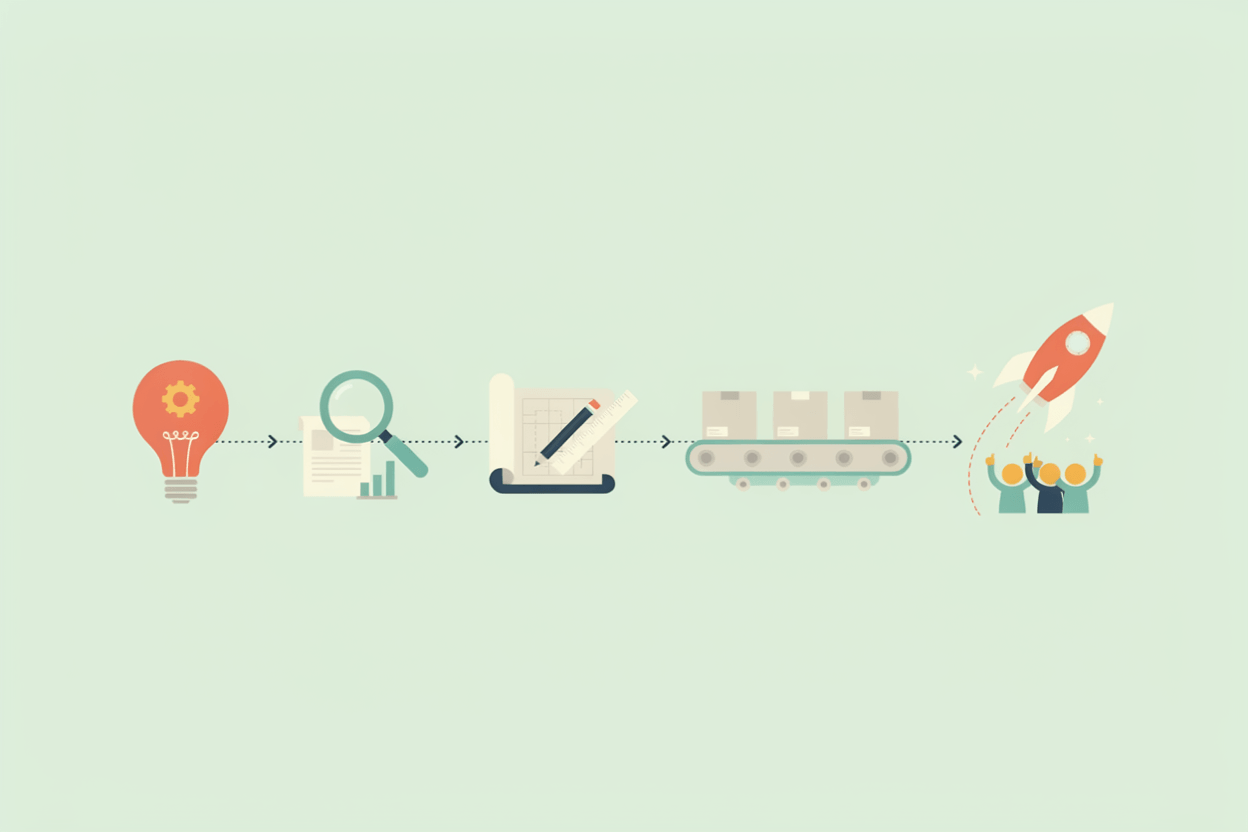
Key Takeaways
- New product development runs from idea to post-launch review. Skipping the unglamorous middle steps is what sinks most launches.
- Around 25% of new products stop selling within a year and 40% within two, so validation before spending matters more than speed.
- Product data readiness is a launch bottleneck. Messy specs and inconsistent attributes drive returns and slow every sales channel.
- Choose software by the problem it removes, not the feature list. A PIM system pays off once you sell across more than one channel or market.
What Counts As New Product Development
New product development is the full path a product idea takes to reach the market and stay there. It covers physical goods, digital products, and services.
People argue about the exact number of steps. Some models list five, some nine. The labels matter less than the logic: each step exists to kill weak ideas cheaply and give strong ones a real chance. Treat the steps as gates, not a checklist you tick on the way to a launch you already promised.
Idea Generation
Ideas come from customers, sales teams, support tickets, competitors, and the occasional shower. The mistake is treating this step as a brainstorm you do once.
Good input beats clever facilitation. Talk to the people who use and sell your current products. Read the complaints. A recurring workaround your customers have invented is often a product waiting to be built.
Write ideas down in a shared place with enough context to judge them later. A one-line idea in someone's notebook is lost the moment they leave.
Idea Screening
Screening is where you say no. Most teams are bad at it because saying no to a colleague's idea feels rude.
Set simple criteria before you screen, so the decision is about the idea and not the person who pitched it. Ask whether the idea fits your strategy, whether customers actually want it, and whether you can build and sell it at a profit. Score ideas against the same criteria so comparisons are fair.
The point of screening is to fail cheaply. A weak idea killed on a spreadsheet costs a meeting. The same idea killed after tooling and inventory costs a quarter.
Concept Development And Testing
Now turn the surviving idea into a concept a real person can react to. That means describing what the product is, who it is for, and why they would choose it over what they use now.
Test the concept before you build anything. Show mockups, sketches, or a landing page and watch what people do. Interest is easy to fake in a survey. A pre-order, a deposit, or a signup is harder to fake.
This is also the stage to check that the idea is different enough to notice. A product that does the same job as three others, only slightly cheaper, rarely earns a place on the shelf.
Business Case And Go-to-Market Plan
Here you put numbers on the concept. What will it cost to make, price, and promote? What volume do you need to break even, and how long will that take?
Be honest about the assumptions. A business case built to justify a decision you already made is theatre. Stress-test the numbers with someone who has no stake in the outcome.
The go-to-market plan belongs in this step, not after the product is built. Decide early which channels you will sell through, because that choice shapes the product data, packaging, and content you will need later. Manufacturers who leave channel decisions until launch week tend to discover their new range needs three different spec formats and none of them exist yet.
Product Development And Prototyping
This is the step people picture when they hear "product development." Engineering, design, and sourcing turn the concept into something real.
Build in iterations. A rough prototype in front of a customer teaches you more than a polished one you finish in isolation. Feed what you learn back into the design instead of defending the first version.
Keep the launch plan visible to the build team. Features are easier to cut when everyone can see the deadline and the budget.
Product Data And Content Readiness
This step is missing from most textbook lists, and it is where launches quietly break. A finished product still needs data before it can sell: names, descriptions, specifications, attributes, images, translations, and channel-specific formats.
In projects we implemented, manufacturers came to us with the same problem again and again. The product was ready, the launch date was set, and the product data lived in a dozen spreadsheets that nobody trusted. Someone was copying attributes by hand into each marketplace at midnight.
That manual work is slow, and it introduces errors that reach the customer. The cost shows up as returns. Research from Akeneo found that 43% of consumers returned a product in the past year because the pre-purchase information turned out to be wrong. The same research found that 62% are far more likely to keep what they buy when the information is clear and accurate.
Shoppers have said this for years. Back in 2017, Salsify reported that 87% of consumers rate accurate, complete product content as very important when deciding what to buy, and half had returned an online order because it did not match the description.
This is where a PIM system fits into the steps in new product development. A PIM holds product information in one place, keeps it consistent, and pushes it to each sales channel in the format that channel expects. Instead of copying specs between spreadsheets, a team edits an attribute once and every channel updates.
The problems a PIM removes tend to look like this:
- The same product has three different descriptions on three channels, and nobody knows which is current.
- A new range launches late because translations and images are stuck in email threads.
- Returns climb because sizes, materials, or compatibility data were entered wrong somewhere along the way.
For teams that want to start without a heavy license commitment, open-source options like AtroPIM let you model your own attributes and workflows and adjust them as your catalog grows. The right choice depends on your catalog size and channel mix, which the last section covers.
Test Marketing
Before a full launch, put the product in front of a limited market. A soft launch, a single region, or a pilot with key accounts tells you what a spreadsheet cannot.
Watch the real numbers: conversion, returns, support questions, repeat purchases. Small problems at this scale are cheap to fix. The same problems at full scale are not.
Launch
Launch is an operations problem as much as a marketing one. The product, the data, the stock, and the promotion all have to arrive together.
A launch checklist saves you here. Confirm that product pages are live and correct, that stock is in place, that sales and support know what they are selling, and that the data flowing to each channel matches what you approved. Then launch.
Post-Launch Review
The last step is the one most teams skip because they are already onto the next project. That is a waste of the most useful data you will ever get.
Review sales against the business case. Read the reviews and the return reasons. Ask what you would do differently. A short written review, shared with the team, is how the next launch avoids repeating this one's mistakes.
Why So Many New Products Struggle
The failure numbers are worth keeping in view, without the scare-story inflation. A 2021 study in Marketing Letters tracked 83,719 grocery products and found that 25% had stopped selling within a year and 40% within two.
The causes cluster around a few themes. Teams misjudge what customers need, fail to make the product distinct, or ignore the feedback that arrives after launch. Notice that none of these are engineering failures. They are failures of research, judgement, and follow-through, which is good news, because those are fixable.
Choosing Software For New Product Development
Software will not save a weak product. It removes the friction that stops a good one from reaching the market cleanly. Choose it on that basis.
Start with the problem, not the category. Map where your current process breaks. If ideas get lost, you need a place to collect and screen them. If the build stalls, you need project and design tools. If launches slip because product data is a mess, you need a PIM. Buying tools for steps that already work is a common way to waste money and add logins nobody uses.
A few types of software cover the steps:
- Idea and roadmap tools collect, score, and prioritise ideas so screening is consistent.
- Project and design tools manage the build, from prototypes to task tracking.
- PIM software structures product data and content, then feeds it to every sales channel in the right format.
- Analytics and feedback tools tell you what happened after launch so the review step has real numbers.
When you evaluate a PIM specifically, judge it against your own catalog. Look for these:
- A flexible data model, so you can define the attributes your products actually have instead of bending your data to fit the software.
- Clean import and export, plus connectors to the channels and marketplaces you sell on.
- Roles and workflow, so several people can work on product data without overwriting each other.
- Support for multiple languages and channel-specific content, if you sell across markets.
- A pricing and hosting model you can live with, whether that means SaaS, self-hosted, or open source.
Run a trial with your own data, not the vendor's demo catalog. A tool that handles a tidy sample can still buckle under your real product range with its odd variants and half-filled fields. The messy import is the honest test.
Match the tool to your stage. A team selling a handful of products on one channel can run on spreadsheets for a while, and that is fine. The moment you add channels, languages, or a growing range, manual product data becomes the thing that slows every launch. That is the point where a PIM stops being optional and starts paying for itself in hours saved and returns avoided.